

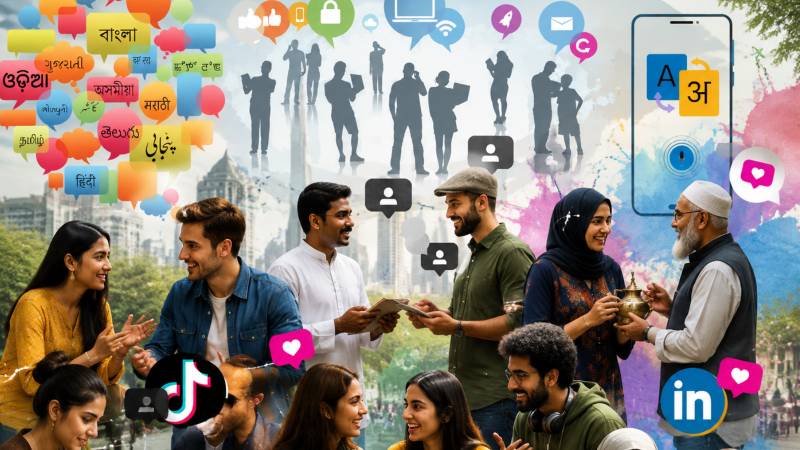
Listen to a conversation between two young Pakistanis in almost any city and you will hear something remarkable happening in real time: a sentence that begins in Urdu, borrows a verb from English, folds in a phrase lifted whole from a meme two continents away, and lands, without any apparent effort, back in Urdu again. It is an impressive linguistic performance, four or five registers, deployed fluently, inside a single breath. The usual response to this, from an older generation, is alarm: that neither language is being spoken properly, that something is being lost. This essay is not interested in that alarm. It is interested in a stranger, harder question underneath it.
Borrowing is not the problem, and it never has been. Urdu itself was built from other people's words; Persian, Arabic, and Turkic vocabulary over a Sanskritic grammar, absorbed over centuries by a language that had no fixed home to begin with, born, as most serious languages are, at the crossroads rather than the centre. What makes this history worth remembering is not that Urdu borrowed. It is what Urdu did with what it borrowed. An Arabic word entering Urdu did not simply sit there, foreign and untouched. It was bent, re-pronounced, given new shades of meaning it never carried in Arabic, until it became something that could only be described as Urdu, recognisable in origin, but transformed in ownership.
Judged by pure range, this may be the most linguistically capable generation the country has produced.
This is the distinction worth sitting with: there is a difference between occupying a word and owning it. A tenant can live inside a house perfectly comfortably, use every room, know exactly where the light switches are, without ever having the right, or the instinct, to knock down a wall. Ownership is what allows transformation. What is less clear, watching a generation move through five registers in a single sentence, is whether that same transformation is still happening — or whether the borrowing has become a kind of permanent tenancy, fluent and functional, but never quite renovated into something the speaker could call entirely their own.
The internet complicates this further, and not in the direction that first-generation complaints usually assume. Young Pakistanis today have more words available to them than any generation in the country's history — dictionaries, subtitles, four platforms' worth of slang, entire vocabularies in languages their grandparents never encountered. But vocabulary and voice are not the same achievement. A voice is what a person does with words once they belong to them; language does not merely express thought, it sharpens it. What the internet rewards, structurally, is closer to the opposite instinct: language encountered in fragments — a caption, a stitched clip, a phrase lifted from whatever argument first produced it, built to be recognised on sight rather than unpacked. Recognition of this kind asks very little of anyone encountering it, only that the phrase register as familiar, not that its origin or weight be understood. Ownership has always asked for something closer to the opposite — the slower work of sitting with a sentence long enough that it stops being borrowed and starts being one's own, the kind of attention sustained reading and revision still teach better than a scroll does. A generation fluent in recognising language may, for exactly this reason, be getting less daily practice than any before it in the harder work of actually making it theirs.
Some of this has been inherited rather than chosen. Pakistan's education system has, for decades, handed its students two languages in two equally incomplete ways. English arrives as professional currency worth acquiring, rarely worth loving, taught with an eye on the job market rather than the sentence, so that fluency becomes a performance of correctness rather than an act of possession. A particular accent, closer to a particular foreign standard, still carries more social weight in Pakistani drawing rooms than actual precision of thought which suggests that what often passes for bad English is not incompetence, but a fairly accurate performance of anxiety, the sound of someone who has learned, correctly, that they are being assessed. Urdu, meanwhile, is handed over as civic inheritance rather than living material recited for exams, invoked at ceremonies, rarely taught as something a student might actually go on to think in, argue in, or make something new inside. Neither language, in other words, was ever fully given away. Both were issued, like a uniform: worn correctly, inspected regularly, never quite tailored.
Writing Urdu in Latin script, sliding between languages mid-sentence, inventing a hybrid grammar for a WhatsApp message; these can be genuinely creative acts, closer to how living languages adapt than to decline.
None of this makes Roman Urdu, or code-switching, the villain of the story. Writing Urdu in Latin script, sliding between languages mid-sentence, inventing a hybrid grammar for a WhatsApp message — these can be genuinely creative acts, closer to how living languages adapt than to decline. The honest question is not whether this hybrid form is legitimate. It clearly is. The honest question is whether it is being allowed to deepen into something with its own settled grammar and interior life, the way Urdu itself once settled into something more than a marketplace pidgin — or whether it remains, for most of the people using it, a convenient tent pitched between two houses neither of which they were ever quite let all the way into.
None of this is really an argument that young Pakistanis are speaking badly. Judged by pure range, this may be the most linguistically capable generation the country has produced; moving between registers that would have been separate countries to their grandparents, doing so daily, without apparent strain. The harder, more unsettling possibility is that range and ownership are not the same inheritance, and a person can be fluent in four languages simultaneously while being entirely certain of none of them. That is not a story about decline. It is the story of a generation given unprecedented access to language, and remarkably little opportunity, anywhere along the way, to feel that any single one of those languages was entirely its own; a generation that has, as a result, become remarkably skilled at visiting, and not yet skilled at staying.