

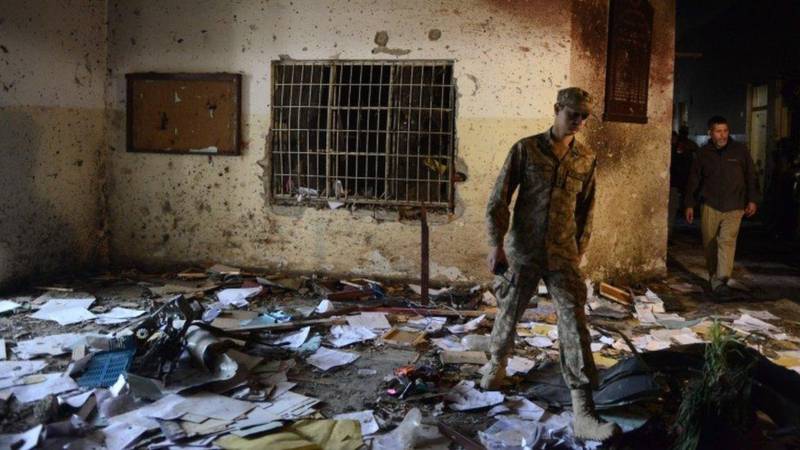
It was a winter morning, and I woke up as an 11-year-old boy who had managed to convince my father to take a day off from school. My mother was in the United States looking after her father, so our grandmother was taking care of us along with my father. Growing up in Pakistan during those years, attacks, blasts, and firing incidents were not shocking. They were part of the background noise of our childhood. But I had never personally known a loved one caught in an attack. My father, a few years earlier, had escaped a bomb blast at the PC Hotel in Peshawar, though as a child, I wasn’t told about it.
That morning, our grandmother received a call. My father’s aunt had been caught in an attack in Peshawar. I remember the way my grandmother’s expression changed, and a look of worry I had never seen before. Phone calls started pouring in. My father, grandmother, and mother from the States were all in panic. The news came through slowly: there had been an attack on the Army Public School in Peshawar. My father’s aunt, the principal of the school, was initially reported safe, and we prepared to leave for Peshawar, only to cancel again as news of her safety arrived. That day was a cycle of hope and fear, phone call after phone call.
As an 11-year-old, I could not grasp the scale of the tragedy, only that someone I loved was in danger. Around eight in the evening, we received the final confirmation that she had embraced martyrdom. I was in disbelief. Until that day, I had never lost a family member, certainly not in such a violent way. Up until that moment, death like this had only existed in movies or dramas. My mother convinced my father not to take us to Peshawar for the funeral. We stayed behind with an aunt, while the family went ahead. The fear of another attack lingered even at the funeral. The terrorists could not even be trusted to allow a funeral to take place peacefully. Such were the circumstances.
I remember the anger and despair I felt towards those cowards who targeted innocent children. The number of people massacred that day was reported to be around 140 innocent lives, including 132 children and nine staff members of the school. These are human beings we are talking about, not statistics. It is difficult enough to come to terms with the death of an elderly loved one who has lived a full life; here, these were children who never even got the chance to step into practical life or pursue the dreams they must have carried. The figures we hear, 140 plus killed, 132 of them students, are numbers for us, but they represent 144 families whose lives were shattered forever.
Children our age back then did not understand a certain saying, but in hindsight, today, 11 years later, it stands true: “The smallest coffins are the heaviest”
It would be a disservice not to mention the children martyred that day, but their loss is so vast that it cannot be captured in a single paragraph. Each one of those more than a hundred innocent souls had a story, a future, a family, and a world of their own. A full documentary could be made on each child, on each family’s suffering during and after the attack, the trauma, the grief, the lifelong void left behind. Children our age back then did not understand a certain saying, but in hindsight, today, 11 years later, it stands true: “The smallest coffins are the heaviest.”
After the attack, the world around me changed. Conversations with friends no longer revolved around cricket or games. Instead, we discussed how to escape if something similar happened at our own schools. At eleven, I had believed that the violence on television could not touch us, that the privileged bubble I grew up in had shielded me. But that bubble had burst, and I began to understand the reality for many children in Pakistan who face violence daily. Such is the disconnect between classes in Pakistan that it is almost unreal for a privileged child to even fathom such situations as a reality. This is, however, the reality for most children in Pakistan daily.
Even now, I marvel at the courage of children and educators in remote areas, living under constant threat, going to school because they believe in a cause. People like Malala Yousafzai, who faced death for education, show the extraordinary bravery of Pakistan’s youth. Madam Tahira Qazi, my father’s aunt, embodied that courage. She was not just the principal of a school; she was a soldier in her own right. Coming from a military family, with a husband who had served as a prisoner of war, she faced the attackers with strength and resolve, protecting the students under her care until her last breath. She paid in blood, protecting the most important principle of what it means to be a principal. She was always the last to leave the school, and she wanted it no other way on the 16th of December.
Cowards may have guns, but children and youth wield the pen, and in the long run, education is the ultimate revenge
In a society that often underestimates women, she showed a bravery that many men cannot match. Her words, “I am their mother, talk to me,” echo as a testament to her fearlessness and honour. In Pakistan, one does not have to wear a uniform to be a soldier. Courage, spirit, and commitment to a cause are the real weapons. In a country that has been through what Pakistan has been through, every man, woman, and child is a soldier for a cause in Pakistan. On the 16th of December, all those who died were martyrs. Children and teachers who went to school despite the danger were defending education itself, the greatest weapon we as a nation possess.
Madam Tahira Qazi is just one example of many who have sacrificed their lives to protect a cause. Their bravery is a reminder that even in the face of cowardice and violence, education, hope, and courage endure. Today, no one remembers the cowards who decided to pick up arms against children, but the names of everyone who was martyred that day will always be remembered for generations to come.
This attack was carried out by the Tehreek-e-Taliban Pakistan (TTP), and on that day, six to seven heavily armed men faced hundreds of unarmed but brave Pakistani students and faculty. All the attackers were neutralised during the operation that day. In the broader network of facilitators, many were brought to justice through military courts and counterterrorism operations, though a small number did manage to escape. Nothing good can ever come from an attack like this, yet in hindsight, it offered a harsh lesson for the nation.
At the time, the Pakistan Tehreek-e-Insaf (PTI) sit-in protest, which had been ongoing for over 100 days, was immediately called off. The entire nation stood firmly behind the armed forces. The National Action Plan was created, and all political parties set aside their differences to back the military in operations that dismantled militant networks and ensured justice was served. Looking back today, as challenges rise again, we are reminded that in times of crisis, unity and national maturity are stronger than any threat. Political differences exist everywhere, but certain principles demand collective resolve. That period remains a testament to the power of political and societal unity in defending a country and its people.
Cowards may have guns, but children and youth wield the pen, and in the long run, education is the ultimate revenge. The memory of that day must never fade, and it must inspire us to never give up on what truly matters. Madam Tahira Qazi, who faced death with unmatched courage, showed us what it means to protect not just lives, but the very hope of a nation. The children who left us that morning never grew old, but their dreams did, carried forward quietly in all of us, shaped by her bravery.
In every empty chair in a classroom, in every mother who still waits at a doorway, in every teacher who stands unarmed yet unafraid, her courage lives on. She walked among children as a principal, but she became a symbol of the nation’s strength. And every year, when we remember her and the children she protected, it is not just grief; it is a promise whispered to their memory: your lives, your courage, and your dreams were not in vain, and as long as Pakistan breathes, your light will never be extinguished.