

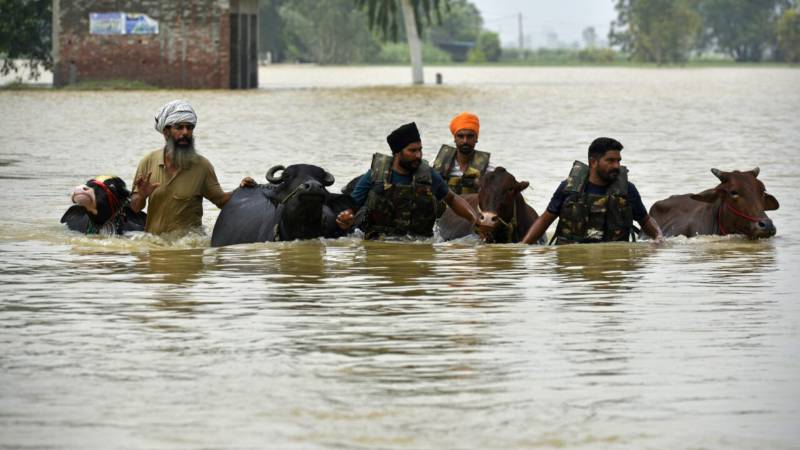
On 10 August, when the swollen rivers of Punjab breached embankments and gushed into villages, few imagined the water would stay for weeks. By 9 September, as rooftops, fields, and cattle lay submerged, Prime Minister Narendra Modi finally flew over the devastation in an aerial survey. Only then did the Centre announce a relief package of Rs 1,300 crore.
By then, the damage was immense. Entire districts looked like inland seas. Families huddled in gurdwaras. Crops that fed millions had vanished beneath muddy waters.
For many Punjabis, this was not just a natural disaster but a political message. The Centre’s silence and delay fed into an old suspicion: that Punjab continues to be punished for rejecting the ruling Bharatiya Janata Party’s brand of politics.
Punjab is among the few Indian states where the BJP has never gained a foothold. The dream of a non-Sikh chief minister remains out of reach. For decades, the state’s electoral loyalties have swung between the Akalis, Congress, and more recently, the Aam Aadmi Party (AAP). The BJP, despite its dominance elsewhere, remains a marginal player here.
That political distance has deepened since the farmers’ protests of 2020–21. Largely led by Punjabi farmers, the year-long agitation forced Modi into a rare climbdown, withdrawing his government’s controversial farm laws. For the BJP, it was both a humiliation and a reminder of Punjab’s defiance. Modi himself was heckled during the 2022 campaign when protesters blocked his convoy, preventing him from addressing a rally.
“The Centre’s cold shoulder is no accident,” argues political analyst Rajinder Pal Singh Brar. “Modi’s relationship with Punjab was strained long before the floods. But the farmers’ protest turned it into open hostility. The state embarrassed him globally, and he has not forgiven it.”
Years of declining minimum support prices, rising input costs, and shrinking water tables have pushed farmers into debt
Crops drowned, lives uprooted
This hostility has now collided with a climate crisis. Punjab, known as India’s “food bowl,” is unaccustomed to such catastrophic flooding. Its extensive canal network and groundwater irrigation were designed for agriculture, not to manage deluges of this scale.
All 23 districts were declared flood-prone. Nearly 1.76 lakh hectares of paddy and maize—ready for harvest—were washed away. United Nations figures suggest nearly 20 lakh people across 2,050 villages have been affected.
Inside homes, water rose up to five feet, forcing residents to climb to rooftops or flee to nearby gurdwaras. “We left with nothing but the clothes on our backs,” says Balwinder Kaur, a farmer’s wife in Sangrur. “The water came at night. By morning, our buffaloes were gone. The fields my husband worked on all year are gone, too.”
In Tarn Taran, 55-year-old Jaspal Singh stood ankle-deep in sludge where his wheat once grew. “We heard the Prime Minister tweeting about Afghanistan’s earthquake while our villages drowned,” he said bitterly. “Does he not see us as Indians?”
The cattle losses have been staggering. Hundreds of animals were swept across the border into Pakistan. For a state where livestock is both food and wealth, it is a crippling blow.
Silence from Delhi
What stings most is not just the loss but the neglect. For the first three weeks, not a rupee of central relief reached Punjab. When Modi returned from a foreign trip on 1 September, his condolences went to Kabul—not to the flooded villages of Punjab. Only after Sikh clergy, including former Akal Takht head Giani Harpreet Singh, publicly reminded him of Punjab’s suffering did the Prime Minister visit. Even then, the announcement came not from his office but the state BJP unit.
The Rs 1,300 crore package, too, has disappointed. It was not fresh money but a reallocation from Punjab’s own State Disaster Relief Fund. Meanwhile, the state has demanded the release of its long-pending Rs 60,000 crore dues. “It is like giving a man back his own wallet and calling it charity,” quipped one state official.
The floods also laid bare Punjab’s own political drift. Chief Minister Bhagwant Mann was conspicuously absent, citing poor health. His Aam Aadmi Party government has been accused of failing to negotiate strongly with Delhi. The Akali Dal, once Punjab’s dominant force, is riven by internal splits, with Giani Harpreet Singh floating his own platform.
The BJP, meanwhile, has tried to revive the spectre of Khalistan, suggesting separatist forces are exploiting the chaos. Sociologist Harvinder Singh Bhatti dismisses this: “There is no separatist movement here. It is the Centre that drags it out whenever Punjab asserts itself—during the farmers’ protest then, or now when youth drive tractors full of relief across the state.”
Food bowl under strain
The floods hit Punjab when its agrarian economy was already under stress. Years of declining minimum support prices, rising input costs, and shrinking water tables have pushed farmers into debt. Thousands have committed suicide in the last two decades.
Punjab is valued by Delhi only when soldiers are needed at the border, not when civilians drown at home
“The government wanted to push us into corporate farming through those farm laws,” says Gurmukh Singh, a farmer near Patiala. “Now even nature is against us. And Delhi turns away. How long can Punjab feed the country like this?”
Indeed, Punjab produces nearly a third of India’s wheat and rice procurement for the central pool. With fields submerged, questions loom over the country’s food security. Experts warn that if Punjab’s farmers are forced off the land, India’s supply chains will feel the shock.
If the loss of crops was not enough, Punjab has also paid a heavy price for Delhi’s decision to close the Wagah border with Pakistan. For years, cross-border trade through Attari and Wagah had been a lifeline, bringing in revenues and sustaining local economies. The sudden halt ended exports of basmati, fruits, textiles and manufactured goods, cutting off thousands of jobs.
“At one stroke, our trucks stopped moving, our warehouses went silent,” recalls Sukhdev Singh, a transporter from Amritsar. “The Centre never gave us an alternative. We lost income, and now, with floods, we have lost our homes too. Is this the reward for being part of India?”
No substitute trading corridor has been created, deepening Punjab’s sense of being economically strangled for reasons of national politics rather than local well-being.
Community resilience
Yet amid official neglect, Punjab’s people stepped up. Locals fashioned boats from drums when the Centre refused to send any. Community kitchens sprang up in gurdwaras, ensuring that food was available for all. Rows of tractors ferried water and medicines. Diaspora Punjabis raised millions through radio campaigns in the United States and Canada. Celebrities from the Punjabi entertainment industry visited flood-hit areas, distributing aid.
“What we see is Sikh resilience and Punjabiyat,” says Professor Gurmeet Singh of Punjabi University, Patiala. “The teachings of the Gurus give our people strength. Even when abandoned, they stand for each other.”
National media, aligned with Delhi’s narratives, largely ignored the floods. Independent Punjabi channels and social media platforms became the main chroniclers of the tragedy. The selective coverage deepened the sense of alienation.
As Punjab begins the painful work of rebuilding schools, health centres, and homes, resentment against the Centre is likely to grow. The BJP’s hopes of expanding in Punjab look dimmer than ever. At the same time, Mann’s perceived failure has created space for a new political class—local leaders, religious figures, and civil society actors—who stepped into the vacuum.
For many here, the floods confirmed what they long suspected: that Punjab is valued by Delhi only when soldiers are needed at the border, not when civilians drown at home.
Rajinder Brar sums it up sharply: “When at war with Pakistan, Punjabi men are asked to sacrifice. When it is a disaster, we are left alone. That is the price Punjab pays for not keeping Delhi in good humour.”