

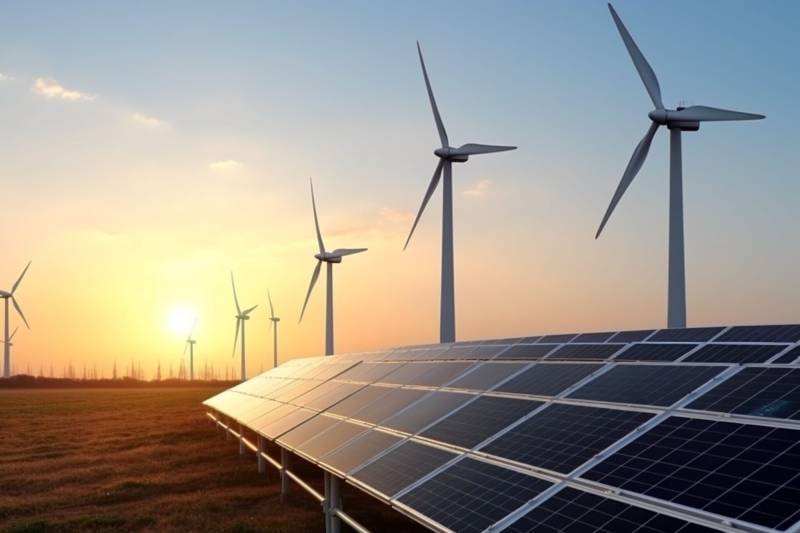
Located in the southwestern frontier of Punjab, the Koh-e-Suleman mountain range in Dera Ghazi Khan district has long been one of Pakistan’s most neglected regions, isolated by harsh terrain, political marginalization, and inadequate infrastructure. For decades, the residents of this rugged and beautiful land have lived with minimal access to electricity, relying on wood, kerosene, and expensive diesel generators to meet their basic energy needs. These limitations have not only restricted economic development but have also hindered progress in health, education, and communication. However, over the past few years, a quiet revolution has begun to take root in the form of solar energy which is emerging as a transformative force, breathing life into the rural economy of Koh-e-Suleman.
In an area where extending the national grid remains both financially and logistically impractical, solar technology has proven to be a highly efficient and sustainable alternative. The abundance of sunlight in this region, especially during the long, hot summers, makes solar power an ideal solution. Small-scale solar systems ranging from rooftop panels to solar-powered tube wells are increasingly being adopted by households, schools, health centers, and farms. These installations, many of them facilitated through government, NGO programs and largely through household installation, are not only lighting homes but also contributing towards a broader economic revival.
One of the most immediate and visible impacts of solar energy in Koh-e-Suleman has been on education. In many remote villages, children previously struggled to study after sunset due to the absence of electricity. Schools lacked fans, lighting, and digital tools, which put students at a significant disadvantage compared to their urban counterparts. The installation of solar panels in rural schools has improved attendance, enhanced the learning environment, and even allowed for the use of computers and mobile devices for educational purposes. Teachers now have more flexibility, and students can study in the evenings, reducing the dropout rate in an area already facing low literacy levels.
Even in the most isolated and underdeveloped areas, meaningful change is possible when appropriate technology meets the real needs of people
In the remote and arid region of Koh-e-Suleman, solar energy has begun to address long-standing gaps in healthcare access, particularly by enabling the refrigeration of vaccines that require constant freezing, something that was previously impossible due to unreliable or non-existent electricity. In the past, residents had to undertake long and often dangerous journeys to distant district hospitals for urgent needs such as snake bites or time-sensitive vaccinations, as local health facilities lacked the power to operate essential equipment. With the gradual integration of solar panels, some of these challenges are being mitigated, allowing for better local availability of critical medical services. While solar systems are still not sufficient to fully support energy-intensive cold-chain requirements across all facilities, their growing presence is reducing healthcare disparities and enhancing emergency response capacity, especially in hard-to-reach desert areas.
The economic benefits of solar energy in Koh-e-Suleman are also becoming increasingly evident in the agricultural sector. In a region dependent on farming for livelihoods, access to water has always been a major challenge. Diesel-powered tube wells, while common, are expensive to run and subject to fuel shortages. Solar-powered tube wells and irrigation pumps have emerged as game changers, providing reliable water sources at a fraction of the cost. This has led to higher crop yields, diversification of crops, and an increase in farm incomes. Many farmers are now able to grow cash crops like vegetables and fruits, which are sold in nearby markets, thereby integrating them into the wider economy.
Moreover, solar energy is enabling the growth of small businesses in previously underserved areas. Grocery stores, tailoring shops, mobile repair centers, and barber shops now operate longer hours, thanks to solar lighting and fans. Apart from the extended hours, the running cost of solar is nearly zero, thus the small and medium enterprises have benefited from the feasibility of reduced costs. These micro-enterprises are gradually reshaping the local economy, creating jobs and reducing migration to urban centers.
Another important dimension of solar energy’s impact in Koh-e-Suleman is its environmental value. By reducing reliance on firewood and diesel, solar power contributes to forest conservation and air quality improvement. Deforestation had become a serious issue in the region, leading to soil erosion and reduced biodiversity. With solar energy reducing the need for wood as fuel, the local ecosystem is gradually finding balance. This shift also aligns with Pakistan’s broader climate goals and its commitment to renewable energy transitions under international agreements.
Despite these positive trends, challenges remain. The initial cost of solar installations, while lower than ever before, is still out of reach for many impoverished households without subsidies or financial support. Maintenance and technical knowledge also pose concerns, many systems fail due to lack of proper care or absence of local technicians. There is a pressing need for solar training programs to build local capacity, so communities can maintain and expand their energy systems independently. Additionally, policy support from the government must go beyond one-time projects. Long-term planning, financing models such as microloans, and integration of solar energy into rural development frameworks are essential for sustaining the momentum. Partnerships with NGOs, private sector innovators, and local governments will be crucial in scaling up solar deployment across all of Koh-e-Suleman.
Nonetheless, the story of solar energy in Koh-e-Suleman is one of hope, innovation, and empowerment. It shows that even in the most isolated and underdeveloped areas, meaningful change is possible when appropriate technology meets the real needs of people. It is a testament to how renewable energy, often seen as a distant, urban solution, can serve as a grassroots engine of rural transformation. As Pakistan looks toward a more sustainable and inclusive future, the experiences of Koh-e-Suleman offer a blueprint for how solar energy can drive social equity, economic resilience, and environmental stewardship.