

Emaan Maqbool: Eight years since you graduated with a Bachelors in Visual Arts, as an emerging practitioner with numerous group shows to your credit along a Biennale participation (The Karachi Biennale 2017), what was it in curation that sparked an interest early on in your career: three curatorial projects in a span of two years as opposed to say your debut solo exhibition?
Talal Faisal: I’m fortunate enough to have laid the foundation of my Art under the influence of the likes of Huma Mulji, a practitioner with an unmatched sense of deep critical engagement with her work, allowing her to navigate fluently across an array of mediums. It was her pragmatic approach towards art-making that instilled in me the “notion of artistic exploration as opposed to artistic expression.” A constant scrutiny of one’s artistic concerns allows for positioning oneself around those earlier assimilated ideas/concepts, resulting in evolution rather than getting trapped in a never ending vicious cycle of market-influenced production.
Thus for me art-making has never been about competing in some sort of a rat race that I term it. Instead it's an ongoing process of mastering the art of critical thinking.
I see the curatorial as an advanced stage of critical thinking, allowing for deeper engagement with diverse practices of fellow practitioners: putting myself in their shoes to chalk out future directions, that I not only find challenging, also thrilling because individual art practices are stand-alone meta narratives, different turfs, varying set of contexts , conditions and factors to consider. This hopping from one artist’s shoes to another allows me to discover numerous distinct mindsets, varying artistic sensibilities and approaches towards art-making, accompanied with their respective concerns and artist positions. In addition it provides me with a vague picture of the "curatorial" as opposed to the "curation."
EM: How do you distinguish between the two: "Curation" and "the Curatorial"?
TF: If ‘curation’ is a composite of professional practices that have to do with
setting up exhibitions and other modes of display, then ‘the curatorial’ operates at a very different level: it explores all that takes place on the stage set-up, both intentionally and unintentionally, by the curator and views it as an event of knowledge.
So drawing a distinction between "curation" and the "curatorial" means emphasizing a shift from the "staging of the event" to the "actual event" itself: it's enactment, dramatization and performance.
Curating produces a moment of promise, of repossession to come. In contrast, "the curatorial" is what disrupts this process, splits this stage and gives birth to a narrative in that very moment of utterance. Hence "the curatorial" is a hinderance, a revelation, a narrative.
"Increasingly, the activity of curating is becoming the subject of much institutionalization and governance. With this comes a new set of pressures, risks and hierarchies"
In this sense, if curating represents the formal aspect of practices and modes of cultural production pertaining to art institutions and establishments, the curatorial is more like a disruption of such processes, an invitation to actively challenge and reflect upon the operative functions of curating and critically rethink its relation to the wider social sphere.
According to Jean-Paul Martinon, curating is a "constitutive activity" as opposed to the curatorial that is a destructive process. From beginning to end, what is intrinsic and consistently takes place throughout the curatorial is the "crumbling of our assumed knowledge, which is to say what we mean by art, literature, philosophy and every other discipline that constitutes out cultural inheritance."
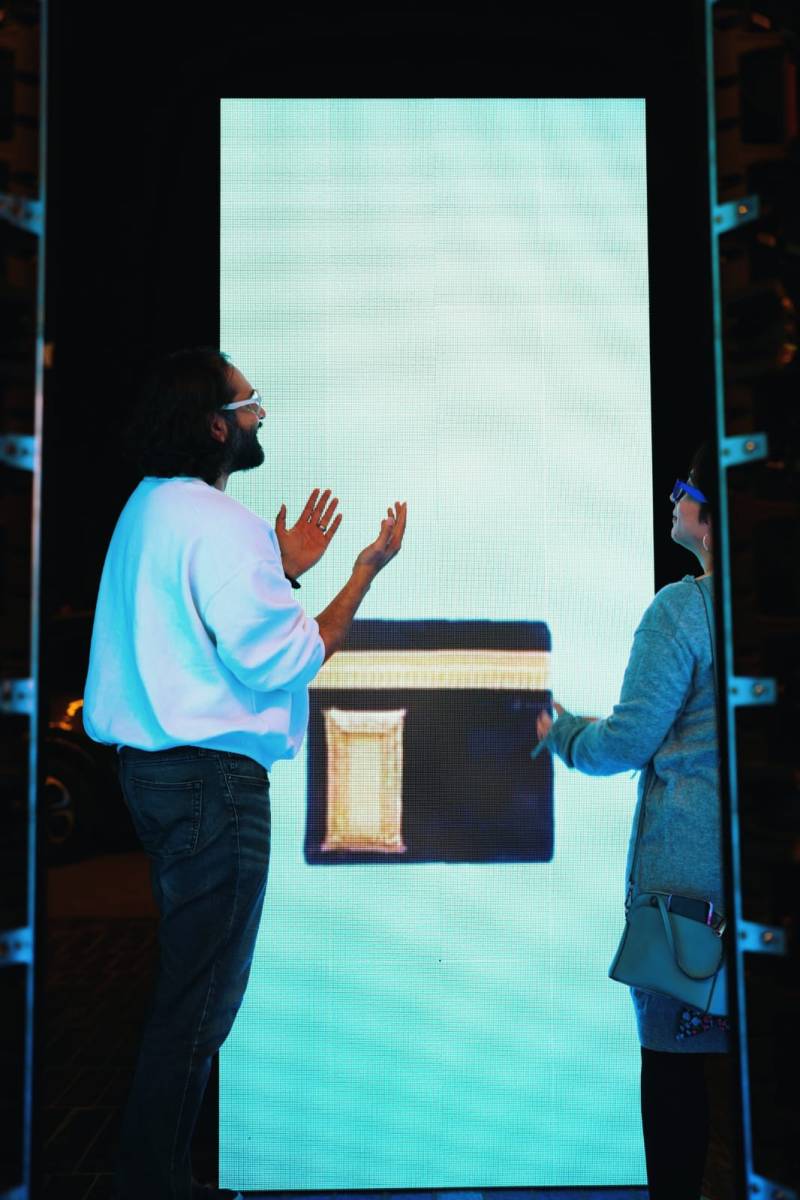
Joshua Simon corroborates that art world agents ‘operate within politics, but the political has to be constantly invented, engineered and produced’, the same way that the curatorial has to be continuously rethought to push for new ideas and significations: ‘The curatorial is part of [the] “elsewhere” of politics.
EM: How does the discourse of an exhibition come into being followed by the exhibition itself? Would you care walking us through the process?
TF: If we leave aside commemorative exhibitions, biennales and art fairs whereby a curator is expected to respond to a preconceived, overarching theme or concept, there are basically two distinctive tendencies in curating:
The exhibition as a result of a concept the curator wants to explore as part of the way she or he perceives the world's narratives and enables the coming together of artists, works and processes under a spatio-temporal context whereby the curator engages primarily with artists and their existing works and doesn't normally go around commissioning new ones to prove a point.
At times it's the polar opposite: the artist's works, processes and discourses that reveal to the curator certain aesthetic and/or theoretical speculations that contain the seeds of a curatorial experience, as it's the artist who prefigures and configures the curator's concept, while the artist or artwork becomes the maker of meaning.
Every exhibition is a "text" considered from a semiotic point of view, a message that has been constructed in any medium and may be typographic, oral or visual in nature.
Narrative has a beginning, middle and an end, but not necessarily in that order.
It basically allows us to relate to time by selecting and ordering those events that are relevant to us and our particular perspective of the world.
In short, metanarratives, also known as les grands récits, are philosophies, theories, ideologies, discourses or ideas that provide a totalizing, authoritarian and comprehensive explanation and legitimation of the world in terms of our historical experience or knowledge.
The prefix "meta" suggests both "beyond" and "about." Hence, a metanarrative is a big story that may contain other small stories. It is also metatextual in nature, as Gérard Genette examined in Palimpsests: Literature in the Second Degree (originally published in 1982):
A metanarrative involves a relationship with other metanarratives without necessarily quoting or mentioning them.
And, of course, mention must be made of Jean-François Lyotard's 'Postmodern Condition': especially A Report on Knowledge, the canonical book on postmodernism's authoritative discourse, in which he defines postmodern as "incredulity towards metanarratives."
Curating is metanarrative, as it embodies a narrative about narrative dealing with the nature, structure and signification of curatorial narratives. Every curator selects and orders artworks, and her or his perspective adds to the subjectivity of the narrative. And, as such, the curatorial constructs a text that refers to the generation and accumulation of meaning across texts.
We could say that an exhibition is basically a text that constructs the meaning of the past in the context of the present.
Like fiction, history and art history, an exhibition is always metanarrative: it tells a story about a story, and the curator uses, as American historian Hayden White coins it, "a mode of emplotment."
And especially a good exhibition is the more so, as it explains the world to us (metanarratives) and lets us explain ourselves to the world (micronarratives).
EM: How long does it take to put a show together? Also on what basis do you select your artists and what sort of an artist/curator relationship do you share?
TF: Generally a show takes around a year to put together as per the record: three years, three shows. As far as selection of artists is concerned, there is no fixed criteria, other than maybe the fact that I might have exhibited with them in the past. I generally keep a keen eye on fellow artists and their practices. So, some I select on the basis of a prior work of theirs that I believe fits into the conceptual framework of the exhibition. In such a case, it's just the formal decisions that I resolve together with the artist.
"Bodily movement is a site of domination and control, but also a potential space for imagining otherwise. 'Performance' becomes a sociopolitical form for enacting strategies of survival and solidarity"
In other cases it's everything that one deals with: from conceiving the idea to finality of form. I don't mind that as I mentioned earlier, it's like putting on the artist's hat and challenging oneself by owning the artist's practice for a while. As I said it expands my visual vocabulary and consolidates my reading of works on multiple levels, allowing me the opportunity to engage with diverse practices deeply and deconstructing them in the process. Also I feel it humbles me and keeps me grounded, fellow practitioners bestowing their trust in me with regards to art that is generally considered a highly personal affair that I totally denounce.
EM: In some cases you say you walk your artists' through the entire process i.e. from the very inception of the idea to the final form, implying that it's just the execution that the artist deals with. Isn't this quite a bewildering revelation in its own?
TF: I don't find it perplexing at all, maybe because my mind has been wired in such a manner ever since I stepped into the arts. From the very beginning I was made to engage in dialogue regarding the works I proposed for exhibitions curated by my mentor Amin Gulgee. He would have numerous spells of conversations with me till I began with the execution of the proposed work and he would do this with each one of the exhibiting artists of his shows.
Similarly during the four years of undergraduate studies, there was one promising senior student namely Idrees Hanif who I was fortunate to cross paths with early on. It was with him that I developed this precious bond of examining diverse practices, suggesting theoretical texts to each other, critiquing and in the process resolving our own works. This continues to date and it's precisely the manner in which I deal with most of the artists I plan on making part of my show. As I said earlier, I'm part of no rat race, I'm constantly competing with the version of me that passes by, just like this second did. I believe in originality, depth and sanctity of thought as opposed to originality of an idea because thought carries along while an idea ceases to evolve without an authentic thought behind it. So thought should be authentic, ideas shall follow through.
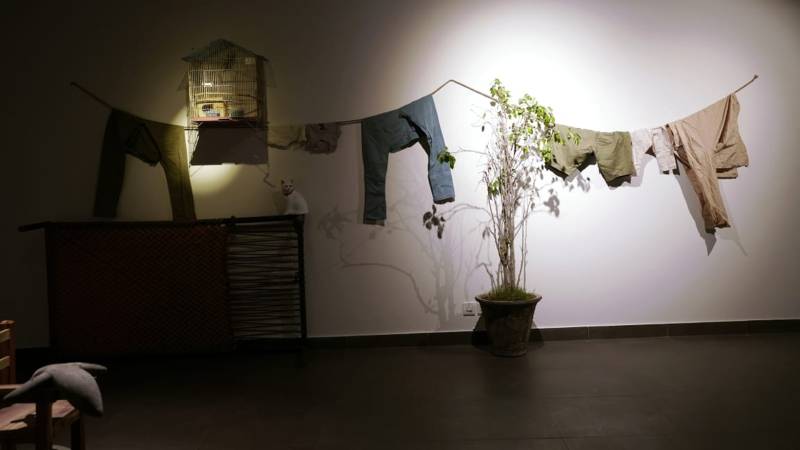
EM: This recent exhibition of yours titled "Dispositions of Being" stems from the notion of "Social Choreography." Would you want to expand upon it and its significance for you ?
TF: "Social choreography (a term coined by Andrew Hewitt in his 2005 book of the same name) as a methodology is what I envision as a topic of research for my upcoming MFA.
It has to do with the idea that social and political ideology isn't just reflected in, but is enacted and rehearsed through, daily movement.
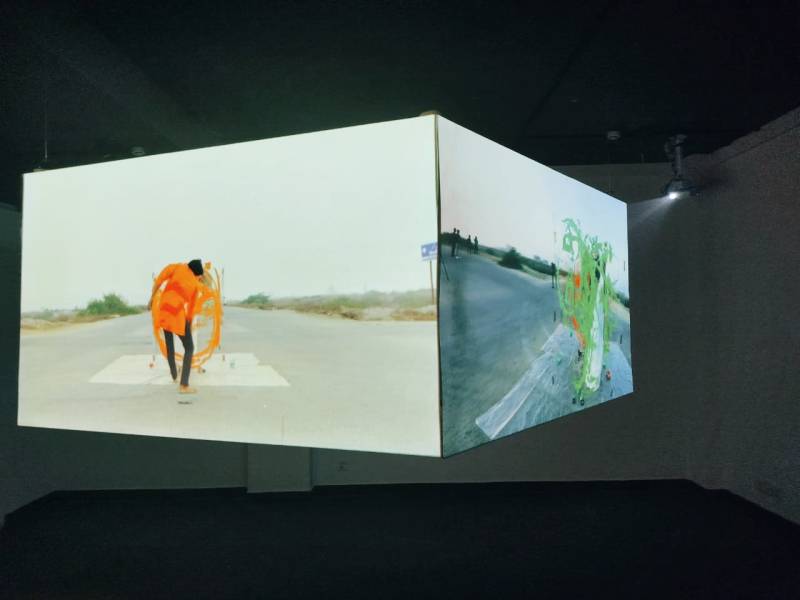
Through this lens, bodily movement is a site of domination and control, but also a potential space for imagining otherwise. "Performance" becomes a sociopolitical form for enacting strategies of survival and solidarity.
However for the exhibition "Dispositions of being" I broadened the scope from "Everyday movements" to the "Everyday" in an attempt to make it more inclusive and comprehensive.
Social choreography focuses on transforming social structures through aesthetics. It explores the fundamental role of embodiment in ethics, relations and governance.
Through interdisciplinary practices, artists develop experimental ways to learn, move, and organize in response to the pressing issues of our time—from climate change to immigration to systemic racism to unfettered capitalism.
EM: As a viewer if you were to pick two most convincing responses to the theme of the exhibition, which would they be?
TF: I ensured prior that the responses be convincing enough!
But on a serious note, each work was a spectacle on its own: From Idrees Hanif’s Kiefer like rawness to Zoya Currimbhoy’s stunning floating narratives to Manizhe’s haunting poignancy to Mariya’s hypnotic tactility to Daud’s rhythmic contours: they all had their salient features.
EM: It’s your second back to back curation at Haam Gallery, any particular reason for it ?
TF: I have a personal liking for non-commercial spaces because of their purpose-driven nature as opposed to profit-driven and we need more of these to foster/support experimental Art. I’d like to specially make mention of the very few such as the COMO Museum in Lahore or the Amin Gulgee gallery in Karachi, primarily because they’re concerned with what one proposes in comparison to what one earns for them.
Why two back to back shows at Haam? On a lighter note, maybe because its barely 2 minutes away from my residence! But seriously the gallerist Hassaan Amjad is someone I get along with quite well. Firstly he is roughly my age so that brings with it an added sense of comfort. Secondly he’s extremely passionate with a macro-focused lens: It’s the larger picture that matters to him most despite all expected and unexpected hurdles coming in the way. In this regard he’s hands on too and enjoys being part of the entire process: From the initial brainstorming to the numerous in between dialogues till resolution, followed by the final execution, he is an active participant.
EM: In what ways do you see “curation as a discipline” transform itself and Art at large?
TF: Over the last decade the meaning and function of curating have been witnessing a significant transformation as a result of a number of factors and dynamics. Increasingly, the activity of curating is becoming the subject of much institutionalization and governance. With this comes a new set of pressures, risks and hierarchies, chief of which are the emergence of new power structures in the cultural field as well as the growing utilitarian imperative of the marketization of arts and culture. Responding to such trends requires the opening of new and different paths of critique that are capable of engaging with the activity of curating beyond the figurations and practices of market and institutions.