

Ajay Kamalakaran is a journalist and writer, based in Mumbai. He has been a regular traveller to Sri Lanka since 2003. Ajay is the author of Globetrotting for Love and Other Stories from Sakhalin Island and A Week in the Life of Svitlana. His articles regularly appear on Scroll, Russia Beyond, Open, Manorama Online, Gateway House and other publications.
In the heyday of ocean travels and steamships when the sun did not set on the British Empire, that is, during the late 19th and early 20th centuries, Columbo was a major link between the East and the West. On the voyage from Europe to Australia, the city was the last port of call before ships made the tiring journey ahead. It was also the primary port for ships loading coal and suppliers to ships heading to China and Japan.
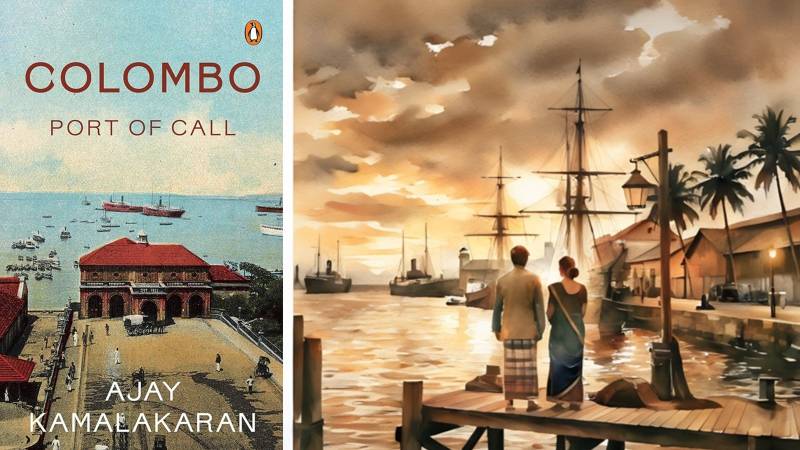
Colombo: Port of Call is the author’s attempt to look at the city through the lens of the famous figures that visited it during its history. This marvellous collection of essays has a cast of characters from Gandhi, Don Bradman, Mark Twain, and Chekhov to lesser known, yet fascinating figures like Urabi Pasha.
Ajay writes in the introduction: “Having survived the 2004 Boxing Day tsunami and also having taken local bus routes that were very much on the LTTE radar before the end of the civil war, I feel a great sense of kinship with the warm, ever-smiling and hospitable people of Sri Lanka.”
Having survived the 2004 tsunami and navigated the civil war era, Kamalakaran shares a profound, decades-long kinship with the people of Sri Lanka
He has lived there a great period of time and feels an affinity to the people. He explains why he wrote this book as follows: “While walking around different corners of Colombo over the last two decades, I have noticed many remnants of a bygone era: buildings, vintage cars and even English words and expressions that have long been out of daily use in most other parts of the world. These streets, decaying heritage buildings, markets and older luxury hotels all have a unique story to tell.
I always wondered what those stories were about and what it would have been like to be a fly on the wall when people like Sir Arthur Conan Doyle, Don Bradman and Anton Chekhov observed the beautiful people of the island, sipped on its fine tea and took in its crimson sunsets. Looking through the archives, reading old newspapers, travelogues and diaries has helped me find more pieces of the puzzle of the past. It has been for me, and I hope it will be for the reader, a chance to travel back in time and experience a part of the living history of this city and country.”
Among famous figures, it remains a matter of great pride for Sri Lankan cricket fans that Don Bradman played in the country twice and was part of two other visiting teams. He never played anywhere else in South Asia.
According to the author, when Mahatma Gandhi visited Ceylon almost 50 years after Carnegie, he was shocked to see how alcohol consumption was considered fashionable and civilised in an island that considered itself the guardian of Theravada Buddhism in the region.
Furthermore, any comparison between the Sri Lankan and Japanese railway systems would seem completely absurd in the present day. However, in the era of the British Raj, Ceylon was one of the most advanced economies in Asia (albeit with massive income disparities, based on the prevalent colonial and racial hierarchies).
According to the author, when Conan Doyle began writing his serialised essays titled The Wanderings of a Spiritualist in 1921, he was in Ceylon. The essays would be compiled into a book a few months later. ‘I write these lines with a pad upon my knee, heaving upon the long roll of the Indian Ocean, just one shade greyer, lining the Eastern skyline,’ Doyle wrote in the introduction.
Mark Twain noticed “the ‘unimaginable grace’ of local clothes and soft silks and ‘splendid’ colours such as ruby, red, green, yellow, blue and purple.”
Just like virtually every traveller to Ceylon, the Russians also sang praises of the garden. They were given a personal tour by British botanist Henry Trimen, who was the director of the garden for sixteen years and wrote the classic book, The Flora of Ceylon. Before leaving, the crown prince and the grand dukes planted a tree each in the garden in their memory.
Gandhi visited and told a gathering of Indians:
“I would ask you to live as sugar lives in milk. Even as a cup of milk, which is full up to the brim, does not overflow when sugar is added to it, but the sugar accommodates itself to the milk and enriches its taste, even so would I like you to live in this island, so as not to become interlopers, and so as to enrich the life of the people amongst whom you are living. Take care that none of the vice we have in India are brought with you in order to poison the life; nor must we bring to these shores, the curse of untouchability.
He called for the ‘broadest toleration’ and said he was working to that end. ‘I ask people to examine every religion from the point [of view] of the religionists themselves,’ he said.525 ‘I do not expect the India of my dream to develop one religion, i.e., to be wholly Hindu, or wholly Christian, or wholly Musulman, but I want it to be wholly tolerant, with its religions working side by side with one another.’ This is a message that the Mahatma would have intended for Ceylon as well, an island where social problems on the issue of language, fuelled by religious supremacism, would lead to a two-and-a-half-decade- long civil war that began in 1983.”
Anton Chekhov’s work has inspired generations of wonderful Sri Lankan writers, as well as the kind of people who exaggerated and who invented stories about his brief but refreshing sojourn on the island.
They book is thoroughly researched and well-written and so an exceptionally good read. One finds out a great deal about Sri Lanka through it, and details about the lives of interesting personalities. I would recommend it to all history aficionados and those who are interested in the lives of dead renowned individuals.