

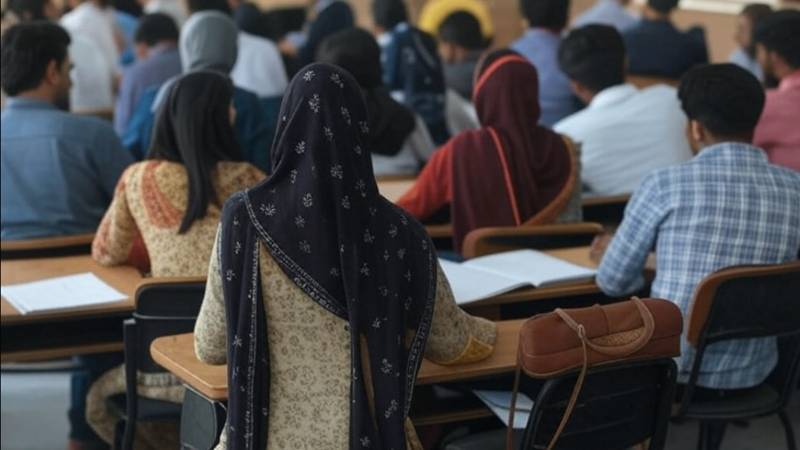
Of late, there has been a glut of alarming news items about the severe financial distress that the 34 public universities in Khyber Pakhtunkhwa face. Amid talk of department closures, fee hikes, and multiple other crises, higher education in the province faces a big question mark. At a time when institutions like the University of Peshawar are being asked to raise fees and ‘generate their own revenue,’ it becomes important to remind ourselves who pays for public education, and that the State, which already receives its money from the people, is misguided in turning something as foundational as education into a commercial enterprise.
Shifting the financial burden to students ultimately harms the very taxpayers whose children we are mandated to educate. Just as citizens finance the State, the public funding of education is intended as a national contribution to our shared conversation about equity, nation-building, and making education accessible to all.
Like many countries in the world, in Pakistan, a widespread misunderstanding persists: many citizens assume that whatever governments spend on public welfare, like roads, hospitals, educational institutions, and subsidies, is an act of generosity. This illusion is further reinforced by the administrative language of ‘grants,’ ‘favours,’ ‘bailout packages,’ or ‘relief.’ In reality, the government possesses no money of its own. All public expenditure originates from the economic labour, consumption, and contributions of the citizens, especially the working class and marginalised groups who bear the heaviest tax burden. Recognising this truth is vital for democratic thinking and for a responsible governance culture in all state institutions, including universities.
The State's financial resources come entirely from the people through direct and indirect taxes and economic activity. Income taxes from salaried workers and professionals, sales taxes on goods and services, import duties, excise duties, and withholding taxes collectively fill the national treasury. Even those who never file tax returns contribute significantly through indirect taxes embedded in everyday transactions. Citizens also support government revenue through electricity bills, fuel prices, mobile taxes, service charges, registration fees, and banking deductions.
When the government borrows domestically or internationally, it does so in every Pakistani's name, and these loans are repaid through inflation, increased taxation, and cuts in development expenditure. Underlying all of this is the value created by human labour: daily wage earners, teachers, nurses, drivers, clerks, farmers, and service workers generate the economic output that sustains markets and provides the foundation for State revenue, even though their contribution often goes unrecognised.
The University of Peshawar has the capacity to set a national example by fully recognising itself as a taxpayer-funded institution, actively advocating for adequate government support, resisting measures that place unfair financial burdens on students, and upholding transparency and ethical use of public resources
The poorest segments of society often contribute the highest proportion of their income through indirect taxes, yet they are the first to be excluded when public institutions raise fees or reduce services. A strong and just State has a responsibility to protect these vulnerable communities rather than deepen their hardships. Imposing higher fees on the children of labourers, clerks, farmers, and low-income families violates not only the principles of economic justice but also the constitutional promise of equality that public education is meant to uphold.
The reality must be stated clearly: citizens pay for everything. From the salaries of public employees to the fuel used in official vehicles, and from the upkeep of administrative buildings to the functioning of public universities, it is the people’s money that finances every department and every privilege. This includes high-level perks and privileges, administrative allowances, official residences and vehicles, travel expenditures, and the overall maintenance of public offices. Public officials, therefore, are not benefactors dispensing generosity; they are custodians of public funds, entirely sustained by the financial contributions of the citizens they are meant to serve.
Like all public universities in Pakistan, the University of Peshawar is meant to be financed primarily by the federal and provincial governments, both of which carry a constitutional and moral responsibility to fund public education. Universities are state-supported institutions established to provide affordable, accessible education—not commercial enterprises. Yet in recent years, successive governments have shifted the financial burden onto students by urging universities to raise fees, impose new charges, cut programmes, and 'generate their own revenue.'
This shift is fundamentally unjust because affected students are the children of taxpayers whose money already sustains the State, resulting in double taxation on the poor. Public universities exist to expand social opportunity, not penalise low-income families, yet fee increases disproportionately impact rural and working-class students, pushing higher education beyond their reach. When the State withdraws from its financial obligations, it breaches the social contract through which citizens contribute with the expectation that education, health, and security remain accessible. The continual insistence on raising student fees is economically harmful and ethically indefensible, especially in a province where poverty levels are among Pakistan's highest.
As professionals working in a public institution, it is essential to recognise that our salaries, infrastructure, and the entire operation of the university are funded by citizens, and that public-service ethics therefore demand accountability, responsibility, and humility in all our actions. Our administrative decisions must reflect fairness towards the taxpayers who sustain this institution. Such an understanding reflects in careful decisions and transparent use of resources, discourages unnecessary expenditures, strengthens our collective advocacy for adequate government funding, and reinforces our duty to protect student rights. The University of Peshawar has long been a leading academic institution, and it must now also assume a leadership role in safeguarding and promoting public higher education as a public good.
Pakistan urgently requires a shift in civic thinking. The widespread perception that the government is ‘giving’ something to the people is fundamentally flawed, because citizens have already given their money to the State through taxes, daily economic activity, and labour. Education, healthcare, and other public services are, therefore, rights not favours dispensed at the discretion of those in power. When governments underfund public institutions and then compel them to raise fees or impose additional charges, citizens are effectively forced to pay for the same services twice, first through taxation, and then again through escalating costs. This double burden not only distorts the purpose of public institutions but also undermines the very principle of equitable access to essential services.
The University of Peshawar has the capacity to set a national example by fully recognising itself as a taxpayer-funded institution, actively advocating for adequate government support, resisting measures that place unfair financial burdens on students, and upholding transparency and ethical use of public resources. Every faculty member and administrator must internalise one essential truth: public money is not charity; it is the people’s investment in the State, and public institutions exist to serve them with dignity, fairness, and responsibility. By embracing this understanding, the University of Peshawar, as indeed other public education institutions, can strengthen their public mission and reaffirm their commitment to accessible and equitable higher education for all citizens of Pakistan.