

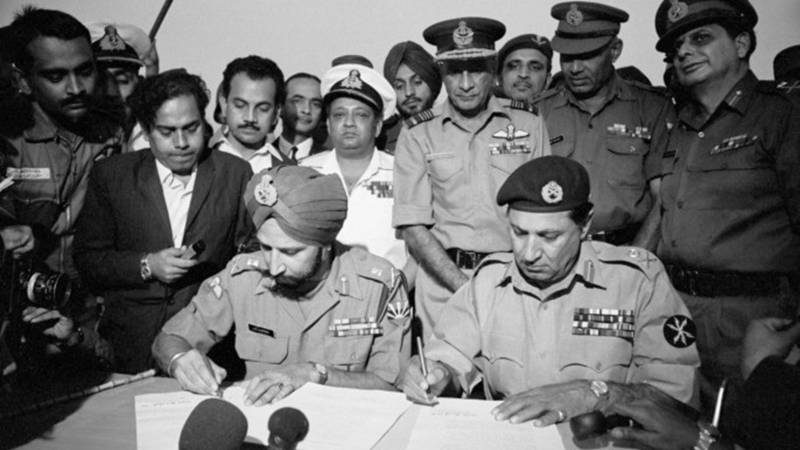
In Dhaka, on 16 December 1971, under clear skies, and in front of a restless crowd of nearly a million Bengalis, Lt Gen AAK Niazi surrendered to Lt Gen Jagjit Singh Aurora of the Indian Army. As one newspaper account put it, he surrendered “first his pistol, then his sword, and then half his country” to his Indian counterpart. The surrender came less than two weeks after an all-out war broke out between Pakistan and India when Pakistan bombed Indian airfields in the West on 3 December 1971, as discussed in last week’s column.
Niazi was the theatre commander in the East, thrust into a role that required strategic leadership. But, as the British historian John Keegan put it, “although the outcome of the campaign was a foregone conclusion after the first week, General Niazi’s largely undamaged force could have held on in Dhaka and other strong defensive positions for weeks, perhaps months.” So why did his entire force surrender in just 13 days?
In his memoirs, issued almost thirty years after his surrender in Dhaka, General Niazi sought to respond to critics who argued that his decision to surrender without a fight for Dhaka was because his will to fight had vanished. Niazi begins by recalling that he “had vast experience of commanding troops. The troops under my command were probably the best in the world.” As if that hyperbole was not grandiose enough, General Abdul Hamid Khan, the army chief of staff during the 1971 war, called him “the highest decorated officer of our Army, and one of our best field commanders.”
Indeed, Niazi considered himself the most decorated officer in the Pakistan army prior to his appointment in Dhaka. Twice, not just once, he had won the Hilal-e-Jurat, the highest medal for gallantry that is awarded in Pakistan to a living soldier. Yet Lt Gen Gul Hassan, who was the army’s chief of general staff during the war, notes in his memoirs that Niazi was one of the weaker divisional commanders prior to his promotion and appointment to Eastern Command. He asserts that Niazi’s professional “ceiling was no more than that of a company commander,” which would suggest the rank of a captain.
Once the war began in December, Niazi did not venture out of Dhaka. To top that off, Generals Yahya and Hamid disappeared from East Pakistan after they launched the ill-conceived Operation Searchlight on 25 March.
With the fall of Dhaka imminent, Niazi called a press conference and boasted that Dhaka would fall over his dead body. To eliminate any doubt, he puffed up his chest and stated that Dhaka would not fall until the Indians drove a tank over his chest.
In an ironic reversal of Pakistan’s strategic doctrine that 'the defence of the East lay in the West,' the defence of West Pakistan was now contingent on the surrender of East Pakistan
In a few days, he came to realise that only 5,000 of the 40,000 troops and 53,000 supporting irregulars under his command were available for the defence of Dhaka. As noted by then Major Siddiq Salik, his Press Relations Officer, in Witness to Surrender, Niazi had deployed most of the troops in “penny packets” all around the border with India to prevent India from seizing territory and setting up a puppet state.
By that time, India had neutralized the single PAF squadron in the East by blasting the runways. Only six helicopters remained in flying condition. The artillery equipment was obsolete with a limited range.
When Niazi saw paratroopers landing near his headquarters, he asked Salik to venture out and see if they were “blue” from the south or “yellow” from the north. Those were code words for Americans and Chinese forces. Niazi was convinced that either of the two would arrive to save East Pakistan from falling. Salik returned and told Niazi what he probably already knew: “Sir, they are brown like us.”
When he saw the end coming, Niazi requested GHQ in West Pakistan to arrange air strikes against Indian forces around East Pakistan, and to send in airborne reinforcements. Comments Gul Hassan: “Even a second lieutenant would have known that these requests were impossible because Pakistan did not have the capability for staging such operations.”
Niazi displayed a consistent pattern of blindly following orders coming from the General Headquarters in the West. Three such orders led to disaster.
The first order was to accept the command of the Eastern Garrison. As noted in his memoirs, Niazi knew that he “had been given a rudderless ship with a broken mast to take across the stormy seas, with no lighthouse to me any direction.” He would be operating in a theatre that had no possibility of getting reinforcements from the west, which was separated from the east by a thousand miles of Indian territory, in a hostile countryside swarming with rebel forces.
The second order was to not take the war into India, even though he had planned to “capture Agartala and a big chunk of Assam [to the east of East Pakistan], and develop multiple thrusts into Indian Bengal [to the west of East Pakistan]. We would cripple the economy of Calcutta by blowing up bridges and sinking boats and ships in the Hooghly River and create panic amongst the civilians.”
This proposal was rejected by General Hamid who said that the Pakistan government “was not prepared to fight an open war with India…You will neither enter Indian territory nor send raiding parties into India, and you will not fire into Indian territory either.” Of course, an open war with India had broken out on 3 December when Yahya ordered the PAF to bomb Indian airfields in the west.
And the third order was to surrender the Eastern garrison to India, “to save West Pakistan, our base, from disintegration and Western Garrison from further repulses.” In an ironic reversal of Pakistan’s strategic doctrine that “the defence of the East lay in the West,” the defence of West Pakistan was now contingent on the surrender of East Pakistan.
Niazi rightfully contends that Yahya disappeared from East Pakistan after launching Operation Searchlight. To make matters worse, when asked about the situation in East Pakistan, Yahya, not exactly known for his observance of religious principles, would say, “all I can do about East Pakistan is pray.” General Hamid visited the troops in the East just twice. General Gul Hassan stopped answering Niazi’s phone calls. The top brass of the Pakistan army had abandoned their “most decorated officer” to his own devices.
Niazi does not accept any blame for the loss of East Pakistan. He says he challenged the Pakistan Army to court-martial him, but they refused because such proceedings would probably have implicated the top army brass, not just Niazi. This is borne out by the judgments contained in the report of the Hamoodur Rahman War Commission. Referring to Niazi, the Commission finds that:
“[E]very Commander must be presumed to possess the caliber and quality, appurtenant to his rank, and he must perforce bear full responsibility for all the acts of omission and commission, leading to his defeat in war, which are clearly attributable to culpable negligence on his part to take the right action at the right time. He would also be liable to be punished if he shows a lack of will to fight and surrenders to the enemy at a juncture when he still had the resources and the capability to put up resistance.”
A noted historian of the Pakistan army, Brian Cloughley, concludes: “Yahya bore overall responsibility for what befell his country; but General Niazi was the commander who lost the war in the East…He was just not suited to high command.” Gul Hasan writes that the army surrendered in 13 days with more than 45,000 soldiers still in fighting condition because “with Niazi at the helm, they had no chance.” Of course, that begs the question of who put Niazi there. The most strategic command in the army was turned over to a “hastily promoted Major General.”
The list of culprits for handing over the fate of East Pakistan to Niazi undoubtedly begins with Generals Yahya and Hamid, but neither can it exclude General Gul Hasan. In the end, all the blame falls on Yahya, who had boasted earlier in the year that if India choose to declare war on Pakistan “I will shoot my way out of it.” He had also boasted about how he had escaped from a prisoner of war camp in Italy during the Second World War, while Sam Manekshaw, now the Indian Chief of Staff, was one of many fellow prisoners who had been unable to escape.
Now, in vastly different circumstances, a chastened General Yahya sought to relabel the surrender in the east as being nothing but a ceasefire between India and Pakistan. To add insult to injury, he went on to say that “I have always maintained that war solves no problem.” However, as Oxford historian Robert Jackson noted in South Asian Crisis, “the victors in Dacca knew otherwise.” When I reached out to Jackson to discuss what happened, I learned he had become a Member of Parliament in the UK.
Here is what he wrote to me:
“Looking back on it all, the sad story of the demise of East Pakistan does seem to have been a miasma of personal ambition.”