

"One cannot be at all sure that any operational plan will survive the first encounter with the main body of the enemy"
In 1871, Prussian Field Marshal Helmuth von Moltke the Elder wrote that dictum. A century later, it was validated yet again, this time in the war between India and Pakistan.
The Civil War in East Pakistan had turned into a nightmare for the four infantry divisions of the Pakistan army that were deployed there. Since independence in 1947, Pakistan had maintained the 14th Infantry Division in East Pakistan, even though that province accounted for more than half of the nation’s population. As the Civil War intensified, three infantry divisions were rushed over from West Pakistan but without their usual complement of artillery and armour. India had banned Pakistani aircraft from flying over its airspace, so they had to fly via Sri Lanka.
The Civil War had forced millions of East Pakistanis to flee to Indian Bengal as refugees. In November, to slow the onslaught of refugees, Indian artillery had started shelling Pakistani forces in East Pakistan. Indian forces were deployed on all sides of the land border around East Pakistan. They heavily outnumbered the Pakistani troops, who were already worn out by fighting the 70 million people who lived there.
General Yahya thought that by bombing Indian air bases in the West, he would divert India’s forces to the western border, where Pakistani and Indian positions were more evenly balanced, and prevent an India takeover of East Pakistan.
The general was the most powerful man in Pakistan. He wore three hats: President, Commander-in-Chief of the army, and the Chief Martial Law Administrator. He had seized power on 25 March 1969, from his mentor, Field Marshal Ayub Khan who had himself seized power on 28 October 1958. The country was up in revolt against Ayub, who had failed to deliver much by way of economic progress since the inconclusive war of 1965 with India. To divert attention, Ayub had begun to celebrate a Decade of Development in 1968 but that just exacerbated the revolt. He had lost all credibility with the people. His former foreign minister, Zulfikar Ali Bhutto, had created a political party, the Pakistan Peoples Party (PPP), to throw Ayub out of office.
Ayub asked Yahya to declare martial law to subdue the nationwide revolt. To Ayub’s amazement, he said he would do so only if Ayub stepped down. Ayub had no choice but to do so. He was heard murmuring to himself that perhaps the people are tired of seeing my face.
Yahya went on to conduct the fairest general elections in the country’s history in 1970. Before the results were announced, he promised to transfer power to whichever party won the elections, saying the army and not politics was his first love.
In the elections, the Awami League, based entirely in East Pakistan, won a clear majority in the National Assembly. Soon after the election results were announced, Yahya referred to Sheikh Mujib, the head of the Awami League, as the future prime minister of Pakistan. But the special interest groups in the West, who dominated the army and the civil service, could not countenance such a possibility. Neither could Zulfikar Ali Bhutto, the chair of the PPP. Bhutto went so far as to call for two prime ministers in the country, one in the east and one in the west, and threatened to break the legs of any member of his party who went to Dhaka to attend the opening session of the National Assembly.
Yahya succumbed to the pressure from within the western elites, reversed course, annulled the elections and launched Operation Searchlight on 25 March 1971. The goal was to find and arrest the leaders of the Awami League, who were declared traitors. Given the disastrous course of events that the operation unleashed in the months that followed, General Yahya launched the PAF against IAF bases on 3 December 1971.
The Pakistani Chief of Naval Staff learned of this air strike from a Pakistani radio broadcast, while driving to work the next morning
It would turn out to be one of the biggest miscalculations not just in the military history of the Subcontinent but probably in the history of warfare. The IAF had dispersed its aircraft. Few were destroyed. There was no repeat of what the Israeli Air Force had done to the Egyptian and Jordanian air forces in the Six Day War of 1967.
Unlike the Arabs during that war, the Indians had anticipated the PAF attack. Moreover, the attack was launched with an anemic force of six F-104 Starfighters and ten F-86 Sabres. This contingent was smaller than the one used by Pakistan in the early stages of the 1965 war, when almost 60 aircraft hit more than eight IAF bases in a series of coordinated attacks. Not surprisingly, the PAF offensive failed to create a dent in India's warmaking capabilities. And it became a strategic liability, as it gave India a long-awaited pretext for invading East Pakistan.
To make matters worse, there was no coordination between the army, navy or air force. The Pakistani Chief of Naval Staff learned of this air strike from a Pakistani radio broadcast, while driving to work the next morning. On the eastern front, Lt Gen AAK Niazi, the military commander of East Pakistan, learned about the air strike while listening to the BBC World Service.
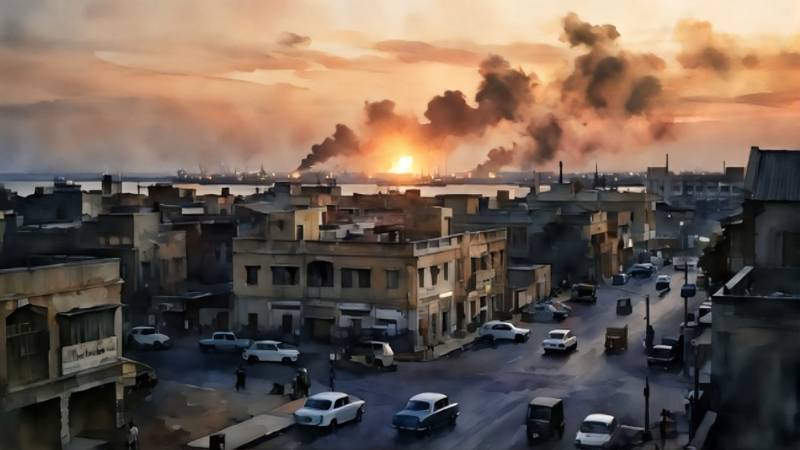
On the night of 4-5 December, the Indian navy attacked Pakistan's oil storage depots near the Karachi harbour using Russian-made Osa missile boats. The attack achieved complete tactical surprise. The Pakistani defenders mistook the Styx missiles for aerial rockets and opened fire on them with anti-aircraft rounds. India used a decoy force of surface combatants that was deployed to the Northwest of Karachi. It exploited the fact that the PAF fighter force was not operational at night, and that the night-enabled B-57B bombers were too slow to chase small fast moving missile boats.
The Osa missile boat attack was preceded by an incident of "friendly fire" among the ships of the Pakistan navy that were deployed out at sea to protect the sea lanes coming into Karachi. One Pakistani destroyer mistook another Pakistani destroyer for an Indian warship and attacked it. The Osa boats then engaged both destroyers and one was scuttled, and the other badly crippled. After this incident, the Pakistani navy ceased to be a combat force and withdrew into the sanctuary of the Karachi harbour. India now imposed a complete blockade of Karachi, like the blockage that it had imposed on the port of Chittagong in East Pakistan, where the Pakistani navy had a very negligible presence to begin with. A Pakistani submarine sank an Indian frigate in the Arabian Sea. While this temporarily boosted morale on the Pakistani side, it had no impact on the continuation of the blockade.
The Indian attack on the oil storage depots packed a massive psychological wallop, since the oil fires generated a gargantuan plume of black smoke that hung over the city of Karachi for days. During the first couple of days, the smoke was so dense that the skies over Karachi turned pewter during the daytime. At night, the burning flames acted like a homing beacon for the IAF's Canberra bombers.
The blackout practiced by the residents became redundant. The bombing of civilian targets occurred every night and served to terrorise and demoralise the residents of Pakistan's largest city. One high rise apartment building received a direct hit from a 1000-pound bomb. The explosion obliterated the building, and the debris disappeared into a water-filled crater that was created by the force of the blast. Nightly news broadcasts on television showed bombed out people and injured or dead civilians.
Pakistanis throughout the country felt a sense of helplessness that was unlike the elation they had experienced in the 1965 war. Towards the end, an emboldened IAF sent its SU-7 fighter-bombers into Karachi’s poshest neighbourhoods, in broad daylight, to strafe the citizenry who had gathered on their rooftops to celebrate the Pakistani victory that never came.
On the eastern front, Indian forces invaded the province from three sides. The heavily outnumbered Pakistani forces put up a valiant fight, but this was yet another case where numbers and munitions weigh more in combat than morale. According to the Hamoodur Rehman Commission of Inquiry into the 1971 war, which was established by Prime Minister Zulfikar Ali Bhutto, Lt Gen Niazi had lost the will to fight as early as the 7th of December 1971 after the fall of two major fortresses at Jessore and Brahmanbaria.
General Yahya kept on hoping that Pakistan’s long-time friends, China and the US, would come to its aid on the eastern front. China had become Pakistan’s most significant ally since the 1965 war. It had supplied arms and ammunition to the Pakistani military. Pakistan had several defence agreements with the US and had facilitated a visit by Henry Kissinger to Beijing in July 1971, which led to a breakthrough between China and the US during Yahya’s tenure.
But a week into the fight, there was no sign that either country was ready to commit forces to save East Pakistan. It had begun an inexorable slide into history.