

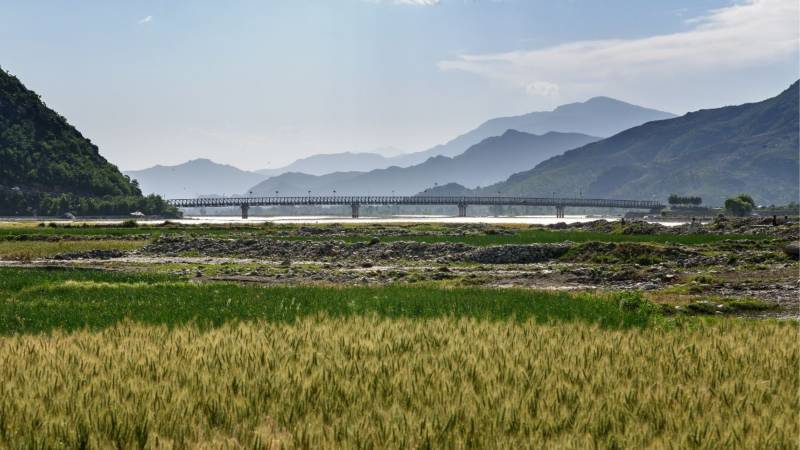
Swat was never merely a valley; it was a sanctuary where the rhythm of human life moved in perfect harmony with the breath of the mountains. To look upon Swat was to see a reflection of the divine, a place where emerald rivers whispered ancient secrets and the pine-scented air felt like a healing touch upon the soul. This harmony was our sacred inheritance, a living garden where every stone and stream told a story of belonging.
However, that story is now being rewritten in the harsh language of grey concrete and black smoke. The peace we once knew has been wounded, first by the shadows of past conflict and now by a relentless, unplanned expansion that threatens to bury our heritage under the deceptive weight of progress.
In Mingora and the surrounding towns, the serene silence of the mountains has been replaced by a deafening, toxic roar.
The valley’s narrow roads, never intended for the excess of the modern world, are currently being crushed under the weight of over 114,000 vehicles. Among them is a plague of 12,000 illegal auto-rickshaws, their outdated two-stroke engines coughing out thick clouds of poison that emit thirty times more pollution than modern cars. This chaos is compounded by a surging sea of motorcycles and traditional handcarts.
These carts, while a source of humble livelihood, compete for the same inches of asphalt as speeding cars, creating a friction that brings life to a standstill. In this cramped geography, the fragrance of blossoms has been surrendered to the stench of unburnt fuel, creating a future where our children’s lungs will know only exhaust and their ears only the frantic blare of horns.
The proposed motorway from Chakdara to Baghdheri presents a heartbreaking choice for our people. Instead of following the barren, rocky banks of the river where the land has already given what it can, planners have set their sights on our most fertile agricultural belts. These ancient orchards are our "green gold", a legacy passed down through centuries that is now being threatened.
A garden that cannot feed its own people is no longer a garden, but a graveyard of beauty
There is a profound sense of betrayal as survey markers appear in family fields, leaving the community to wonder why their survival is being sacrificed for a few minutes saved on a commute. When these orchards are paved over, the soil does not just change use; it dies. You cannot "un-pave" a motorway to plant an orange tree. To the locals, this is not just a road; it is a wall being built between them and their ability to feed themselves.
We must face the terrifying reality that in the entire Swat Valley, we have only 200,000 acres of irrigated land to feed 2.6 million mouths. This is not just a statistic; it is a precarious lifeline.
Every time a new gated area is fenced off, or a sprawling concrete campus is built on flat ground, we are committing an act of spatial neglect. By claiming these precious plains for walled complexes, the state is effectively locking away the valley’s life-support system. In a landscape where flat land is a rare gift of nature, building over it is an ecological tragedy. Unlike the vast plains of Punjab, a single kanal in Swat is a masterpiece of human effort, representing a tiered system of terraces managed for generations. When a farmer loses that land, he loses a vertical heritage that took centuries to perfect.
Planners often treat our land as a blank canvas, forgetting that land cannot be reproduced. Swat sits on active fault lines and remains haunted by the devastating floods of recent years. In this high-risk environment, the soil and the trees are our only shield. The deep roots of our orchards act as anchors for the slopes, and the porous earth serves as a sponge for the rains.
When we replace this living infrastructure with rigid, unyielding concrete, we are dismantling our last safety nets and inviting the next flood to wash us away. Even the Swat River, once our pride, has become a dumping ground where illegal sand mining dries out the wells of nearby orchards and the iconic Swat trout vanishes from the warming waters.
The path forward requires us to stop treating Swat as a resource to be extracted and start treating it as a home to be protected. This begins with an immediate halt to the conversion of agricultural land until a plan is in place that respects our limited acreage. We must transition from toxic engines to subsidised electric transport and organise dedicated zones for handcarts to clear the arteries of our towns.
Furthermore, the Upper Swat Development Authority should be reimagined as a Conservation Authority, focused on saving water and soil before building another road. We must protect what little fertile ground remains in a sacred trust, ensuring that no motorway can ever touch the land that feeds our children. The question is simple: Is a faster road worth a hungrier valley? A garden that cannot feed its own people is no longer a garden, but a graveyard of beauty. We must choose to be the ancestors who stood their ground so that the garden could remain.