

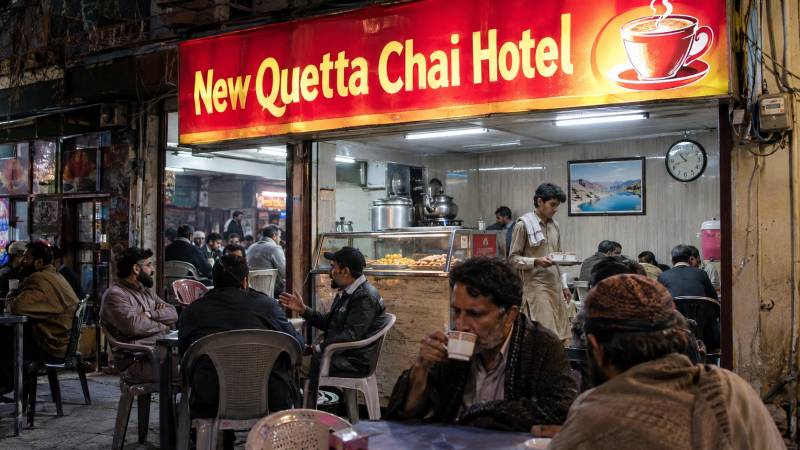
The chai was not good. I should say that at the beginning, because this essay is not really about the chai.
The sign said New Quetta Chai Hotel, red and yellow on a backlit flex board, a sign I had passed a dozen times without stopping. This time I stopped. Quetta is the name the country gives to where I am from, and a man will walk toward the name of his home the way he turns toward a face he thinks he knows in a crowd. The hotel stood in a row of shops in one of those Islamabad markets that everyone calls by the name of another city. The capital, it seems, names its parts after the places its people left.
Inside, under tube lights that gave everything the colour of a hospital corridor, there were plastic chairs and steel-topped tables, a counter with a glass box of rusks, and two kettles the size of drums hissing on blue flames. On the wall hung a framed print of Hanna Lake, slightly crooked, beside a clock that was eleven minutes fast. The lake hangs like this in ten thousand establishments across Pakistan, most of whose owners have never seen it.
I ordered doodh patti. It came too hot to hold, and it was, there is no honest way around this, ordinary. A minute too long on the boil, sweeter than it needed to be. I sat with my disappointment like a man who has caught a relative lying. Then I stopped tasting and started looking.
At the next table a man in a security guard’s uniform, the grey nylon of some private company, was asking the room whether anyone had news of the Mashkel road, whether it was open, whether the buses were running. Two students near the counter were arguing in Brahui about a semester fee. The waiter, a boy of maybe fifteen with a damp cloth over his shoulder, was greeted by name by three different customers in the ten minutes I watched, which meant he belonged to all of them, or to their village, which here is the same thing. Near the door a truck driver slept with his head on his folded arms, a phone I took to be his charging at the counter, at home in the exact way a man can only be in a place that is not his. Nobody in that room was drinking tea the way I was. I was tasting it. They were drinking something else.
The tea has an older history. Quetta earned its name: a cold city on the old road between Kandahar and the Indus plain, it spent decades feeding men on long routes at stalls where the kettles never really cooled and doodh patti was less a beverage than a form of heating. The tea was real before the sign was. The hotels as we know them began in Karachi, where, according to a 2022 PIDE working paper, migrants from drought-stricken Balochistan took over the old tea houses, and after Karachi’s troubles in the 2000s the model moved north to Rawalpindi and Islamabad. I have watched how it spreads in my own district. A son comes home at Eid with money in his pocket and confidence in his walk. Within a season a cousin or a brother-in-law has opened another one two streets away, with borrowed capital, no experience, and the same sign. The sociologist Pawan Dhingra has described the same copying of kin and neighbour among Gujarati Patels, whose community, with other Indian Americans, came to own about half the motels in America. The Quetta chai hotel is our version of the Patel motel, a franchise with no head office, no royalties, no training manual, no quality control. The boy who served me will be trusted with the cash drawer within the year; in three he will have a hotel of his own two sectors over. The chain does not reproduce through investors. It reproduces through its own waiters.
The Quetta chai hotel is our version of the Patel motel: a franchise with no head office, no royalties, no training manual and no quality control. The chain does not reproduce through investors. It reproduces through its own waiters.
It reproduces because the alternatives are a short list. A young man in a village in Pishin can drive a van, enlist, clerk if he is lucky and connected, or buy into a cousin’s hotel with borrowed money and a famous name. The boom is real. One owner told The Frontier Post in September that Islamabad has at least 100 to 200 of these cafes, and the paper traced the model largely to Pashtun entrepreneurs from Pishin and Qila Abdullah. Many of the owners come not from the city on the sign but from the districts around it, and they borrow Quetta because it is the name the country already knows. Something from Balochistan is, at last, visible in the capital. But it is a distress boom, an evacuation in instalments. The first wave exported a craft. The second exported an exit, and you can taste the difference. When the only asset you can carry is the name of the nearest city, you sell the name.
What I did not expect an ordinary cup to teach me: bad tea has not closed a single one of these hotels. The room was full, and it was full again when I went back. Which means the tea was never the product. What the Quetta chai hotel sells in Islamabad is proximity: a chair for an hour at the price of one cup, a language, news of a road, a waiter who knows your village. No office or agency I know of offers a night-watchman or a homesick student any of this. A community with few options built it by accident, out of kettles and borrowed chairs, and franchised it to itself for free.
Nobody owns the name. No geographical indication protects it, no owner can stop another red and yellow sign going up over another pot, and nobody collects a rupee when one does. One of Balochistan’s most visible exports is an idea of itself, and the province earns nothing from it. Each new entrant spends down the credit of the name a little, cup by cup. No ministry designed this network, no bank financed it, no hospitality school certified it. It is worth asking what a ministry, a bank or a hospitality school could add to it, and what they might take away.
I finished it, because the room, whatever its chai, was warm. And I recognised in my disappointment something I did not love: a man auditing authenticity, the man I once resented across a Lahore café table as he explained my province to me. The men around me were not buying my Quetta. They had brought their own, and they were drinking it quietly, and it had nothing to do with what was in the cup.
I went back some months later. The boy had been moved to the cash drawer, and he sent a fresh cup to my table without being asked, which is the one craft the second wave never diluted. The tea had not improved. I had.