

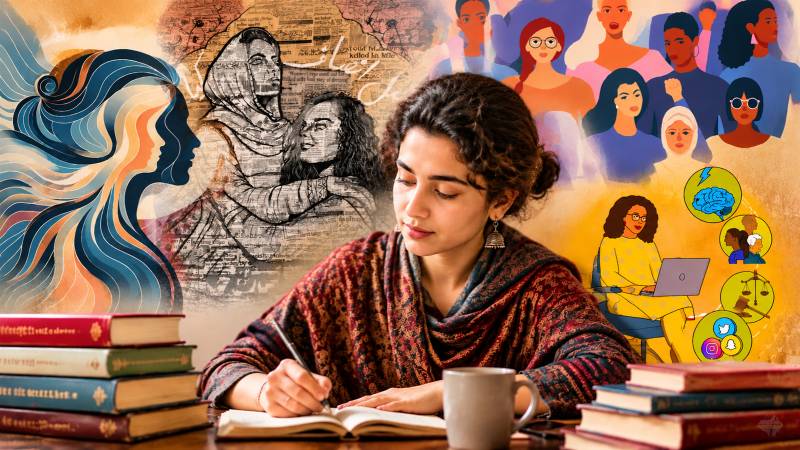
Violence Against Women (VAW) is usually divided into four neat categories: physical, sexual, psychological and economic. My research in Pakistan took me to a hundred and even that fell short. For much of my working life, across research, training, mentoring, television, radio, theatre and podcasting, I have examined how women’s lives, choices and voices are constrained. That mapping of one hundred forms I later brought to a 2025 assignment with UN Women and another international partner felt exhaustive. I thought I had seen every way women are sidelined and made invisible. Later I realised how mistaken I was. Today, I want to name one more form, rooted in the gendered politics of writing.
As the 16 Days of Activism begin on 25 November, I keep coming back to one question: what happens when a woman’s thinking is welcomed in the room but left out of the record? I have started calling it the 101st form: cultural exclusion. A caution first. I am not suggesting that being left off a festival panel equals physical or sexual violence, and I am not proposing a new official category. I offer the phrase as a lens, a way of looking at how institutions decide whose work counts.
Literature has had notable moments for women. South Korea’s Han Kang won the Nobel Prize in 2024, and this October it went to Canada’s Anne Carson, whose work moves between poetry, essays, and classical scholarship. In May, Taiwanese novelist Yáng Shuāng-zǐ and translator Lin King claimed the UK-based International Booker Prize, the same month Scottish author Ali Smith won Ireland’s Dublin Literary Award. Weeks later, Virginia Evans and Lyse Doucet took home Britain’s 2026 Women’s Prizes for Fiction and Non-Fiction awards founded specifically to counter institutional blind spots and the shortlist for the U.S. National Book Award for Fiction featured exclusively women and nonbinary writers. Yet the Booker, the Pulitzer for Fiction and the Goncourt all went to men this year. A podium moment is worth celebrating, but it only lights up one person. It doesn’t show us who gets into the room on an ordinary day.
In Pakistan, that distance between the podium and the everyday room is even wider. At the 2026 Karachi Literature Festival, Shandana Minhas won the English Fiction Prize from an all-women shortlist, even as top Urdu prose and poetry honours went to men a reminder that visibility at the top masks how steep the climb remains outside privileged circles. Getting to that room is itself an effort. For many Pakistani women, researching, documenting and publishing means working against limited access to education, mobility, money and public space. And even when a woman gets there, something curious can happen: her journalism, research or public commentary is treated as adjacent to literature rather than part of it. She may spend decades researching, teaching, reporting and writing columns, yet stay outside literary recognition. She is introduced as an activist, journalist, researcher or development practitioner, as though those roles make her any less a writer.
English remains a passport into elite spaces, while writing in Urdu and regional languages often struggles to cross those same thresholds. Access is uneven, and too often mistaken for merit. Publishing connections, literary surnames, institutional affiliations and cultural capital open doors for some; others build substantial work outside those circles.
Male commentators cross the same lines with ease. Literary festivals now make room for politics, journalism and social commentary alongside fiction, and some of my favourite columnists, including Suhail Warraich and Wusatullah Khan, are rightly recognised as public intellectuals on the strength of their commentary. I wonder, simply, why comparable recognition is not extended as readily to women whose work spans columns, research and public debate. A man’s professional identity can confer intellectual authority; a woman’s can confine her. She is invited to speak about gender, but not always recognised as a writer in her own right.
The issue is not men’s presence. It is whether we apply the same standards to everyone’s work. If journalism and non-fiction count as intellectual contributions when men produce them, women’s work should not have to prove that it is writing.Nor do any of us enter the literary world from the same place. Publishing connections, literary surnames, institutional affiliations and cultural capital open doors for some; others build substantial work outside those circles, often alongside demanding jobs and households. Language and geography matter too. English remains a passport into elite spaces, while writing in Urdu and regional languages often struggles to cross those same thresholds. Access is uneven, and too often mistaken for merit.
Recognition, too, is not only about books, reviews or festival invitations. It is also about who is remembered for making room for others to speak. Through training, mentoring, broadcasting and public engagement, many of us have tried to make women’s experiences and ideas more visible. That labour of building spaces, facilitating conversations and encouraging newer voices is rarely counted as intellectual or cultural work. The person who speaks is remembered; the person who built the room can vanish from the account. This is not an argument that every contribution deserves an award, a review or an invitation, or that recognition should be handed out as a favour. It is an invitation to examine how recognition is produced, and whether our standards are applied consistently.
The 16 Days bring familiar slogans, campaigns and statements, and they matter. But we should also look at the quieter structures that limit women’s authority. Exclusion can be polite, institutional and perfectly respectable. It can happen without any rejection at all, simply by being continually overlooked. After decades of documenting how women are silenced in homes, workplaces and public institutions, I find myself asking a related question about our cultural world: who decides which women are heard, whose work circulates, whose names are cited, and who becomes part of our collective memory?
I mapped one hundred forms of violence against women and girls and thought the list was complete. It was not. The 101st was waiting in a place I had been standing all along: the room where some women are invited to speak, some to listen, and some are never invited at all. Perhaps the question is not how many women are writing in Pakistan, but how many we have failed to recognise. The list remains live.
Par tum jis lamhe mein zinda ho, yeh lamha tum se zinda hai
Yeh waqt nahin phir aayega, tum apni karni kar guzro, jo hoga dekha jaayega
Fahmida Riaz