

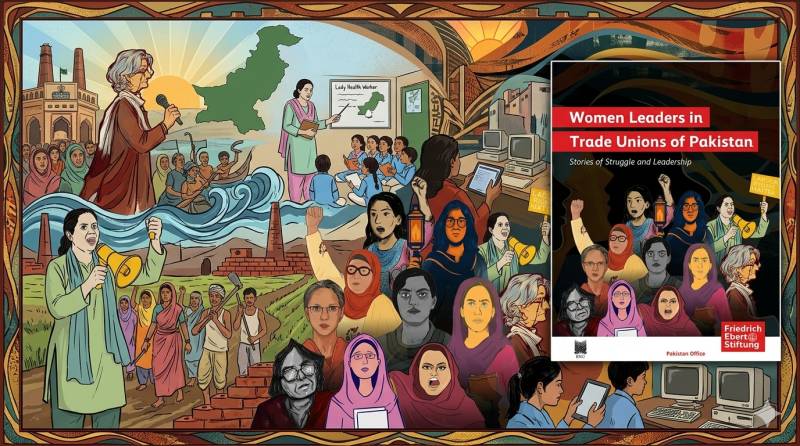
Aima Mehmood, a socialist who co-founded the Sanati Mazdoor Ittehad, questioned the dominance of older male leaders and introduced technology into union work.
Fatima Majeed, who learned to manoeuvre the sea of troubles in Pakistan in her fight for environmental justice, and why would she not, coming from the fisherfolk community, to rise like a wave of change as Senior Vice Chairperson of the Pakistan Fisherfolk Forum.
Halima Zulqarnain Laghari, founder of All Sindh Lady Health Workers Association, fought to go to school. A pillar of empathy and determination, she faced violence personally and professionally, jail time and more. For her, it all came down to integrity.
Kaneez Fatima. From sitting on the dock as a child, to sitting at Regal Chowk, she became the first woman trade union leader in Pakistan as she lived to serve those who remain invisible – brick kiln workers, hari women, bonded labourers, sanitary workers, kathiawari women and peasants.
Tragically, one is certain that if someone asked any of today’s schoolchildren who these remarkable women were, they wouldn’t know. A reflection of the education system, a society stands poorer if these names are not on the tip of one’s tongue.
In fact, as a social experiment, it would be worthwhile to ask those champions of education if they know of any of these women and what it would take to teach children about such people.
There are a total of 11 stories about women who have sustained a movement for decades despite the trappings of postcolonial, capitalist, patriarchal structures designed to keep class systems in place and offering very little economic safety, let alone personal security.
It is then truly commendable that these stories have been documented in a remarkable collaboration between Dr Saba Gul Khattak, FES Pakistan and Beaconhouse National University, resulting in a glorious publication titled ‘Women Leaders in Trade Unions of Pakistan’.
From Nusrat Bashir’s legal fight for brick kiln workers to Saba Ali Baig’s story of how women can and should uplift women, this is not an easy read
This is not academic work, which risks being safely tucked away in a library only ever to be brought out by starry-eyed students dreaming of a revolution. Nor is this a self-celebratory piece of work.
Clearly fuelled by authenticity and driven by a desire to document those who deserve to be heard, these are stories of what justice, driven by passion and pursuit of humanity for the sake of humanity and not personal gain, can achieve.
Written in the format of a graphic novel with illustrations by BNU students, this is a visual delight, offering story after story about how these women valiantly fought with very little, at times just using their voices and bodies as a means of creating change.
While all of them learned the ugly truth of being a female in Pakistan, a somewhat national experience, it is fascinating how each formed their own individual paths – from being based in Beijing to bringing about the transformative Bonded Labour System (Abolition) Act, 1992!
Once again, there is a jolt of realisation that Pakistani women, irrespective of class, ultimately do face the same battles and struggles – of course, the severity and context can vary, as can the cushioning or hardness, depending on the luck of place of birth. But what remains firmly in place is the struggle.
However, what defines these women is that their own personal lives full of demons and horrific circumstances were channelled into a fight for a greater good – for women, children and men. That transformation is not something one comes across every day.
From Nusrat Bashir’s legal fight for brick kiln workers to Saba Ali Baig’s story of how women can and should uplift women, this is not an easy read.
As much as text remains firm in the cold passage of time, impact risks dilution, especially in an age of communication where we see words and language being weaponised for polarisation rather than progress. Perhaps it is a wise move then to depict these case studies through graphic imagery, as the harshness can only be depicted.
A remarkable piece of work, there is no excuse that this should not be mandatory reading for schoolchildren across Pakistan.