

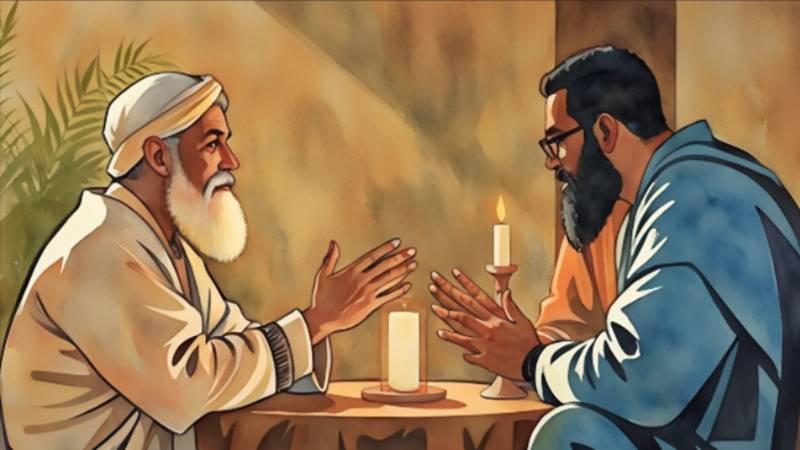
Many millennia ago, per the ancient history and the related archaeological records, certain deep-thinking humans inquisitively imagined and introduced an idea of a Deity whom they believed to be Creator of the universe and everything natural on the earth. This idea may have led to another idea called the “Hereafter”, which probably gave birth to many various ideologies known as religions whose holy books contain teachings, stories (often fables or parables), beliefs, and rituals of worshipping or prayer practices, all of which are claimed to be the words of or inspired by the respective Deity of the religions and to have been communicated orally and/or in writing by the founders and recorded by the followers of the religions. The ideas of Deity and Hereafter are the roots, without which religions cannot exist. However, either or both of these ideas can survive without religions, such as certain irreligious people who believe in Deity or multiple deities and are known as deists.
Another word for Deity is God in English, Dios in Spanish, Dieu in French, Gott in German, Bhagwan in Hindi, or Khuda in Urdu/Persian. The word “God” is a titular word like the word, “King”, “President”, “Prime Minister”, “Chief”, or “Judge”. Every religion has a specific name of God, which name is not often uttered or written due to an extreme reverence or devotion to God of the religion, but instead, the title, God, is used to invoke God. To show further reverence or address a concern that it might be erased or thrown out, even the word, “God”, is often written as “G-d” or “Gd”, for example, in some Jewish publications. However, the attributes of God stated in the holy books of various religions are spoken/written, which, for example, are Omnipresent, Omnipotent, Omniscient, Infinite, Beneficent, Supreme, Merciful, Gracious, Wise, Just, Compeller, Bestower, and many other attributes.
In Arabic, God is called Allah. The word, “Allah”, which is also an Arabic titular word (not a proper name), is a combined form of the two Arabic words, "al" and "ilah", which, respectively, mean "the" and "god". So, "Allah" means "the god" or “God” (which is a title like Chief as a title). This is evident in the first part of the Arabic Kalma Tayyab (the Islamic faith phrase), "La ilah illallah", which literally means "no god but the God". To elaborate on this Arabic phrase, "La" means "no", "ilah" means "god", "ill" means "but", and "Allah" means "the god" or “God” (Allah in Arabic). Just like a soldier would normally salute “no commander but the commander” of her/his own country’s army, a religious believer would submit to “no god but the God” of her/his own religion. So, the first part of the Arabic Kalma Tayyab can also be applicable to or compatible with all the other monotheistic religions.
In the 7th century and before, the Arab Pagans and Sabians (or Sabaeans) used the titular word, "Allah" ("the god") for their chief deity as a respect (without naming the chief deity) whose proper name varied depending upon the tribes/clans of Arab Pagans or Sabians. For example, the name of the chief deity of some Meccan Pagan clans was Hubal while the name of other Meccan Pagan and Sabian clans was Sin (pronounced as See-een), which was a crescent-moon god that is mentioned in the ancient religious books. Mount Sinai (which means mountain of Sin) is indicated and claimed in the Torah to be the mountain at which the Ten Commandments were given to Moses by God Whose name is Yahweh. There is a Quranic chapter called “Ya-Sin”, which means “O, Sin”, like “Ya-Allah”, which means “O, Allah”. The Quran alludes also to “Rahman” as a name of Allah. As such, the Arabic compound words, “Abdurahman” means “the servant of Rahman”, and “Abdullah”, means “the servant of Allah”. For example, the name of the Prophet’s (PBUH) father was Abdullah.
It can be scrupulously stated that every religion has a right to use the Arabic titular word, Allah, for God
It is worth mentioning that the crescent moon is Islam’s cherished or sacred symbol, which is found atop the Maqam-e-Ibrahim in the Kaaba and also atop the Makkah Clock Tower that below the symbol, has the Arabic word, Allah. The crescent moon is also found on the domes and/or minarets of many mosques in the world (eg, Faisal Mosque in Islamabad, Pakistan) and depicted on the flags of many Islamic countries, such as the flags of Pakistan and Turkey. As a counterpart to Red Cross, there is Red Crescent that is painted on the ambulances in many Islamic countries.
Since it is just a title, the Arabic word Allah is archaeologically and historically found to have been used by many other religions, such as Judaism and Christianity, in Arabia for more than two millennia, predating the Quranic and Muslim era. This further shows that the word Allah has been a universal Arabic titular word for God, which was and still can be or is possibly used by various religions in Arab countries so as to respectfully refer to God of the religions without actually saying the name of their God. Thus, it can be scrupulously stated that every religion has a right to use the Arabic titular word, Allah, for God.
This view is also based on the Quran 2:62 verse that says: "Verily! Those who believe and those who are Jews and Christians, and Sabians, whoever believes in Allah and the Last Day and do righteous good deeds shall have their reward with their Lord, on them shall be no fear, nor shall they grieve." Moreover, the Arabic word, Islam, means submission or surrender (to God). The Quran repeatedly emphasises “Submission” (to God) nine times in its various verses, such as the Quran 3:85 that says: "And whoso seeketh as religion other than the Surrender (to Allah) it will not be accepted from him, and he will be a loser in the Hereafter." It must be noted that the Quran does not provide daily prayer’s sequential steps or ritual routines, nor does it require to use Arabic in prayers. So, in the views of the Quran only, a person who believes in God & Hereafter and submits to God by praying to God (in whichever language or ritual) is a true believer in any religion that includes “Submission” to God.
Submission (surrender)—bowing, kneeling, genuflecting or prostrating---to God is fundamental to faith in God of almost all ancient to medieval religions. A believer of any religion, having a strong faith in God, spiritually submits to God for obedience while simply or ritually praying to God silently or vocally whichever way with whichever words in whichever language the believer chooses or is religiously conditioned to say the prayer. In other words, submission to God is to appeal to God for forgiveness or help in life’s difficulties and/or to thank God for bestowed-upon blessings while saying prayers.
It is worth noting that religious people from the land of Judea (hence Judaism) are called Jews, the religious people from the land of Hind are called Hindus, the followers of Zarathustra are called Zoroastrians, the followers of Buddha are called Buddhists, the followers of Jesus Christ (claimed to be the God Incarnate) are called Christians, and the believers/followers of the Islamic Prophet (PBUH) are called Muslims – who were also called Mohammedans in the 19th century mostly by the Westerns.
Hence, based upon the above discussion, Muslims, Christians, Jews, Hindus, Zoroastrians, and peoples of all other religions who believe in God and the Hereafter and submit to God in their respective religions must visit others’ worship places, often attend others’ religious services or festivals, and objectively study their own and other religions’ holy books, while respecting/treating equally not only one another (in the context of Quran 2:62 and 3:85), but also the polytheists, deists, agnostics, atheists, secularists, and all others for the sake of inclusivity, harmony, and peace in a diverse society.