

Many Pakistanis, especially the youth in colleges and universities, while celebrating Independence Day every year (Thursday, 14 August 2025, marks the seventy-eighth), express bafflement as to how a state purportedly created in the name of ‘Islam’ is juxtaposed with the term ‘Republic’. They wonder how a Parliament, where the majority is not that of theologians, working under the Westminster model, retains, amends and enacts mainly Anglo-Saxon laws and yet claims that Shariah is supreme. In Europe and the United States and elsewhere, the term ‘republic’ connotes a state that precludes a monarch and the clergy. In our context, the predominant view (though totally misconceived) is that divorced from religion, politics is “changezee” (chaos, anarchy and disorder).
جلالِ بادشاہی ہو کہ جمہوری تماشا ہو
جدا ہو دیں سیاست سے تو رہ جاتی ہے چنگیزی
What poet Dr Muhammad Iqbal emphasises in the couplet, Jallah badshahi ho ya jamhori tamasha ho; Juda hon deen siyasat se, to reh jati hai changezee, is that ethics contained in the Holy Quran should be part and parcel of governance. The majority misconstrue deen (Quranic term seerat-e-mustaqeem—right path) as conventional mazhab (religion). By reading the second stanza in isolation, the clergy interpret and insist that politics should only be in the name of their brand of conventional (orthodox) religion. They and many others conveniently ignore the first stanza of the couplet. The couplet unambiguously conveys that whether it is monarchy or democracy, governance sans ethical framework of deen is “changezee”.
With conventional mazhab comes Shariah that is a contentious issue since the adoption of the Objectives Resolution of 1949. In a fragmented society marred by sectarian hatred (not merely genuine differences over interpretation of Islamic laws) it has become a permanent source of conflict with claims and counter-claims on how to run the state.
Ziauddin Sardar (born in Lahore and who left Pakistan in 1960 at the age of nine, now author of not less than fifty books with world-wide acclaim as a public intellectual specialising in Muslim thought) says that “if you equate Islam with state, then religion becomes a reason of the state and that state becomes the power of religion. Basically you produce a totalitarian system”. He elaborates that the very idea that “Islam is equal to the state is a totalitarian equation. We don’t have to go very far; we just have to see recent history. Wherever Islam has been equated with the state, we have produced totalitarian systems, like Iran, Saudi Arabia, Sudan, Afghanistan, you name it”. Of course, Saudi Arabia is now drifting away from the influence of the clergy, but not the monarchy.
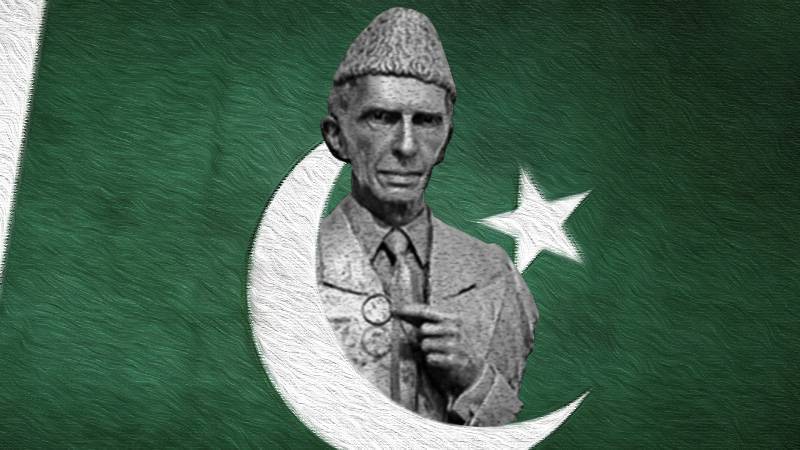
Quaid-e-Azam did not want to make Pakistan a theocracy but certainly an egalitarian state
According to critics of the Objectives Resolution, it was a departure from the ideals of Quaid-e-Azam, Muhammad Ali Jinnah, of equality for all citizens and his principles of fair governance. Using it as a ploy, they say that all governments, both military and civilian, managed to convert Pakistan into an exploitative state where, ultimately the Shariat Court held land reforms against Islam. According to them, Quaid-e-Azam did not want to make Pakistan a theocracy but certainly an egalitarian state.
The Objectives Resolution, passed by the first Constituent Assembly on 12 March 1949 under Liaquat Ali Khan’s leadership, is undoubtedly one of the most important documents in the constitutional history of Pakistan—it served as the preamble for the Constitutions of 1956, 1962 and eventually became part of the 1973 Constitution when the Eighth Amendment was passed in 1985. Its proponents claim that it confirms the true genesis of Pakistan by reiterating, “Sovereignty of the entire Universe belongs to Allah alone and authority should be delegated to the State through its people under the rules set by Allah”. Therefore, it has become a blend of Islam and Western democracy.
Liaquat Ali Khan explained the context of the resolution in his speech delivered in the Constituent Assembly on 7 March 1949 claiming it to be “the most important occasion in the life of this country, next in importance only to the achievement of independence”. He said that we as Muslims believe that authority is vested in Allah Almighty and it should be exercised in accordance with the standards laid down in Islam. He added that this preamble had made it clear that the elected persons would exercise the authority, which is the essence of democracy, and it eliminates the dangers of theocracy. The events that followed proved him wrong as the clergy started asserting its own authority instead of that of Allah’s by saying “religion is what we interpret”.
The logical outcomes of the Objectives Resolution were: (a) movement against Ahmadis, (b) clergy’s campaign against Ayub Khan’s regime in the name of Islam, (c) support of religious parties and the right wing to military crackdown in East Pakistan culminating in the dismemberment of the country and (d) Zulfikar Ali Bhutto’s compromises with religious leaders.
The two-nation theory, based on the foundation of the religious divide of Hindus and Muslims, received an irrecoverable setback when the Bengalis were maltreated by the ruling elite of West Pakistan
The matter did not end there. It paved the way for an 11-year dictatorial and nightmarish rule [1977–1988] of General Zia-ul-Haq. Zia’s legacy was reflected in the formative political years of Mian Nawaz Sharif, three-time elected Prime Minister of Pakistan. Military dictator late General Pervez Musharraf, who deposed Nawaz Sharif on 12 October 1999, and all others who followed him failed to undo Zia’s legacy—unfortunately, since 1977, religious bigotry has haunted us. The militants and terrorists derive their ideological strength from the notion that real authority rests with Allah and they are waging jihad to make Pakistan a true Islamic polity.
The Objectives Resolution, being part of our Constitution, though emphasises the existence of a Muslim State based on the principles of justice and equity for all, yet contradicts the concept of a secular state free of any religious obligations. Shariah as a body of laws cannot be free of sectarian biases, thus one cannot reconcile the two conflicting ideas. For example, in Indonesia, the debate whether you can have an Islamic state was a long drawn one with much depth, and they finally reached the conclusion that Islam and politics are linked, not through the state but through a civic society. It means that if you are a socially-conscious Muslim, you ought to bring your own moral and ethical outlook, express it openly in a civic context, debate and discuss it. Obviously, this has nothing to do with declaring Islam as the state religion with legal obligations. The idea of an Islamic state has to be construed innovatively to create a civic society and not a state religion through constitutional command as done by us through the Objectives Resolution.
Dr Iqbal Hussain Qureshi, known as I.H. Qureshi, chief author of the Objectives Resolution, a well-known academic historian, admitted, “Resolution was quickly prepared and passed ‘in a snap’ at a meeting of the Muslim League Party”. At the time of presentation of the Objectives Resolution, Pakistan was not an Islamic Republic. Its structure was republican fully in line with the Indian Independence Act of 1947. After becoming an “Islamic Republic”, we have miserably failed to reconcile these two conflicting objectives. The concept of an “Islamic State” logically calls for decision-making in the hands of “pious ones”, so certified by the clergy!
We must learn from Bangladesh. One of the unique features of the Constitution of the People’s Republic of Bangladesh is that it pledges to conserve secularism (Article 12) while also declaring Islam as its state religion (Article 2A). A five-member bench of the Supreme Court of Bangladesh in 2023 dismissed an appeal by the country’s largest Islamist party [Jamaat-e-Islami] seeking to overturn a 2013 ruling that barred it from participating in elections for violating the constitutional provision of secularism, but not from political activities. The historic context of this decision vis-à-vis the constitutional and political evolution of Bangladesh is available in an article by Dr Arshi Saleem Hashmi.
The final judgement of the highest court of Bangladesh, while reconfirming the State as a secular pluralistic constitutional democracy, barred the use of religion in politics. The recent students’ uprising in Bangladesh was mass-based and not a resurgence of religion as wrongly portrayed by a section of the Indian media. The dismemberment of Pakistan in 1971 exploded the myth that the “real” purpose behind the creation of Pakistan was the establishment of an Islamic State. The two-nation theory, based on the foundation of the religious divide of Hindus and Muslims, received an irrecoverable setback when the Bengalis were maltreated by the ruling elite of West Pakistan, which ultimately led to the division of the State, proving that socio-economic factors, and not religion, play the decisive role in politics.
Late Dr Ajeet Jawed in Secular and Nationalist Jinnah has brilliantly documented that Quaid-i-Azam wanted a secular Pakistan. Throughout his political career, he struggled against both Hindu and Muslim extremists. After independence, the feudal class, with the help of its cronies—bureaucrats, clergymen and men in khaki—managed to hijack the new state and convert it into an Islamic Republic (sic)—a mere nomenclature, whereas the system remains Anglo-Saxon. The Holy Quran does not permit a class society and concentration of wealth—its main stress is on the empowerment of the have-nots.
Even in the very beginning, vested interests tried to tamper with the famous speech of the Quaid of 11 August 1947, but failed to do so. Dr Ajeet revealed in her book (available in Urdu as well): “It was allowed to be published in full only after Dawn's editor, Altaf Hussain, threatened those who were trying to tamper with it to go to Jinnah himself if the press advice was not withdrawn”.
For building a secular Pakistan, Dr Ajeet writes, Quaid sought the help of Khan Abdul Ghaffar Khan, because, as he said in his letter to Badshah Khan, he was “surrounded by thieves and scoundrels” through whom he could do nothing. With substantial evidence, Dr Ajeet has established that Quaid remained a secularist and nationalist up to the last moment of his life. Thus attempts to make Pakistan an ‘Islamic Republic’ is a great betrayal.
Late I. A. Rehman, outstanding journalist and public intellectual, summed up the entire debate aptly in his article, Jinnah’s new Pakistan is possible, “Those who wish to save or reconstruct Jinnah’s Pakistan will do well to avoid following the Quaid’s actions that were determined by time and circumstance… to progress Pakistan must continue to be defined by a firm commitment to constitutionalism and the model of a welfare state, sovereignty of the people, and equal rights for women and members of minority communities…it is necessary to retain Jinnah’s vision of Pakistan, subject, of course, to changes in details demanded by contemporary realities….all those interested in building this Pakistan must realise that they will not be successful without going beyond the 11 August speech and that state-building cannot be done by think tanks alone”.