

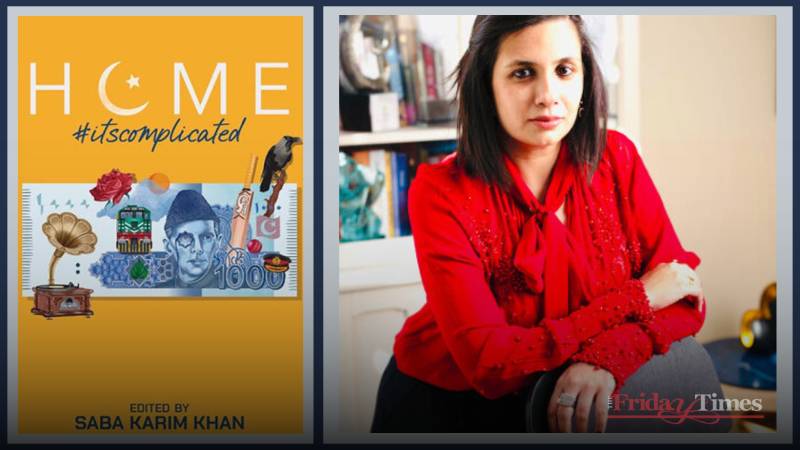
The brainchild of Saba Karim Khan, Home #itscomplicated is the latest addition to Pakistani literature exploring the theme of home as Pakistanis. One could be forgiven for thinking what could something new possibly be said given how much this topic has been addressed, but much like how this anthology explores home, via what Khan refers to as “an invitation for a dance, welcoming readers to solve the piece of the puzzle alongside us”, one has to view it differently.
Admittedly my rural background, the foundation of my thoughts, colours my own observations when it comes to the topic of home. Consistently, one is struck by how there is a secureness in rural soil when it comes to ‘home’ that the security of bricks and mortar in urban spaces fails to offer inhabitants - but this is a conversation for another day.
Time and context in which a publication emerges matters far more than is realised. Events, circumstances, the environment all influence writing and ultimately serve some form of documentation - fiction or non fiction - weathered and coloured by life’s trajectory. This is how this collection can be viewed. What has come to define the writers experiences of home as Pakistanis, within Pakistan and outside?
Yes, the stories overlap in the exploration of themes in the context of identity, family, politics, culture, migration and more. But this is where like branches of a tree, they stretch out sprouting leaves of validation for Pakistanis from all walks of life.
Nuanced and deeply personal there is something utterly marvellous at how Pakistan has shaped each person in its own way - if it isn’t someone weathering the blows of terrorism, it is another suffering at the hands of the patriarchy.
If it isn’t someone calling themselves Pakistani despite never having lived in Pakistan, it is a Pakistani who, having been born and bred in Pakistan, leaves the country only to not recognise it again.
And if isn’t someone constantly wrenching themselves from the claws of the patriarchy, it is another finding comfort in the cultural elements of the country as a holistic way of living and rejuvenation.
At this particular moment in time, for a collection like this to come out is much more than Just Another Book. Post war on terror, Pakistan has gone through incredible political and civic change. What makes it different from other countries going through change is, everyone has a unique story to tell as part of their own multi-layered development as a Pakistani.
The stories in this are a mixed bag of people who have experienced life in Pakistan through different periods of time. What strikes one is those who have lived through history and have had deeper experiences, their narratives are shaped by the social and political environment within which they have grown up. It is almost as if there is no difference between the personal, political and cultural.
In contrast, there is more of an inward look by some of the writers who prefer to question home through their own personal lives, possibly unmoved or removed from ground realities as if they unfolded in a separate realm, the distance being a bridge of association as a nationality.
This gap is where the question of home lingers, hanging heavily like the monsoon clouds, the complication of what it is to be a Pakistani as suffocating as humidity. Whose narrative holds more value? Is it those who have lived history and paved the way for those who ask questions about self-identity? Or will this bold quest for self-identity finally reclaim rights and space that historical events cruelly snatched from people?
This is why time and context matters especially when it comes to non fiction. Why now? Does this anthology matter? A whole country of young Pakistanis, politically aware, keen on taking ownership of their own narratives most certainly ought to be be engaged in literature where diversity of voices, each one with a unique story yet common in terms of thematic exploration, makes them realise the gravitas of history to lend credence to their own stories as they unfold.
From cultural elements, to the headiness of youth and cruelty of politics and the umbilical cord-esque connection with diasporic living, Home #itscomplicated offers far more than personal narratives. At this point in time, it acts as a reminder of how far the country has come and how so much of it continues to add colour to each writer’s relationship with the country.