

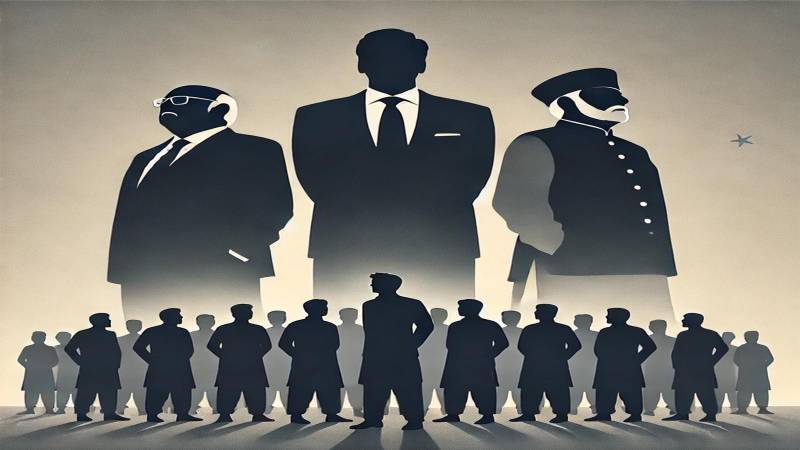
In the article entitled, ‘Democracy in Name, Oligarchy in Practice’, it was explained how oligarchic structures had deeply permeated Pakistan’s political landscape, primarily due to elite control over information. With key facts and policy discussions restricted to the corridors of power, the electorate was left to navigate politics with limited objective information, pushing them towards affective voting i.e. where emotional attachment and personal admiration take precedence over rational policy considerations. This information asymmetry was seen to strengthen elite dominance, ensuring that political engagement was driven by sentiment rather than substance, and highlighting a critical question: how do emotional dynamics shape Pakistan’s political landscape?
The use of emotional appeals in political persuasion has long been recognised as a powerful tool, shaping public opinion and influencing voter behaviour. Aristotle’s Rhetoric (4th Century BCE) emphasised pathos (emotion) as a key persuasive strategy whereby appeals were made to the audience to evoke strong emotions, while Machiavelli’s The Prince (1532) highlighted the role of fear and manipulation in maintaining power. By the late 19th century, basing his arguments on mass movements of his time including riots and revolutions, Gustave Le Bon published The Crowd: A Study of the Popular Mind (1895) in which he argued that such movements were more influenced by emotions than rational arguments, making them susceptible to charismatic leaders and propaganda. As is evident, centuries later, these theories still lay the foundation for understanding how emotional rhetoric continues to dominate political discourse in Pakistan.
Pathos remains central to Pakistani political rhetoric, with each major party crafting emotional narratives to rally support. The PPP sustains voter loyalty through the Bhutto legacy, while PMLN leans on themes of victimhood, portraying Nawaz Sharif as unjustly wronged to evoke public sympathy. Meanwhile, PTI fuels nationalist anti-corruption sentiments, with Imran Khan positioning himself as a lone warrior against a corrupt elite, using religious and patriotic appeals. In a media landscape where elite-controlled narratives and algorithmic filtering shape public perception, emotional appeals remain potent tools for political influence in Pakistan’s evolving democracy. Amongst a myriad of evidence from neuroscience, political psychology, and media studies, there is consensus that political actors exploit the neurological impact of music to shape public sentiment, leveraging its ability to activate the limbic system, which governs emotions and memory.
Instead of engaging in rational choice voting, where voters assess candidates based on policies like education, healthcare, human rights, food security, and taxation, the electorate is swayed by populist rhetoric, personality cults, and historical allegiances
By embedding ideological cues within emotionally charged anthems, they engage in affective conditioning, reinforcing partisan loyalty while circumventing rational scrutiny. This strategic psycho-political manipulation ensures that voters form deep-seated emotional associations with party identities (mostly the ‘leaders’) prioritising sentiment over critical policy evaluation. Machiavelli’s famous words, "Everyone sees what you appear to be, few experience what you are," perfectly encapsulate this calculated manipulation of public perception, when music is used in crafting emotional appeals through anthems, to secure voter loyalty without substantive debate. This has been a powerful means of emotional mobilisation, particularly in an environment where access to objective political information was always restricted. Recently, during the 2024 elections, all major parties in Pakistan strategically deployed musical narratives and replaced substantive debate with emotional engagement, keeping voters deeply invested in party identities rather than critically assessing governance issues.
All the major political parties have each embodied the principles of the Machiavellian Prince, mastering the art of political survival through manipulation, and power consolidation. The PPP has wielded patronage politics and populist rhetoric to maintain influence, securing loyalty not through governance but through feudal networks and emotional appeals. The PML-N, much like a princely dynasty, has relied on pragmatic alliances and institutional bargaining, using state resources to fortify its rule while navigating shifting allegiances with the military and judiciary. Meanwhile, the PTI has succeeded in exemplifying Machiavellian opportunism, leveraging state institutions when in power and resorting to mass agitation when ousted. Each party, in true Machiavellian fashion, has justified its means-be it populism, patronage, or institutional manoeuvring-under the guise of public service, ensuring that power-grabbing remains the ulterior objective.
While there is much more to be written, it suffices to state that Pakistan’s political landscape remains entrenched in affective polarisation, where voting behaviour is driven by emotional attachment to political figures rather than substantive policy considerations. Instead of engaging in rational choice voting, where voters assess candidates based on policies like education, healthcare, human rights, food security, and taxation, the electorate is swayed by populist rhetoric, personality cults, and historical allegiances. While this has long been the norm, the real question is not just why the people of Pakistan have been casting their votes, but what, in truth, have they been voting for. Have we, the people of Pakistan, been choosing a future of prosperity, justice, and progress, or merely clung to familiar faces and empty promises, hence endlessly chasing the mirage of a saviour who never arrives? Have we been voting for quality education, skilled healthcare, and policies that reduce food prices and improve living standards? No, but what we have been unknowingly doing is casting votes for our suffering, trapped in a cycle where loyalty matters more than livelihood, and emotions outweigh reason.
Our preference for affective voting reflects what Antonio Gramsci termed ‘cultural hegemony’ i.e. where dominant political narratives shape public consciousness to align with the interests of the elite. Endless debates over leaders' morality, past mistakes, or personal charisma serve as a smokescreen, diverting attention from economic mismanagement and core policy issues, which is particularly detrimental to a country where democracy remains fragile, and public institutions struggle with inefficiency. Until voters break free from this cycle of what Marx called ‘false consciousness’ and demand accountability on governance and policy issues, elections will remain an exercise in emotional manipulation rather than a means of societal progress. The real question, then remains, whether, we, the people of Pakistan are prepared to shift from a politics of identity and emotions to one of rational deliberation or whether we will continue to be pawns in a game where issues of real consequence are perpetually sidelined, so that a few can enjoy an unending walk in the corridors of power.