

“Calamity is the perfect glass wherein we truly see and know ourselves”—William M. Daley
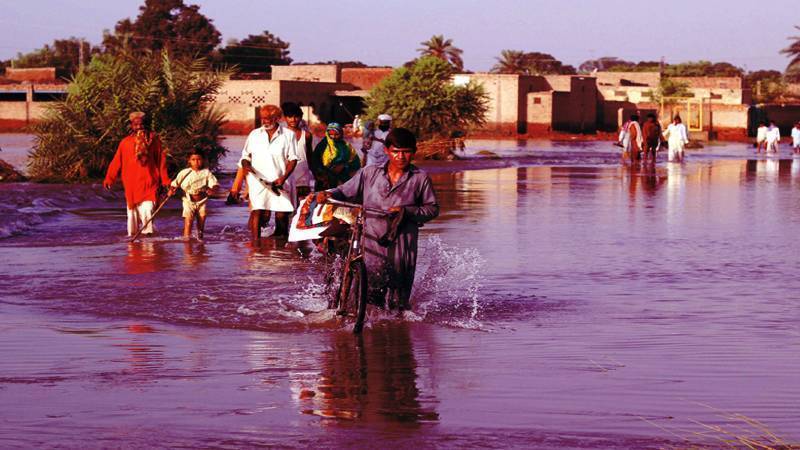
As the summer of 2025 progresses with blistering heat and later the onslaught of monsoon rains, the chances of floods could be tremendous, especially when the river sources are in the control of the ‘enemy’. We, as a nation, have a remarkable quality to stand up like an iron wall when struck with any type of calamity but as soon as the heat subsides, we again revert into slumber mode as if nothing ever happened. The likes of this characteristic have been witnessed during floods in the past many years. On these occasions, people’s reaction was swift, appreciable and exemplary—government as usual is seen unprepared and suffering from lethargy.
Generosity, compassion, benevolence and eagerness to ease the sufferings of the affected are at their full display and no stone remains unturned for alleviating pain and misery. Aid pours in from both national and international sources and all efforts are geared up to rescue and evacuate those who are pushed into precarious circumstances. With the gruesome effects of these calamities settling down, we notice how everybody, including the government, conveniently forgets the terrible moments of disaster until it strikes again.
No doubt, it is impossible to fight Mother Nature, yet we have clear instances of efforts made by many countries to harness rivers to prevent flooding. China, India, the UK, the Netherlands, Italy, and the USA are some of the countries where tremendous work has been done in this respect. However, so far as Pakistan is concerned, there is no plan, not even any talk or debate about devising methods for curbing devastation in case of future floods. They say that when in doubt seek knowledge from those who know. We wish the government would tell the public if consultants have been invited to advise about this issue. How come we quickly invite experts from the World Bank or the International Monetary Fund when in need of funds to cater for wasteful expenses but fail to obtain proposals for the betterment of the country and its people?
Despite the existence of numerous ministries and departments working under the federal and provincial governments, there appears to be none that has specifically been constituted to plan and develop effective flood control systems
The problem in sorting out these matters has nothing to do with meager resources. Actually, there is an absolute lack of will to efficiently manage affairs of the State whereby long-term targets are fixed and work is carried on irrespective of which government initiated those plans. Thus, projects in Pakistan are attributed to a person rather than becoming a national obligation causing not only much inconvenience but also resulting in heavy losses in terms of finances. Likes and dislikes play a pivotal role in the assignment of work. Merit, expertise, acumen, sincerity are terms used only to garnish applications but the true story behind most contracts is fraught with kickbacks, corruption, leg-pulling, conspiracies and nepotism.
If sanity prevails, perhaps a few at the helm of affairs might initiate some concrete plans to manage Pakistan’s water system. It is about time that we stop playing the blame game with our neighbours and move towards far-reaching and efficient solutions to get full control over our precious natural resource, mercilessly neglected by most governments, until it unleashes its terror in the form of floods destroying property and lives.
Today, there are many ways to help prevent and control floods starting as of today. It took the Dutch almost fifty years to complete the Delta Works, their answer to restraining the sea (not rivers) from flooding the country. The Delta Works are a series of constructions built between 1950 and 1997 (officially the project was completed on 24 August 2010) in the southwest of the Netherlands to protect a large area of land around the Rhine-Meuse-Scheldt delta from the sea. The works consist of dams, sluices, locks, dikes, levies, and storm surge barriers. The aim of the dams, sluices, and storm surge barriers was to shorten the Dutch coastline, thus reducing the number of dikes that had to be raised.
In the UK, only fourteen people died in the 1928 Thames flood, and when 307 people perished in the North Sea Flood of 1953 the government was prompted to seek proposals for a flood control system. The concept of the rotating gates was devised by Charles Draper. The barrier was designed by Rendel, Palmer and Tritton for the Greater London Council and tested at HR Wallingford Ltd.
The site at Woolwich was chosen because of the relative straightness of the banks, and because the underlying river chalk was strong enough to support the barrier. Work began at the barrier site in 1974 and construction, which had been undertaken by a Costain/Hollandsche Beton Maatschappij/Tarmac Construction consortium, was largely complete by 1982. In addition to the barrier itself, the flood defences for 11 miles down-river were raised and strengthened.
Indeed, it is notable that only a few deaths inspired the UK government to spend a whopping £ 534 million to prevent River Thames from taking innocent lives but at the same time one is amazed at the apathy of our rulers who have never seemed moved by millions who perished at the hands of perilous floods since 1947.
Despite the existence of numerous ministries and departments working under the federal and provincial governments, there appears to be none that has specifically been constituted to plan and develop effective flood control systems. Delta Works in the Netherlands was conducted under the supervision of the Ministry of Waterways and Public Works which indeed carried out a commendable feat. Instead of having a bunch of worthless and duplicate ministries in both the federal and provincial governments, a competent/efficient few could be more fruitful in managing the State’s affairs and combating hazardous situations.
Focus should be diverted to making best use of the abundance of natural wealth available and more investment on human capital, capable of exploiting it which should make Pakistan a place worth living, and a nation strong enough to fend for itself under all circumstances.