

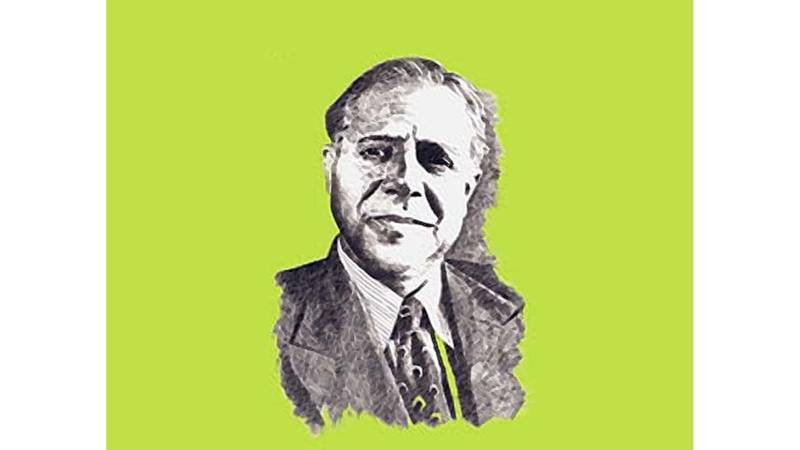
Syed Mohammad Jafri, the intelligent satirist and humourist of the Indo-Pak subcontinent was born in 1905. He obtained initial education at home. He passed the munshi faazil exam at the age of fourteen. In 1922, he passed the matriculation exam with distinction. He obtained the degree of BSc (Hons) (Chemistry). Then he obtained an M.A./M.O.L in Persian Literature from the Government College Lahore. His teachers included Patras Bokhari as well. He had begun versifying very much from college.
Jafri learned painting from Mayo College (now National College) of Arts, and he was proficient at calligraphy too. In the beginning, he was attached to the Department of Education and then became connected to the Ministry of Information and Broadcasting. He retired in 1966 and passed away on 7 January 1976, 50 years ago this month.
Jafri was the most distinguished, respected and important witty poet in the Indo-Pak subcontinent in his lifetime. After Ghalib and Akbar Allahabadi, he was the most important and respected satirical and humourous Urdu poet. He is second to none in poetry, he is the patriarch of this art. It can be said without the fear of refutation that he has no rival in this field nor an equal.
His skill is that he says unspeakable things within the veil of humour. Basically Jafri is a poet of the poem. Incorporation (of another poet’s lines) and alteration (of a word to change its meaning) are mixed in his poems but alongwith his mixture an extraordinary skill and spontaneity is found here.
Due to the diverse qualities of intense feeling, deep observation, meaningful symbolism, sharp allusion, novelty of idea, realistic scenography, limitless intelligence, extemporaneity and spontaneity, collective consciousness and attractiveness, the brilliant verses of Jafri are equally beloved and popular among common and noble people.
His beloved is his world and instead of an individual or individuals he satirises institutions and the foibles of collective life and smiles at its laughable aspect. He does not reopen wounds but dresses them. From the angle of colourfulness of themes, Jafri was the Nazir Akbarabadi of his era and his poetry was the history of the half-century of this subcontinent.
Respect for classical consciousness and literary traditions further adds to the attractiveness of his poetry.
Clerk, UNO, Vaziron Ki Namaz (The Ministers’ Prayer), Buffett Dinner, Purana Coat (Old Coat), Jab Laad Chale Ga Banjaara (When the Peddler Will Pack Up), and Kaghaz Ka Marsiya (The Paper’s Lament), etc. are such masterpieces of Jafri without which no selection or mention of Urdu satirical and humourous poetry can be considered complete.
The two poems of Syed Mohammad Jafri in my translation below are the most superior in quality and quantity of Urdu humourous poetry after the Deevaan-e-Ghalib:
His poem PIA Se Safar (Travelling by PIA) is a case in point. Almost two decades before I read this poem, Pakistan International Airlines - the national airline of my beloved country was introduced to me on a chilly evening in Leeds during my postgraduate studies by my Japanese classmate when she described PIA as ‘Perhaps I Arrive’. While all of us laughed it off as a joke at the time, I was quite embarrassed in hindsight knowing that the reputation of PIA had fallen to such an extent that it was no more one of our worst-kept national secrets; it had clearly gone international, like its unique selling proposition (USP) ‘Great people to fly with.’
It should be re-read now, given the recent fire-sale of PIA to a private consortium.
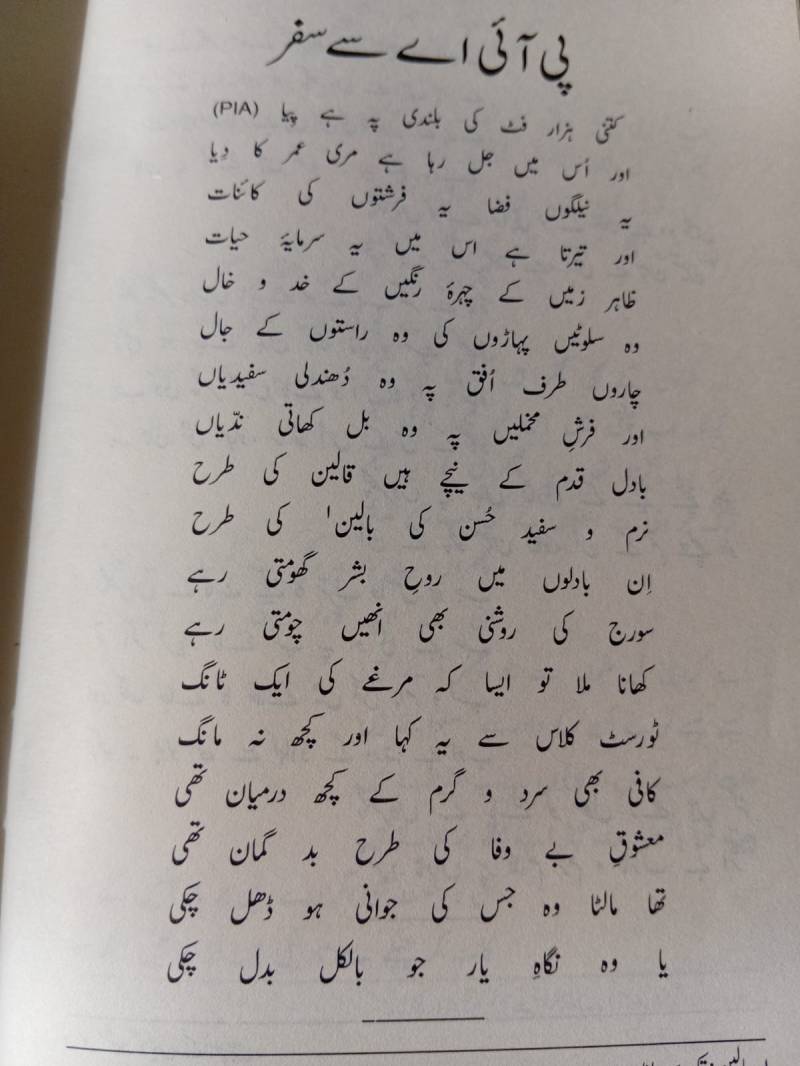
At a height of so many thousands of feet is PIA
And within it the lamp of my life is burning away
This universe of angels, this blue expanse
And this wealth of life floating within like happenstance
Evident are the features of the colourful face of the regions
Those nets of the paths, those folds of the mountains
On the horizon everywhere that foggy day
And on the velvet floor those streams curling away
Like a carpet the clouds are at the feet below
Like the beauty of a soft and white pillow
May in these clouds keep revolving the soul of the human
And they are kissed too by the light of the sun
When the food was served such that there was just the leg of a rooster
The tourist class was told do not demand anything further
Between cold and hot too was poised the coffee
Like a suspicious beloved bent on treachery
Was it an orange whose youth had faded
Or that gaze of the beloved which became totally jaded.
Jafri’s poem Ruet-e-Hilal Committee (Committee for Moon Sighting), is a fine example of Jafri’s trademark humour. The poem was written in response to an event in General Ayub Khan’s Pakistan whence the committee was composed to sight the Eid moon in 1962. The only reporting regarding the new moon came from the Malakand Agency at midnight, on the basis of which Eid was announced in Pakistan. The people, however, were totally unsatisfied with this decision. Because the announcement of the Eid moon was done on an official level, only the sympathisers of the government and government officials celebrated Eid that day.
A few literary and cultural metaphors occurring in the poem need to be explained here for the uninitiated reader. A line in the second stanza (“And in homes there was such disharmony”) in the original poem refers to jootiyon me daal batna, implying discord and dispute. While the very last couplet – which as the reader will note is in quotation marks – ‘I was amazed…my next destination’ – is actually Ghalib’s verse with Jafri’s slight alteration. This serves as a fine example of inserting a verse of Ghalib in Jafri’s own poem to create humour, something which was Jafri’s forte.
Given the national and political obsession with both the Ramazan and Eid moons, and that Ramazan is expected to begin slightly more than a month from now, another reading of this poem should be par for the course.
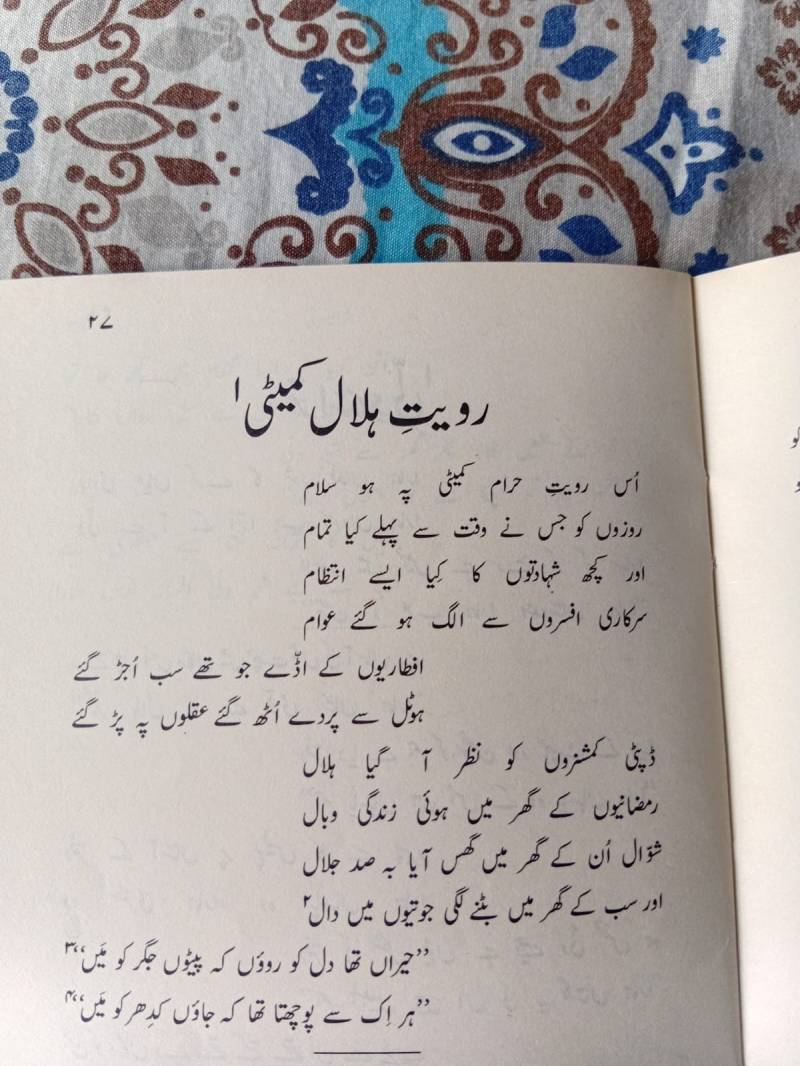
That Committee for the Sighting of the Forbidden deserves congratulation
For terminating the fasting before the expected duration
And they organised the evidence in such a manner
That the people were separated from the government officer
The perches for the iftars were all ruined
Raised from the hotels, for the brains the curtains now became destined
The deputy commissioners finally saw the new moon
At the home of the Ramazanis, life became a misfortune
Shawwal entered their homes with great dignity
And in homes there was such disharmony
I was amazed whether to cry out my heart or subject it to flagellation
I asked everybody where should be my next destination.