

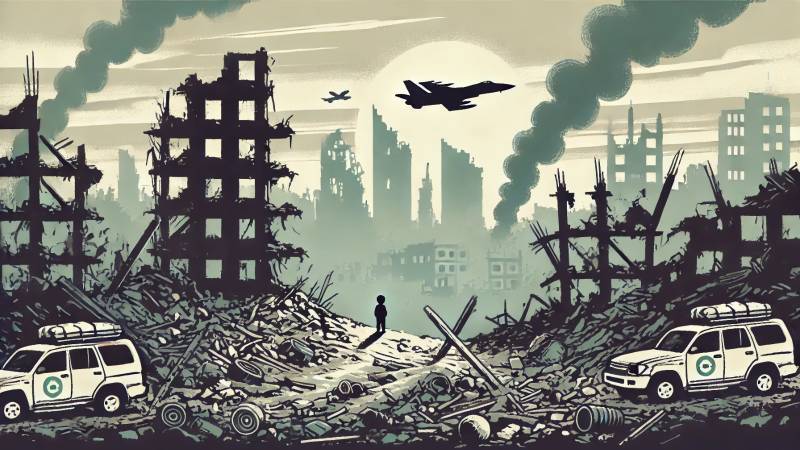
In the shadow of airstrikes and border skirmishes, something far more dangerous is unfolding, not just in the territories being bombed, but in the language, logic, and global narrative surrounding war. Once, the discourse around India and Pakistan’s conflicts, however flawed, used to acknowledge the central issue: Kashmir. The right of a people to self-determination. A legacy of colonial rupture. A contested homeland. But now, even that minimal dignity has been erased. The new conversation is not about people or justice. It is about missiles and drones. J-10 versus Rafale. Radar locking and kill probability. The theatre of war has turned into a showroom. And the audience, governments, corporations, and media houses are watching not for truth, but for technological supremacy and stock market movements.
This is no accident. It is the inevitable result of a world where war is no longer fought over ideas, ideologies, or sovereignty, but over algorithms and military contracts. Where military conflict is not a breakdown of diplomacy, but a lucrative exhibition. It began in Ukraine, where for the first time, a full-scale war became a tech fair. Armies deployed fleets of drones, cyberattacks were launched like guided missiles, and even space was militarised with commercial satellites. Bayraktar TB2 drones from Turkey became internet celebrities. Iranian Shaheed UAVs (Unmanned Aerial Vehicles) found customers beyond borders. Norwegian defense firms cashed in. This wasn’t just a war, it was a weapons expo with a death toll.
Software-defined warfare emerged as the new normal. AI systems, data analytics, surveillance apps, all deployed as seamlessly as soldiers once were. In Gaza, the terrifying efficiency of such systems was laid bare. Israel used AI tools like “Gospel” to classify buildings for bombing - military, civilian, essential, often with fatal errors. “Lavender” gave Palestinians a score of suspicion based on phone data, online behaviour, and digital footprints. People became data sets. A person’s life could be ended not by trial or even intelligence, but by an algorithm’s confidence threshold. Another tool, “Where’s Daddy?”, tracked suspected militants through their phone data. There was no trial. No evidence. Just a prediction. Just code.
When death is calculated in percentages and suspicion scored by algorithms, something far greater than lives is lost
This is not the future. This is the present. And it is a terrifying one.
Now, this dystopia is being exported. When Pakistan’s J-10C jet reportedly downed India’s French-origin Rafale, the first reactions were not questions of escalation or restraint. They were numbers. Dassault Aviation’s shares dropped. AVIC Chengdu rallied by 36% in two sessions. Across the Atlantic, Western defence circles watched closely, not out of concern for peace, but to analyse the performance of Chinese weaponry, and to speculate how a future confrontation with China over Taiwan might unfold.
The skies were not just a battlefield, they were a stock exchange. This wasn’t geopolitics. It was profit. This wasn’t national security. It was corporate competition. War has become a press release. An economic indicator. And the dead? They are collateral statistics, buried beneath the decimal points.
The tragedy is twofold. First, people have been dehumanised, no longer citizens, only coordinates. They are reduced to biometric profiles, geolocation pings, and suspicion scores. Their lives are processed through machines, judged by code, and erased by drones. Second, the spectacle of techno-war distracts from the deeper sickness - poverty, inequality, state violence, and fractured nations. The obsession with military toys serves one purpose: to silence the cries from the ground. It buries the hunger, the hate, the unhealed wounds. It replaces justice with a joystick.
Where are the people in all this? Where is the mother who lost her child to a drone strike? Where is the family displaced by a missile that missed its target? Where is the face of peace in a world lit up by the glow of exploding circuitry?
We are witnessing the rise of what may be called “remote-control war”—a war fought by machines, for machines, watched by markets, and justified by media. The real casualty is the truth.
We must resist this narrative. We must rehumanise the conversation. Technology may have changed the machinery of war, but it cannot be allowed to change our understanding of its consequences. No matter how precise the drone, how advanced the AI, how fast the jet, the cost of human life remains sacred.
Let us not forget Gaza. Let us not forget Kashmir. Let us not forget that behind every “target neutralised” is a family shattered. Behind every “successful strike” is a funeral. We must demand a return to the language of peace, of diplomacy, of justice. Because if we continue down this path, war will no longer be about right or wrong. It will only be about efficiency, precision, and profitability. And when death is calculated in percentages and suspicion scored by algorithms, something far greater than lives is lost. Yet even now, the story can be rewritten. Not by machines, but by those who still believe that people matter more than prototypes, and peace more than performance. In the quiet between airstrikes, that belief is still possible. And worth defending.
And when that happens, we will have lost more than our lives. We will have lost our humanity.