

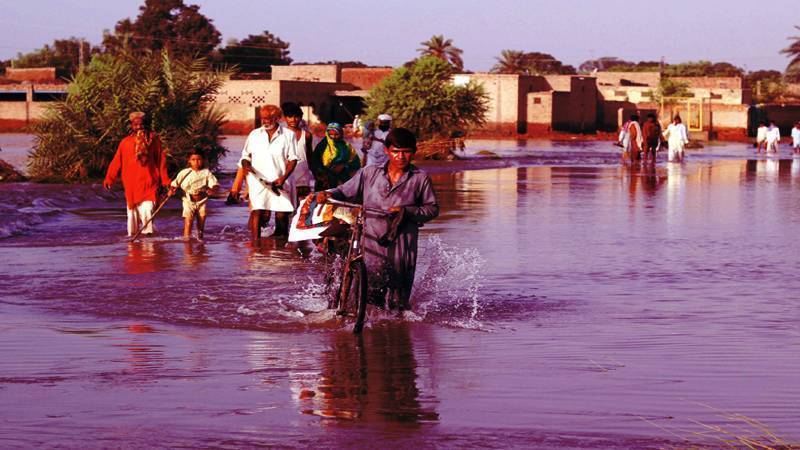
South Punjab is the forgotten heartland of Pakistan. Despite being the main producer of wheat, rice, cotton and sugarcane – the food crops and cash crops that fuel our food and textile industries – its people are still deprived of reliable healthcare, education, and infrastructure. This neglect is not accidental; it is the result of political marginalisation.
In the 2025 floods, the massive evacuation operations relocated approximately 1.43 million people, while 1.5 million livestock were moved to safer areas. So far, 121,000 patients have received treatment for flood-related illnesses and injuries. This is not the first time South Punjab has been underwater. In the 2022 flood report, out of 36 ‘calamity-hit’ districts, 3 were in South Punjab. Over 178,000 acres of crops and orchards were affected in Punjab, and 1,180 schools destroyed due to the emergency.
In the 2014 floods, Punjab was the worst hit, with 688,000 hectares of agricultural land submerged. More than 2,900 villages were inundated, forcing the evacuation of half a million people. Multan district in South Punjab bore the brunt of much of the flooding, as strategic breaches diverted water towards inhabited villages, displacing more than 116,500 people from 121 villages. Out of 16 flood-affected districts of Punjab, 5 belonged to South Punjab.
Most notably, the 2010 super floods led to some of the worst inundation in almost a century, as the Indus broke its levees in South Punjab. Around 392,786 houses were damaged and 728,192 destroyed, inflicting unprecedented destruction on half a million households. Some 8.2 million people were affected, with 746,900 hectares of cropped area devastated, impacting a total of 11 districts and 1,778 villages. Out of the 11 districts of Punjab that were affected by the floods, 7 districts of South Punjab, including Rajanpur, Dera Ghazi Khan, Taunsa, Jampur, Layyah, Muzaffargarh, and Multan, were severely impacted.
The people of South Punjab often argue that their lands and lives are treated as a ‘buffer zone’ to shield the wealthy north
The central issue here is that South Punjab bears the greatest impact of the floods. While most of the monsoon rains occur in Upper Punjab, it is South Punjab that suffers most of the after-effects. These repeated disasters raise serious questions regarding infrastructure and the policies governing South Punjab.
Most of the embankments, barrages, and canals in South Punjab are old, poorly maintained, and insufficient for handling high floods. Yet most flood protection projects are concentrated in Upper Punjab due to political influence, leaving South Punjab exposed to extreme inundation. As Upper Punjab contains the major urban centres and industrial zones (Lahore, Faisalabad, Gujranwala, Rawalpindi), protecting these is deemed more “strategic” for the province’s economy. By contrast, South Punjab is more rural and less politically influential, so its agricultural lands and villages are sacrificed to divert floodwaters.
South Punjab is also considerably underdeveloped compared to Central Punjab, with a lower literacy rate, poor health facilities, and inadequate infrastructure. A large part of the population lives in rural areas dependent on agriculture, so when floods strike, crops, livestock, and homes are destroyed, leaving people with very few resources to recover. Because livelihoods depend mainly on agriculture, many villages are located close to riverbanks and floodplains due to fertile land, making them directly exposed to floods.
Whenever river water exceeds safe levels, controlled breaches are made at embankments to preserve the majority of areas. Engineers prefer breaching in less populated rural areas, mainly South Punjab, rather than risking catastrophic flooding in crowded urban centres of Upper Punjab. However, a historical pattern is evident from the floods of 2010, 2014, and 2022: breaches in dykes and protective bunds in Muzaffargarh, Rajanpur, and DG Khan diverted water away from Central Punjab. This ‘sacrificial strategy’ protected Lahore and Faisalabad but submerged vast agricultural and residential areas in South Punjab.
This practice highlights the structural imbalance of Punjab politics, as Upper Punjab dominates provincial decision-making, leading to the marginalisation of South Punjab. The people of South Punjab often argue that their lands and lives are treated as a ‘buffer zone’ to shield the wealthy north. Political and administrative neglect is further evident as disaster management resources such as the National Disaster Management Authority (NDMA) and the Provincial Disaster Management Authority (PDMA) are slower to respond in South Punjab, resulting in fewer relief camps, poor medical facilities, and inadequate rehabilitation measures compared to the scale of displacement.
The recurring devastation in South Punjab is not merely the story of natural calamities, but of man-made neglect. Time and again, its fertile lands and vulnerable communities have been sacrificed to protect the wealthier and politically dominant north. Until this structural imbalance is addressed, each flood will only deepen the cycle of poverty and displacement. The real question is: how many more times will South Punjab be drowned before Pakistan recognises that protecting its heartland is just as strategic as safeguarding its urban centres?