

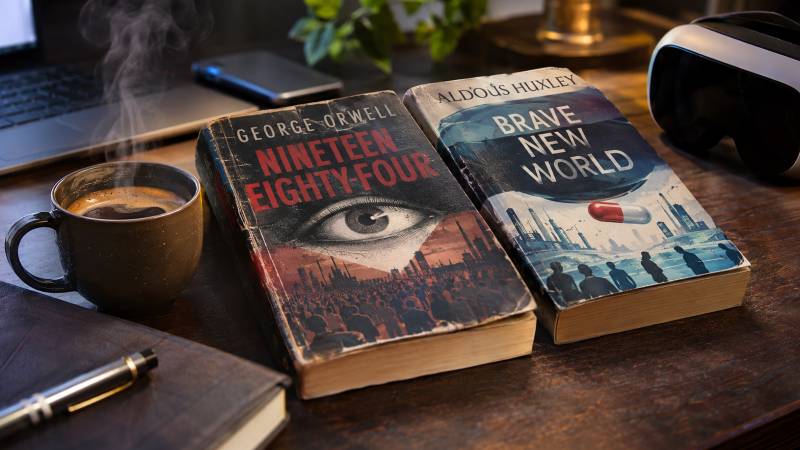
I first read George Orwell’s Nineteen Eighty Four and Aldous Huxley’s Brave New World in high school. They were novels to understand, analyze and eventually be examined on. Their worlds seemed terrifying but remote. Today, I find myself wondering whether we were reading warnings about a future we are now helping to build. Orwell imagined a state that watches its citizens, rewrites history and punishes independent thought. Big Brother demands obedience not merely in behaviour but in belief. Power determines truth. Its relevance today lies in pervasive surveillance, manufactured information and attacks on independent institutions. By 2040, Artificial Intelligence could make such control more precise and less visible.
Huxley imagined a society organized through biological engineering, rigid social conditioning and compulsory happiness. Pleasure, consumption and the soothing drug soma keep uncomfortable questions at bay. Today’s attention economy offers an unsettling parallel. By 2040, personalized digital worlds could make withdrawal from public life so satisfying that freedom is surrendered without a struggle. Neither novel describes our world completely. Their convergence is what troubles me. The possibility of being watched like Orwell’s subjects while being entertained like Huxley’s. Yet one remains hopeful. Warnings matter because they leave us time to choose.
Fourteen years separate us from 2040. During that period, artificial intelligence will reshape work and power, climate pressures will intensify, and societies will confront difficult choices about democracy, security and inequality. Borders, alliances and sovereignty may change alongside them. The likeliest danger is not universal collapse. It is an age of managed disorder. Technological progress alongside institutional decay, extraordinary wealth alongside insecurity, and expanding capabilities without agreement on who should control them.
Democracy’s crisis begins partly with delivery. Too many systems struggle to provide affordable housing, secure employment, functioning services, fair taxation, humane migration policies and a believable future. Elections change governments without changing these realities. Citizens become receptive to leaders promising strength over restraint and decisiveness over deliberation. The result may be electoral authoritarianism. Governments retaining elections while weakening courts, legislatures, regulators, universities, civil services and independent journalism. Democracy survives as procedure while losing its capacity to restrain power.
The Democratic “blue wave” or so called “blue tsunami” in the November 2026 US midterms offers a counterpoint. Voters have returned control of both chambers of Congress to Democrats, demonstrating that electoral accountability can still interrupt concentrated power. But this hope deserves proportion. A Republican defeat is not proof of democratic renewal, nor does Democratic victory guarantee accountable government. The deeper test is whether renewed checks produce better governance, protect institutions and improve lives. Democracy must deliver more than alternating disappointments.
Authoritarianism offers no dependable escape. Governments can build infrastructure or mobilize resources quickly while concealing costly mistakes. Suppressed criticism deprives rulers of the information needed to correct them. The decisive distinction may therefore be between systems that can deliver, remain accountable and learn and those that cannot combine these qualities. Geopolitically, the path to 2040 points towards contested multipolarity. The United States may remain the strongest overall power, with China its principal strategic competitor and India and other powers increasingly consequential. Europe faces defence pressures, demographic change and political fragmentation. Türkiye, Saudi Arabia, Indonesia and Brazil will pursue greater strategic independence.
Globalization will adapt rather than disappear. Security will increasingly compete with efficiency. Governments will subsidize strategic industries, duplicate supply chains, restrict technologies and compete for minerals, energy and computing capacity. Resilience will carry a price, especially for countries unable to finance it. War makes these adjustments more dangerous. Ukraine has shattered assumptions about settled European borders. Conflict involving Iran, Israel and the United States demonstrates the Middle East’s capacity for wider escalation. Taiwan remains a potential confrontation between nuclear powers, with consequences for the semiconductor economy.
Modernizing nuclear arsenals and weakening arms control arrangements compound the risk. Catastrophe need not begin with a decision to wage world war. A blockade, drone strike, cyberattack or maritime collision could trigger consequences no participant intended. Borders may remain legally intact while becoming less meaningful in practice. Ukraine’s recognized territory may differ from the ground it controls. Sudan, Libya, Yemen, Syria, Somalia and parts of the Democratic Republic of Congo illustrate the gap between sovereignty on paper and authority on the ground.
The possibility of being watched like Orwell’s subjects while being entertained like Huxley’s is what makes the future so troubling.
Militias, autonomous administrations and foreign forces can divide states without formally replacing them. Today’s ceasefire lines may harden into tomorrow’s boundaries. The map need not be redrawn for sovereignty to erode. Maritime competition will matter equally. The Taiwan Strait, South China Sea, Red Sea, Eastern Mediterranean and Arctic connect trade, energy, fisheries and military access. Control over routes and infrastructure may become as consequential as ownership of territory.
Climate change will place further pressure on both. Heat, flooding, drought and coastal exposure will increasingly shape where people can live, insure property, grow food and sustain livelihoods. By 2040, environmental stress could amplify migration and political conflict without determining either automatically. Climate policy will consequently become inseparable from food, water, health, housing, energy and national security. Governments will need resilient grids, cooling systems, flood protection, water recycling and adaptable agriculture. Countries least responsible for historic emissions will often have the fewest resources to respond.
AI will accelerate almost every challenge and many possible solutions. Better diagnosis, scientific discovery, personalized education and more effective administration are substantial opportunities. The question is who captures the benefits and who bears the disruption. Ownership matters alongside capability. Those controlling models, chips, cloud infrastructure and data could accumulate exceptional influence. Others will use AI to increase productivity. Many will face disrupted occupations or weaker bargaining power; others may remain excluded altogether.
Large technology companies already operate systems essential to communication, finance, computing, satellites and cybersecurity. By 2040, dependence could extend further into how governments function and how societies produce knowledge. Public authority may increasingly rely on privately controlled infrastructure. Here Orwell and Huxley meet again. The same system can monitor behaviour and manufacture distraction. It can identify our fears, anticipate our preferences and decide which version of reality reaches us. Manipulation becomes more effective when it feels like personal choice.
The issue is not wealth earned through innovation. It is the concentration of wealth, information, infrastructure, political access and algorithmic influence without equivalent public accountability. A billionaire need not hold office to exercise power over public life. Health emergencies will test this order too. Another pandemic before 2040 is plausible. Vaccine platforms, genomic surveillance and AI assisted discovery may improve scientific preparedness. The WHO Pandemic Agreement adopted in 2025 reflects an effort to address COVID’s failures.
Political preparedness is less assured. Distrust, unequal access and polarization could undermine better science. AI generated misinformation may spread faster than institutions can establish credibility. We could possess more powerful tools while becoming less capable of acting together. Underlying these risks is elite impunity. Inequality becomes especially corrosive when citizens believe opportunity is closed and wealth purchases favourable laws, regulation, access and protection from consequences.
People are more willing to accept unequal outcomes when the rules seem fair. Anger grows when losses are socialized, gains privatized and powerful groups escape obligations imposed on everyone else. That anger can support reform or empower leaders who exploit it. The state will therefore become more involved in technology, defence, energy, food, medicines and strategic supply chains. Markets alone cannot settle collective questions about pandemic preparedness, climate resilience or technological monopoly.
What matters is the state’s character. Will it be capable and constitutional, captured by patronage, or armed with unprecedented surveillance? Public intervention can widen opportunity, but it can also entrench insiders. Capacity without accountability is no guarantee of public service. One remains hopeful because history also records correction. Societies have challenged slavery, expanded voting rights, strengthened public health, reduced poverty and built institutions for cooperation. These achievements were incomplete and contested. They nevertheless demonstrate that arrangements once defended as permanent can change.
The capacity to correct ourselves rests on practical foundations in terms of credible information, independent institutions, accountable elites, public trust and peaceful means of replacing failed leadership. Criticism is part of that capacity. So are journalism, scientific inquiry, competitive elections and courts able to restrain governments. We should judge technological progress by whether it strengthens these foundations. Does AI broaden access to knowledge or make citizens dependent on opaque systems? Does digital government improve service or remove avenues of appeal? Convenience should not become a reason to abandon scrutiny.
The same principle applies internationally. Competition needs channels for negotiation. Security needs restraint. Climate adaptation needs finance and cooperation. Governments cannot eliminate every crisis, but they can avoid making each crisis an excuse to destroy the institutions needed for the next one. Returning to Orwell and Huxley now, I understand their warnings differently. As a schoolboy, I saw oppressive governments and manipulated societies. Today, I see the smaller acts through which human agency can disappear. Privacy is exchanged for security, judgment delegated to algorithms, civic responsibility displaced by entertainment, and truth filtered through tribal loyalty. Each compromise appears manageable. Together, they can leave citizens with fewer meaningful choices.
But surrender is not inevitable. AI can widen access to expertise. Cleaner energy can improve security as well as reduce emissions. Health research can deepen cooperation. Elections can remind those in power that citizens remain capable of refusing them. The task is to turn these possibilities into durable institutions. Hope requires more than confidence in human ingenuity. It requires rules that prevent ingenuity from becoming another instrument of domination.
By 2040, we may have built societies that are healthier, more prosperous and better informed. We may also have built systems that know everything about us while leaving us little influence over them. Neither outcome is preordained. The central struggle is whether we retain the freedom to question, the institutions to correct and the collective will to act. Orwell and Huxley may prove more relevant than I imagined in high school. I still hope their books will remain warnings we heeded, rather than futures we accepted.