

I grew up listening to Sarwar Begum, my dearest Booji, stern but dignified paternal grandmother, not stories but events in the lives of the Gakhar Rulers and their attachment to Pharwala Fort. Sarwar Begum had a certain pride in their Gakhar heritage and legacy passed on to her from her husband Raja Wazir Khan, also known as Raja Bagh Bahar, a revenue officer and a prominent member of the Gakhar clan. In my youth, I accompanied my grandmother a few times to the Pharwala Fort to meet some extended family members who had chosen to live there. For the last few years, I have been planning to visit Pharwala Fort and Kahuta where my father and his siblings had spent their childhood, but for various reasons, I could not fulfill this wish.
As the dawn of 2025 broke on the globe’s horizon, I did not have to wait too long to fulfill this desire, as ‘fate moved its huge hands’. A common love of archaeology and South Asian heritage brought me close to Imran Williams, a noted ‘history buff’ with whom I have been planning to meet for the past few months. As I scanned Facebook, which I do every day, I jumped to an advertisement by Asian Travel Pioneers, a tourist agency announcing a day-long visit to Pharwala Fort, some 49 Km from Islamabad, on Sunday, 26th of January 2025. Pharwala Fort was not some obscure archaeological site but a visit to the Fort of our forefathers, the proud Ghakars, who had ruled the area in and around the Potohar region as it is called, and even beyond.
Imran put me in touch with Amir Aaqib and Wilma Van Der Maten, two amazing personalities connected to Asian Travel Pioneers who knew exactly how a group tour to an archaeological site should be organised and conducted: affectionate and professional! The tourist group, which included anxious and excited people of all ages and chirpy and enthusiastic children, was spread around the ‘cavalcade’ of a well-maintained van and a few cars. I, too, was part of the group that was in the van which made a few scheduled stops to collect group members. At McDonald’s just before one enters Goldberg Green, I was pleasantly surprised to be asked by the ever-alert and caring guide, Aqib (Desert Jeep Rally buff), to sit in the vintage model of a Mercedes-Benz of Afzal Sahib, well-known ‘Merck Guru’. We exchanged interesting anecdotes as the car hurtled towards Pharwala. The cavalcade finally left for Pharwala Fort branching from Gulberg Green onto Japan Road crisscrossed small villages and finally arrived around 11 AM close to Bagh Jogian, where we all disembarked to track towards the Fort.
The Banyan Trees, the rocks, and the gates of the Fort continue to share stories with any passerby, who may care to listen to the chivalry of the rulers and those who braved their lives to protect the Fort and their inhabitants
Led by the formidable group leaders, Wilma, Aqib, and Imran, I collected my backpack and walking cum folding stick and joined the group as it started to move toward the Fort and crossed the Soan River, which can tell stories of warriors, traders, and now a few inhabitants of the Fort who cross this river many times during the day and night. During the crossing of the river and when taking lunch on its banks, the river impressed us all as it looked transparent and clean but what baffled us all was there was no fish in the river. The results of my small research showed that the river has historically been a pristine waterway that supported a diverse ecosystem and human settlements. However, it has faced pollution and environmental degradation over the years.Efforts are needed to clean and restore its original condition.
Nevertheless, retracing the steps of our forefathers who had left imprints on the same hard rocks on which I was putting my feet, I crossed over to the majestic Banyan trees under which lay buried for centuries, some of the proud Gakhars who had held sway over the Potohar region from the majestic Pharwala Fort, whose crumbling façade reflectors ages of neglect and was waiting for some modern John Hubert Marshall to reclaim its historical significance but alas it seems a distant dream. The Banyan Trees, the rocks, and the gates of the Fort continue to share stories with any passerby, who may care to listen to the chivalry of the rulers and those who braved their lives to protect the Fort and their inhabitants.
As the tourists gazed at the fort and swung at the majestic branches of the massive Banyan tree, Imran Williams, our tourist historian guide, kept the interest of the inquisitive tourist group through his narration about the Pharwala Fort. As is known that ‘curiosity kills the cat’, I poured over research material on the fort by the Late Sultan Zahoor Akhter Kiani and Zulfikar Ali Kalhoro, two known authorities in this region the Pharwala Fort is believed to have been built by Sultan Kaigohar in the 11th century and is the most legendary Fort close to Islamabad Territory. Sultan Kaigohar was an associate of Sultan Mahmud of Ghazni. A few Gakhar families still reside inside the Fort whom our group met and had some very interesting discussions. Wilma rightly felt disappointed at the houses that had been allowed to be built inside the fort, scarring its historical heritage. Tahira Hyder and Afzaal Sahib, group members too could not hide their disenchantment at the neglect of the fort by the relevant authorities.
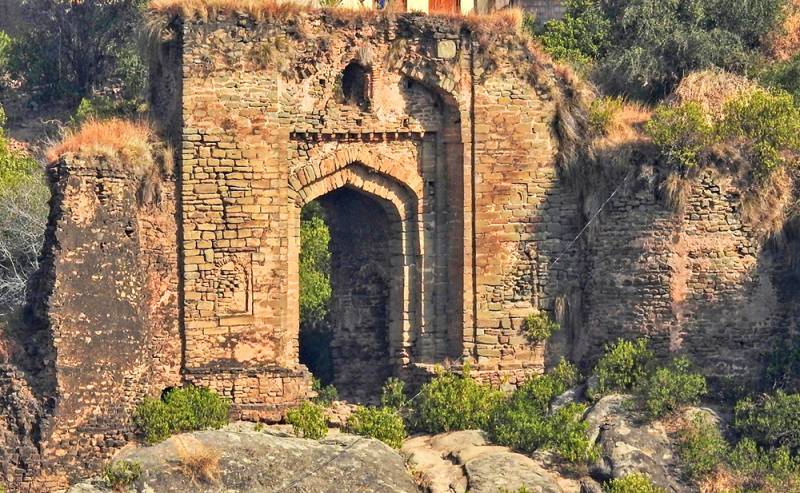
The Pharwala Fort, even though in extremely bad shape, had six gates at one time namely: Bagh Gate, Hathi Gate, Qila Gate, Lashkari Gate, Begum Gate, and Ziarat Gate. Only three now survive
Other than Pharwala Fort, the Gakhars are believed to have built many tombs, mosques, and forts, which are in many villages of Potohar. Some of the forts still dot the landscape of Potohar. The Fort was entirely renovated by Hathi Khan Gakhar, one of the Chieftains of this tribe. He was the first Gakhar Ruler of the dynasty who fought against the Janjua Rajputs and drove them away from the present tehsils of Kallar Syedan, Kahuta, and Rawalpindi. During the reign of Hathi Khan Gakhar, Zahiruddin Babar the first Mughal Emperor attacked and captured Pharwala Fort in 1519. Later, Babar returned the Fort to Hathi Khan when both sides reconciled. History records that in the battle between the armies of Gakhars and Babar, many Gakhar soldiers laid down their lives fighting bravely. Their graves and tombs are in the four villages of Islamabad. Two graves are located at Bagh Jogian, one near the mosque of Mai Qamro and another close to the tomb of Sultan Mukarab Khan. The third graveyard is situated inside the fort.
The Pharwala Fort, even though in extremely bad shape, had six gates at one time namely: Bagh Gate, Hathi Gate, Qila Gate, Lashkari Gate, Begum Gate, and Ziarat Gate. Only three now survive. The three remaining gates which can be seen from far away need urgent attention from the archeology department to preserve them for the ever-inquisitive tourists and the new Ghakar generation. The tomb of Sultan Mukarab Khan is within walking distance from the mosque of Mai Qamro one of the first mosques in that area. The tomb of Sultan Mukarab Khan is unique in terms of architecture as it is octagonal with a portico. One finds many historical tombs and funerary wall enclosures in various villages and towns in Potohar.
Amir Aaqib (Indebted to him for sharing to carry my backpack) and Wilma Van Der Maten had planned the tour of Pharwala Fort in a manner that a small group of inquisitive travellers would gel in a manner as if they had known each other for ages. This is exactly what I experienced, that comradeship had developed in less than a day, and at lunch where we all shared personal anecdotes with our eyes transfixed at the towering Pharwala Fort overlooking Soan River. I am anxiously waiting for the group to travel to Rohtas Fort (103 kilometers) from Islamabad), which is waiting to share its tale on Gakhars. Wait for my next narration, I promise that it shall be equally educative. The journey continues, ‘another city, another town’!