

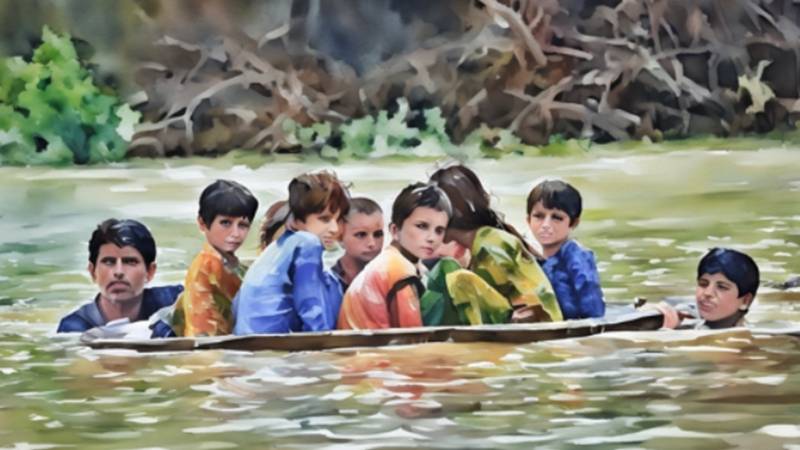
Monsoon rains have pounded Pakistan, especially the Punjab province, causing human and infrastructural casualties in terms of deaths, destruction, and displacement. According to the National Disaster Management Authority (NDMA), 234 people have lost their lives and 596 have been injured. Moreover, 826 houses have been damaged while 203 livestock have been killed since 26 June. Of the 234 deaths, 79 were men, 42 women, and 113 children. Nearly half of the climate-induced human toll is comprised of kids.
Climate change spells disaster for children in every imaginable way in Pakistan. Despite being least responsible for this unfolding catastrophe, children bear the brunt of the climate-induced impacts stemming from torrential rains, drought, and heatwaves, among others. Like elsewhere, child poverty is a major cause exacerbating the existing vulnerabilities being faced by the future of Pakistan—the children. They live in low- to middle-income households. They already face nutritional issues and hence are vulnerable due to malnourishment. Besides, they lack access to awareness needed to cope with climate change. As a result, they are facing a plethora of problems.
A public school teacher, on condition of anonymity, said, "They (students) come clumsily and sit idly, suffocated. The learners are unable to concentrate on academic activity. They keep complaining of excessive heat and subsequent suffocation. Despite efforts, various students in the class can't keep up when it comes to learning. These learners come from lower socio-economic backgrounds, hence have no infrastructural facilities at home, let alone a solar power system necessitated by eighteen to twenty hours of load-shedding in rural Sindh." He lamented that the new generation was facing multiple crises including the harms of climate change, with no sustainable solution in the foreseeable future. Another teacher who asked not to be named said, "In May, sitting in the crowded class with no electricity and solar power was like sitting in a kiln with baking stuff all around.
Educational Disruption
The hubs of academic engagement and personality development called schools are either temporarily closed or transformed into climate refugee camps in areas battered by abnormal monsoon rains. It thus negatively impacts the education of those enrolled in educational institutions, undermining their academic activity. We reportedly have the highest number of out-of-school children in the South Asian region. Those enrolled are lacking in terms of learning outcomes. Still more, climate change negatively impacts their academic activity as well as physical well-being.
Crumbling operational infrastructure and governance suggest that we learned no lessons from past catastrophic conditions faced in 2022
In the 2022 monsoon of biblical proportions and subsequent fury of floods dealt a deadly blow to education in the country. According to Save the Children, a UK-based organisation, over 18,500 educational institutes had been partially damaged or completely destroyed by the torrential rains. The academic year of more than 670,000 students was in limbo—not to mention the COVID-19 closure of learning centres.
Heatwaves Undermining Learning Outcomes
The learning outcomes are already in shambles in our public sector educational institutions due to outdated teaching methods, a lack of teacher training, underfunding, and stepmotherly treatment in terms of infrastructural development and provision of basic facilities across the country. The poor picture in question may vary, but it’s not fundamentally different across all federating units. The climate-induced weather is exacerbating the already fragile academic engagement.
Various senior teachers rendering their services in Taluka Bahrani, District Larkana, believe that under an intense and prolonged heatwave like the one we experienced this year across provinces, children face concentration issues. They struggle to retain their daily academic engagement. They said that children facing prolonged heatwaves not only drop out temporarily but also partly do home assignments or falter completely. This prompts the teaching staff to decrease the amount of teaching under the heavy weight of lethargy—a product of unfriendly weather. Besides, such heatwaves limit them to the four walls of their houses, ultimately depriving them of their playing time and social interaction with children of their age. There is no denying that reduced time for socialisation will have complications for their later practical life.
According to UNICEF Pakistan, an estimated 22.8 million children aged 5-16 are out of school. Currently, Pakistan has the world's second-highest number of out-of-school children (OOSC). Many among them become breadwinners—working as kiln workers, mechanic's helpers, and hotel waiters, etc.—following their parents' financial difficulties and debt trap. Instead of carrying a school bag, they shoulder a heavy bag of burden called earning bread in their formative phase and are thus deprived of their childhoods and subsequent playing time with children of their own age. Carrying heavy bags of burden, earning instead of learning, in tender age has a crippling impact on their physical and mental well-being.
There are various reported cases of children being subjected to violence and sexual harassment, especially those working in homes as servants. They work long hours but are underpaid and overworked. Economic deprivation has tucked them into modern slavery. They wither away in their youth. Article 11 of the Constitution of Pakistan prohibits slavery and forced labour. Despite this, almost 70 percent of bonded labourers in Pakistan reportedly are children, estimated to number over one million. Thus, the established political order has failed the young generation.
On the one hand, there are children deprived of education—out-of-school children—and on the other, those enrolled are not learning properly. As a result, both are deprived of upward social mobility and economic prosperity that education can bring. Their deprivation of education is a violation of Article 25-A of the constitution that ensures free and compulsory education. We feel shame at international forums when we are reminded that we are a country that harbours the world’s second-highest number of out-of-school children.
Erratic Weather Events Unleashing Multiple Health Hazards
Climate change undoubtedly impacts child health, increasing risks for diseases related to malnutrition, respiratory issues, and infectious diseases. Erratic weather events like droughts and floods increase these risks by disrupting access to clean water, food, and healthcare. Besides, increased air pollution due to climate change intensifies respiratory problems like asthma and pneumonia in children.
"During heatwaves, adults are prone to sunstroke and dehydration following their exposure to sunlight, especially the labour class engaged in agricultural work and the construction industry. Whereas, since children are in their formative phase in terms of physical growth, they are sensitive to various diseases as their bodies heat up and suffocate, ultimately impacting their physical well-being," said a senior paediatrician working in a PPHI-run Taluka Hospital in Larkana District. "After floods, stagnant water becomes a breeding ground for mosquitoes, hence malarial diseases intensify," he added further.
It is to be noted that flash floods and torrential rains destroy critical healthcare infrastructure. Flood affectees, especially those living in far-flung areas and indigenous people, face difficulties in terms of availing the healthcare they need. Laura Mills, Researcher with Amnesty International's Crisis Response Programme reportedly said, "Pakistan's healthcare system is woefully under-funded and overstretched, even in non-emergency times. The climate emergency creates an extra strain that is unbearable, and the system is failing to deliver adequate care to those in need."
Addressing Climate Impacts on Children
If we care about children, their future, their well-being, and their insulation from climate-induced difficulties, we need to revisit our prevailing system and subsequently prioritise climate-adapting strategies. This includes making mechanisms that can ward off child poverty and consequent crises they are facing. During the climbing curve of climate impacts like heatwaves, school timings should be reduced, and infrastructural development should be prioritised, such as ensuring electricity or solar power and subsequent systems for fans, and cold drinking water.
In the face of the recent heatwave in Sindh province past May, Deputy Commissioners were entrusted to announce temporary school closures or reduce timings, keeping in view the ongoing environmental onslaught faced by school-going children. Under such circumstances, citizen participation is of paramount importance in terms of understanding particular areas and the erratic weather patterns inducing hot and humid weather. Bureaucrats are to a great extent detached from prevailing conditions and ground realities, deciding while sitting in their air-conditioned offices.
Challenges in Dealing with Climate Crises
It would not be an exaggeration to suggest that we are a country lacking much-needed resources, manpower, machinery, etc. Dealing with crises stemming from abnormal monsoon rains and cloudbursts is beyond the strength of governments (federal and provincial). After every crisis, we wake up to sleep again till the next monsoon rains start battering Pakistan. We see the same scenario—people crying against alleged indifference and inadequate measures in terms of rescue and relief operations. It is no exaggeration that our institutional performance in terms of rescue and relief operation does not match with the enormity of rain-related emergency.
Post-disaster operational management is beyond the strength of the authorities concerned. But a question arises: Did the authorities concerned do their work prior to heavy monsoon rains in terms of identifying vulnerable populations and evacuating them to safer places? Lesson-learning and given our insufficient institutional infrastructure, it was imperative to identify the vulnerable areas. We start work in the face of the enormity of the onslaught of rains after their ferocious downpour. Successive governments sit satisfied that weather forecast alerts and warnings have been issued by the Met office and the National Disaster Management Authority (NDMA), respectively. Alerts and warnings such as these are not a panacea for our climate-related preparedness. Vulnerable sections of the population are not connected to media given their busy professional engagements and limited world view. Those at the helm of the country's affairs and provinces need to understand this local ecosystem.
Given ill-planned housing projects, a poor drainage system, and a non-existent flood drainage system, it is demanded that the authorities concerned identify the susceptible population and those living in slum structures. Many people on social networking sites are highlighting the flooding in Texas apparently to convince the public that torrential rains and consequent damage to property and human casualty are normal in the given circumstances. However, they forget that developed democracies like the superpower in the world are good at mitigating mechanisms, evacuating, rescuing those trapped, and ensuring relief operations. Whereas, our institutional capacity in terms of coping with the climate-induced emergency has been lacking. Besides, the developed countries can afford the economic cost of climate-induced damages. But we are a country with a fragile economy that can't sustain the financial pressure in question.
This catastrophe emanating from climate change is not a punishment from God for our sins. This is a punishment of our own political and operational actions that include but are not limited to: paying no attention to climate call, indifference to the marginalised sections of society in terms of economic patronage and infrastructural development in their areas, ill-preparedness, infrastructural inefficiencies, and failure in terms of prioritising pre-disaster mitigating mechanisms ultimately compounding the climate-induced problems faced by the population. Various problems stem from ill-advised housing projects, encroachment upon banks of rivers, streams, drainage nullahs, riverbeds, blocking natural waterways, and lack of flood drains.
International Organisations Sounding Alarm Bells
While highlighting the looming disaster for the children, UNICEF, in a statement to the press on past Thursday, expressed grave concern over the devastating monsoon floods in Pakistan, which have killed 85 children and injured 162 since 26 June. In the past 24 hours alone, 22 children died in Punjab due to collapsing homes caused by relentless rain. Accelerated glacial melt from record-high temperatures (48.5°C) and torrential rains have triggered widespread flooding, posing life-threatening risks to children, including drowning, electrocution, and disease. UNICEF warns that climate change is making such disasters more frequent and deadly, with Pakistan ranked 14th globally for climate risk to children. The agency is working with authorities and partners to provide emergency aid, including health, nutrition, and clean water support.
Reportedly, an analysis published by the 'Save the Children' charity shows the number of children experiencing crisis levels of hunger due to extreme weather has doubled over the past five years. The latest data indicates a 20 percent rise in "crisis" phase hunger in 2023 alone—bringing to 33 million the number of children affected. That number was 13 million in 2018. According to Save the Children, those impacted live in 18 countries where climate events such as droughts, cyclones, and floods are the primary drivers of food insecurity.
Child Rights Crisis
"At its heart, the climate crisis is a child rights crisis," said Jack Wakefield, the charity’s global policy lead for climate change. "Children are at huge risk, despite being the least responsible for soaring global emissions." Inadequate food supplies put children at high risk of acute malnutrition, which can cause stunting, increase their susceptibility to diseases, and impact their mental and physical development. Malnutrition remains one of the biggest killers of children under five around the world.
Hunger aside, climate events themselves also affect children, warned Save the Children spokeswoman Emily Wight. "Extreme heatwaves in recent weeks have led to the closure of schools in many countries, while terrible floods have displaced many children," Wight said.
Heatwaves Affecting Children is a Global Concern
Global warming is a global concern, especially that of the Global South, as it is in the eye of the environmental storm. Reportedly, about 460 million children are exposed to extreme heat in South Asia, or 76 percent of children, compared to a third of children globally.
"With the world at global boiling, the data clearly show that the lives and well-being of millions of children across South Asia are increasingly threatened by heat waves and high temperatures," said Sanjay Wijesekera, UNICEF Regional Director for South Asia.
The UN warns children in Afghanistan, Bangladesh, India, Maldives, and Pakistan are at "extremely high risk" of the impacts of climate change, defining extreme high temperatures as 83 or more days in a year over 35 degree Celsius (95 degree Fahrenheit). Children cannot adapt as quickly to temperature changes and are not able to remove excess heat from their bodies.
"Young children simply cannot handle the heat," added Wijesekera. "Unless we act now, these children will continue to bear the brunt of more frequent and more severe heatwaves in the coming years."
Statistics About Climate Change and Children
Reportedly, "the climate crisis magnifies inequality, poverty, displacement, and may increase the likelihood of conflict. 90% of diseases resulting from the climate crisis are likely to affect children under the age of five. By 2050, a further 24 million children are projected to be undernourished as a result of the climate crisis. By 2040, it is estimated that one in four children will be living in areas with extreme water shortages. Almost 160 million children are exposed to increasingly severe and prolonged droughts. The education of around 38 million children is disrupted each year by the climate crisis. The climate crisis is forcing families to migrate. By 2050, there could be 143 million more migrants due to the climate crisis."
Understanding Multiple Causes and Effects
The glacial melt accompanied by torrential rains pounded Pakistan, with Punjab being hit hardest. The more we interfere with Mother Nature's order in terms of blocking natural waterways by encroachment, cutting down forests and trees—natural shields when it comes to mitigating floods—the more dire the consequences will be in every imaginable way. The present picture of human and infrastructural casualty is just the tip of the iceberg. Remember the ravages of rain and fury of floods and consequent catastrophic conditions that we have witnessed before.
Dealing with climate-related emergencies is a small part of a bigger issue. A food crisis also looms large as we see paddy crops, wheat, and mango orchards are also feeling the heat of erratic weather and subsequently losing harvests to a considerable amount. If it aggravates, it might unleash food insecurity. It has to be acknowledged that those already left on the margins will be the victims of climate-induced food scarcity and subsequent inflation, including children given they belong to economically disadvantaged households. Price hikes caused by climate-induced impact on crops and vegetables will negatively impact the physical growth of children following diminishing purchasing power of their parents.
Not only this, during monsoon rains-related road connectivity issues and subsequent disruption in the supply chain, manipulators in the market fleece the public by raising prices of commodities, which also puts extra monetary burden on the purse of those already facing economic hardships. It is to be noted that the climate crisis is causing food price spikes around the world.
Children and our dear country are sailing in the same boat as both are bearing the brunt of climate-related impacts despite being not responsible in terms of carbon emissions/greenhouse gases that unleash environmental disaster and dire consequences to be grappled with. Once the damage is done, taking an aerial view, visits of VIPs neither can solve the climate-induced troubles for the climate victims nor can those assess the psychological trauma the affected people are facing. Such visits are aimed at grabbing headlines in the newspapers and optics.
The climate call is not distant. It is here with us. We can't afford to turn a blind eye to the ecological call called climate change. Adaptation measures are needed to navigate children away from death, destruction, displacement, and deprivation triggered by the climate crisis. The public should also show maturity in terms of avoiding visits to hotspots of landslides caused by torrential rains in upper parts of the country.
It was disturbing to note that the public continues to neglect weather alerts and warnings issued by the authorities concerned, which can be gauged from the fact that scores of people thronged to tourist resorts after having neglected cautionary calls and were subsequently trapped in floodwater, and some were swept away. Various news channels chose to show the desperate people and their drowning scenes, quite in contravention of ethical principles.
Public health experts believe that the image of drowning and fear of drowning unleash a psychological burden on the young population, especially those of tender age. They cautioned against graphic images of drowning scenes being shown by electronic media. Following the tragic drowning of several people in the River Swat, former climate change minister Senator Sherry Rehman said that the continued "sleepwalk" on climate stress was triggering such incidents.
She added further, "We need to understand that this and other disasters are deadly impacts of super heavy monsoon in Swat, all triggered by climate stress, and it is not just one area." Rehman also said that the district and provincial administration had alerted but "early warning systems are being ignored by the general public in KP."
"Pakistan needs to understand that such hazards are triggered by global warming and climate change… So please stop calling it a natural disaster or a random flash flood that is disconnected from human actions or responsibility."
Sustainable Solution
Children's overall well-being, their life, learning, education, psychological development, intellectual engagement, health, and happiness are at stake. To weather this storm called climate change requires lesson-learning, investment in human development, especially uplifting the marginalised sections of society living in rural Pakistan, and ending child poverty.
Like a political chessboard, the ecological switchboard is complex but not impossible to turn the tables. We need to pull and push the right buttons. We need to pull the buttons for climate-resilient and eco-friendly approaches, a resilient engineering model, ensuring green belts, and switching off buttons of child poverty and discriminatory infrastructural and economic model.
We have a history of mourning over the disease-stricken body instead of taking the ill to the hospital. This must stop in the interest of the vulnerable population, including children. We need pre-disaster mitigating mechanisms and finding sustainable solutions to problems triggered by climate change.
Crumbling operational infrastructure and governance tell a tale of learning no lessons from the past catastrophic conditions that we faced in 2022. National and institutional commitment is lacking. We need a scientific approach and infrastructural resilience to navigate the vulnerable population and the children of a lesser god.
The established political system that has socially and economically divided the country into elitist and poor suburbs, and kept public schools underfunded and underdeveloped, where children of the ordinary citizens enrol, should be discarded. And this should mark the beginning of the end in terms of insulating children from deprived circumstances in every context.
Climate change-induced catastrophic conditions negatively impact those hailing from humble economic backgrounds, and the farming community, who are losing livestock, homes, and standing crops or reaping poor harvest due to erratic weather, rather than those living in gated communities and engaged in big businesses. Poverty is the product of the unequal distribution of national wealth and resources.
Ending child poverty is a no-brainer: ensure democratic distribution of wealth, support parents of children tucked into beggary through social protection, and implement legal laws that safeguard children from bonded labour. They belong in schools and playgrounds, not agricultural fields, factories, mines, domestic work, and begging. Social safety is a panacea to ills besetting the vast majority, including children in poverty.