

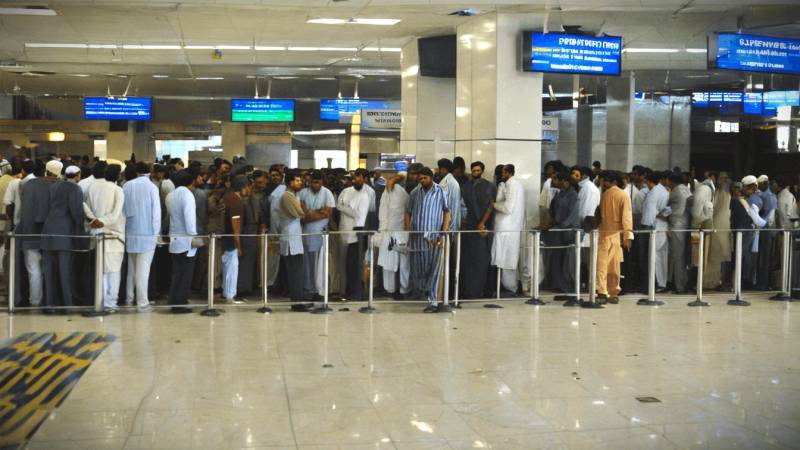
Every year, thousands of Pakistanis leave for foreign labour markets hoping to earn, survive, and uplift their families. Most depart with barely a certificate, few marketable skills, and little understanding of the contracts they sign. Yet they form the backbone of Pakistan’s remittance economy, sending home over $30 billion annually. Their journeys, while essential, are riddled with hardship and exploitation. At the core of this systemic crisis lies an overlooked culprit: weak foundational learning.
Foundational learning refers to the basic competencies acquired in early education (i.e. reading, writing, arithmetic, and problem-solving) that enable individuals to access knowledge, understand systems, and adapt to changing circumstances. When these skills are absent or poorly developed, their consequences stretch far beyond school walls. They shape whether individuals can absorb vocational training, secure decent work, assert their rights, or safely migrate. For Pakistan, this foundational deficit silently erodes the well-being and dignity of its outbound workforce.
Labour migration from Pakistan is heavily concentrated in Gulf Cooperation Council countries, including Saudi Arabia, the United Arab Emirates, Qatar, and Oman, where Pakistani workers are overwhelmingly recruited into the construction sector. It is one of the most physically hazardous and poorly regulated labour domains. Migrants toil for long hours under extreme temperatures, with under-utilised safety equipment and incomprehensible safety protocols. Injury rates are high, and legal protections are mostly inaccessible due to an enfeebled basic education. The vulnerabilities here are not just circumstantial; they are structural. Many workers cannot read the contracts they sign, and have little knowledge of local labour laws and legal provisions. Most of the migrant workers struggle hard to communicate with supervisors and are unable to access grievance channels. Their inability to navigate these systems stems not from apathy, but from systemic educational neglect.
Pakistan’s foundational learning crisis is well documented. According to ASER Pakistan’s 2024 survey, nearly 60 percent of children in grade five cannot perform grade two-level reading and arithmetic. These deficits are deeply entrenched—not only in remote regions, but in migrant-sending districts across all provinces. In such conditions, vocational aspirations suffer. Technical and skills training programmes become hollow rituals, attended but rarely internalised. Workers may complete courses in masonry, plumbing, or electronics, but without basic literacy or numeracy, they cannot apply the knowledge effectively. They are unable to follow instructions, calculate dimensions, or manage tools with precision. The promise of vocational training fades, not because it is unnecessary, but because it is built on an unstable educational foundation.
If we continue to send the untrained into the unknown, every remittance will be paid for in risk, broken dreams, and tragedies
The vulnerabilities extend into financial and social domains. Migrant workers often borrow heavily to fund their travel and placement, e.g. paying recruitment agents, securing travel documents, and arranging initial housing. With almost no financial literacy and limited numeracy competence, migrants are unequipped to evaluate these risks or project long-term implications. Debt bondage begins at home, and often deepens abroad. Once in host countries, language barriers and cultural misalignment compound these hardships. Without basic communication skills or confidence, migrants remain isolated from support systems. They are unable to seek medical care, understand safety briefings, or access legal redress. Their marginalisation is not due to unwillingness, but unreadiness.
Recruitment agents and subcontractors exploit these vulnerabilities. Operating in loosely regulated environments, many deploy workers to jobs mismatched to their skill level or undocumented in their contracts. When conflicts arise, workers lack the literacy and legal understanding to respond. Their weak foundational learning becomes the shield they never had.
The implications ripple through families and communities since migration is often a household strategy triggered by poverty or opportunity gaps. Fathers leave, children drop out, and women absorb the economic and emotional strain. Education suffers, and so does aspiration. Children of migrant families frequently experience interrupted schooling. With limited resources and inconsistent parental oversight, they cycle through informal labour and domestic support roles. Migration becomes an inherited survival strategy. Not a choice, but a necessity. The education system fails not once, but across generations.
Pakistan’s institutional response remains fragmented. Education policy rests with provincial departments. Overseas employment is managed federally through entities like the Bureau of Emigration and Overseas Employment. Vocational initiatives operate in parallel, often underfunded and irregular. Recruitment regulation is sporadic and vulnerable to private manipulation. No national framework meaningfully links foundational education with migration preparedness. Contrast this with China, where mass literacy campaigns, compulsory schooling, and structured vocational channels transformed the rural labour force. Chinese workers abroad are not just labourers. They are skilled technicians and supervisors, offering high-value services backed by systemic investment.
Pakistan continues to export labour without first building capability. To shift the migration narrative from vulnerability to empowerment, reforms must begin at home. Foundational learning in migrant-sending regions must be expanded through community-based and non-formal education models such as accelerated learning centres, mobile classrooms, and localised tutoring that offer flexible entry points for out-of-school youth and low-literacy adults. Strengthening these skills creates the baseline upon which vocational and migration readiness can grow. Structured pre-departure orientation is equally critical.
Before departure, especially to high-risk sectors like construction, migrants should receive mandatory orientation covering safety protocols, basic legal literacy, cultural acclimatisation, and financial planning. Delivered in local languages and through interactive formats, such sessions can build retention and ensure application. Recruitment must also be ethical and tied to verified skills and transparent contracts. Recruiters should be accredited and monitored, with contract terms explained in language the worker understands and placements matched to competency standards.
These reforms are not just humanitarian; they are economic. A skilled worker earns more, remits more, and represents Pakistan with pride. An unskilled one merely survives. Pakistan’s labour export strategy cannot be measured solely in numbers or defined by remittance volumes. It must reflect dignity, safety, and occupational excellence. Foundational learning is no longer a peripheral issue. It is central to migration success.
The future of migration does not begin at the airport but in the locations of origin. If Pakistan is to raise its global labour profile from toil to expertise, it must first equip its citizens to read, to count, to communicate, and ultimately, to provide productive services. If we continue to send the untrained into the unknown, every remittance will be paid for in risk, broken dreams, and tragedies. Learning is the passport. It is time we stamped it with purpose.