

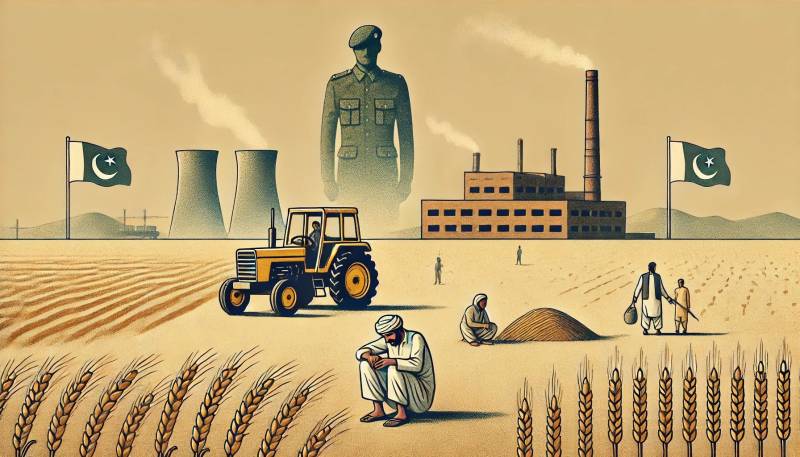
The decade of the 1990s was the worst for the Pakistani poor. In 1988, parliamentary democracy was restored in Pakistan after military dictator, General Zia-ul-Haq, was killed in a plane crash. Benazir Bhutto and Nawaz Sharif took turns becoming Prime Ministers one after another between 1988 and 1999. Economic and industrial slowdown, devastation of the agriculture sector, and substantial reduction in foreign remittances due to the First Gulf War as Pakistani workers and laborers were sent back home from oil-rich countries, caused a substantial rise in poverty in Pakistani society. Political instability is counted as another major cause of the loss of economic growth and increase in poverty in the 1990s. The policy was inconsistent, reforms were interrupted, and no government lasted for more than three years during this period. The result was an economic slowdown and a consequential rise in poverty.
According to credible studies and government reports by the year 1999, “the incidence of poverty had climbed back to 36 percent of the population. Since the population increased to 131 million, the number of people living in poverty reached 47 million”. On the other hand, no military government in Pakistan’s history has lasted less than nine years, ensuring consistency in policy, uninterrupted economic reforms, and political stability in the graveyard.
After the 1971 debacle, Bhutto remained in power for a major part of the 1970s, when in 1977 General Zia imposed martial law in the country. He remained in power till August 1988 when he was killed in a plane crash. Civilian rule was restored in 1988 when Benazir Bhutto became Prime Minister after her party secured the majority in parliamentary elections. Till rule continued till October 1999 when the then Prime Minister Nawaz Sharif was deposed by a military general Pervaiz Musharraf who again imposed martial law.
Pakistani economists generally believe that “the declining trend of poverty during the 1970s and 1980s was reversed during the 1990s”. More than the civilian rules preceding or following General Zia-ul-Haq’s 11 years, it was General Zia-ul-Haq's government’s economic performance that made a historic and substantial dent in the logjam of poverty in Pakistani society. This does not mean that the military Junta was any more pro-poor than the civilian rules preceding or following it. General Zia’s economic policies gave a lot of leeway to the private sector and provided it with a generous amount of subsidies to businessmen, big traders, and industrialists. This generosity towards big money continued in the period of civilian rule that followed General Zia’s 11 years. Neither during Zia’s rule nor during the 11 years of civilian interlude were any notable government policies introduced to alleviate poverty in our society. Elder Bhutto’s government is generally considered the most pro-poor government in Pakistan’s history. But despite its rhetoric of being pro-poor, it hardly succeeded in making a substantial contribution to reducing the society primarily because the growth rate declined during this period relative to Ayub Khan’s era.
As a result of Bhutto’s policy of increasing investment in the public sector—which was and is still considered the most unproductive part of our economy by Pakistani experts—the productivity of investment declined substantially, “A large proportion of this investment was going into unproductive spheres: Defense and public administration were the fastest growing sectors of the economy (11.4 percent) while the commodity-producing sector was growing at only 2.21 percent during the period”. During Bhutto’s period, according to Shahid Javed Burki, Washington based Pakistan expert, “Pakistan's population had increased to 72 million of which 28 million were poor. This was six million more than in 1969”.
Zia was lucky- substantial inflow of US and Western financial assistance, a construction boom in Gulf states that attracted Pakistani labor who in turn started sending substantial remittances back home, and a revival of economic activity in the country following a slowdown of industrial and business activity in Bhutto era due to his anti-business policies—in reducing poverty levels substantially, “The Zia period ended in August 1988, with his death in an air crash. At that time Pakistan had a population of 97 million, of which about 18 per cent or 17 million were poor. This was a remarkable development. While the size of the population in these 11 years increased by 25 million, the number of poor declined by 11 million” reads Shahid Javed Burki’s newspaper column written in 2004.
Why was the decade of the 1990s the worst for the Pakistani poor? Zia years’ gains were all reversed—growth nosedived, there was collapse of agriculture production due to drought, foreign remittance from the Gulf States dried up due to the First Iraq War, Washington imposed military and economic sanctions, tensions with India damaged the business environment, and unstable Afghanistan on our western border and deteriorating political and security situation all contributed. Pakistan Institute of Development Economics (PIDE) quoted some figures in its 2021 Report on the State of Poverty in Pakistan, “According to some estimates, the number of poor increased by 12 million people during FY1993 to FY1999. During FY1999, economic growth and development were halted due to severe drought in the country.
Some Pakistani economists think that the slowdown in private sector investment during the Bhutto era was less a product of his nationalisation policies and more an outcome of the 1965 war on the insecure business environment in Pakistani society
Rural areas have relatively higher levels of poverty than urban populations, as experienced historically. The rural population engaged in non-farm activities was estimated to be 40% of the total population and was affected due to slow economic growth, low public sector development spending, and low remittances” reads the report of PIDE. “This trend was reversed during the 1970s with falling poverty level and increasing income inequality. This trend continued in the 1980s with poverty falling further and increased income inequality. But the gains of poverty achieved in two decades were reduced drastically during the 1990s, increasing the poverty rate to 12% over the decade, bringing almost one-third of the population under the poverty line.
The substantial decrease in economic growth during the 1990s was the major factor behind this rise in poverty in the country, “These increased poverty levels during this decade are highly correlated with low GDP growth rates pertaining to the shocks of 1992-93 and 1996-97. During the end of 1990s the rural poverty was raised to a much higher level of 33% as compared to 30% for urban poverty. Inequality both in rural and urban areas was also immensely increased during the 1990s which amplified the negative impact on poverty due to decreased economic growth during this period” read the PIDE report of 2021.
The Bhutto period, despite its pro-poor pretensions, was less beneficial for the Pakistani poor than the avowedly pro-rich military government of Zia-ul-Haq as the abovementioned figures from credible sources make it clear. But the Bhutto period was not a water-tight compartment of Pakistani history. It had to live with the legacy of the two highly inapt military governments, whose regional military adventures made the Pakistani economy pay for the misdeeds of the military Juntas that ruled Pakistan in the 1960s and early 1970s. Some Pakistani economists think that the slowdown in private sector investment during the Bhutto era was less a product of his nationalisation policies and more an outcome of the 1965 war on the insecure business environment in Pakistani society. Some of the studies point out that the slowdown in private sector investment, which in turn slowed down economic growth and aggravated the poverty situation in society, could be attributed to the impact of the 1965 war between Pakistan and India, and this trend continued till the 1990s.
The God-sent misfortunes that befell civilian government in Pakistan’s history include a contraction in agriculture production in the 1990s, which aggravated the poverty situation in the society, the First Gulf War, which reduction in foreign remittance and thus contributed to the rise of poverty, lastly, COVID-19 pandemic which substantially impacted the poverty situation in the country. All this misfortune happened during civilian rule, “In the given scenario, COVID-19 poses huge implications for the poor and vulnerable segments of the society. It will substantially increase poverty levels across the country. Using a simple econometric model, it is estimated that the poverty rate has increased from 21.5% in 2018-19 to 26% in 2019-20. Poverty in urban areas has increased from 10.7% to 15.2%, and from 27.6% to 32.2% in rural areas from 2018-19 to 2019-20” reads a UNDP report. Pakistan’s military governments, on the other hand, were extremely lucky when it came to positive developments that helped them succeed in their efforts to increase the economic growth rate. In this situation, even when all three militaries were pro-rich, the higher economic growth rates during their tenures helped them reduce poverty, though the difference was insignificant in real terms.
The slogans of a corruption-free society are the intellectual luxury for the middle and upper classes—as these classes live in the bubbles of morality, ethics, and nationalism
Unfortunately, Pakistan’s democratically elected civilian governments were no less pro-rich—except for the Zulfiqar Ali Bhutto government—than the three military governments in our history. By the time Benazir Bhutto became the prime minister in 1988, Neo-liberalism was in full control of the reins of power in Washington and the rest of the Western European world, and the Western world was about to claim victory in the Cold War. Benazir Bhutto was completely under the influence of neo-liberal thought and her policies were a continuation of the military government’s inclinations towards a free market economy. She continued to pay lip service to the cause of poverty and labor while dropping crumbs for these segments of society on her way to hobnob with those who represent big money in society. Poor, in this situation, were considered the recipients of rich people’s generosity. They were not seen as a massive force that could transform the economic scene of society if their economic potential were utilised systematically. The result was several programs of cash transfers and subsidies to the poor. Never during this period of civilian interlude did any systematic attempt be made to recruit the poor for the economic transformation of society.
Pakistan has always been a highly unequal society. But in the post-Zia period, a political class emerged—seeds of the emergence of this class of politician could be traced to the Zia era—which was filthy rich and the gap between the riches of this class and the people they claimed to be leading in the political arena was astronomical to the extent of being scandalous. In our political culture, a political leader is not considered a political leader if he is not riding a sports vehicle and is surrounded by guards carrying expensive American rifles, if he doesn’t have a farmhouse in the vicinity of the city or area where he does politics if he doesn’t have a foreign bank account or a commercial plaza in Dubai. This gap between the financial positions of leaders and those they lead is itself scandalous—the leaders are penniless, propertyless, and jobless voters or supporters of rich politicians. Even if we ignore how these riches have been accumulated, we cannot ignore the political, moral, and ethical aspects of the gap between rich leaders and poor people they are leading.
The poor people have economic, social, and political interests in the equitable distribution of wealth and a more urgent interest in the equitable distribution of income, something which strikes at the roots of the political and economic interests of the rich leader. This rich political leader, who has vast propaganda machinery at his or her disposal, is clearly deceitful in diverting the attention of the poor people he or she is leading away from the issues related to equitable distribution of wealth and income in our society. The problem is our existing major political parties don’t even talk about income or wealth inequalities. They use religion, nationalism, and the glitter of their wealth to intoxicate their voters and supporters. Evidence indicates that wealth inequality is more pronounced than income inequality in Pakistani society, “The share of total household wealth of the top 10 percent is almost three times the share of the total income of the top 10 percent. Moreover, each income decile holds at least 5 percent of income share (see, income bars). In contrast, 83 percent and 96 percent of the nation’s wealth is held, respectively by the top 20 percent and 40 percent of the households” reads a report by Mahbub ul Haq Research Centre at LUMS.
The reaction of the poor, as was expected, turned out to be swift for those who were, in public perception, associated with extreme riches. Imran Khan and his anti-elite campaign was a fabulous success in the 2024 parliamentary elections. The problem is Imran Khan is himself part of the elite he appears to be campaigning against. Morality has a weak influence on public opinion in our society. It doesn’t matter whether the extreme riches you and your family are enjoying or displaying are an outcome of ill-gotten money or whether you have earned it through fair means. Even if you have earned it through fair means, the gap between your financial position and that of the people you are leading is still scandalous. It is only a matter of time before you are exposed to after the poor and downtrodden have inflicted their revenge on the ostentatious rich at the hustings, and the helplessness of that multitude who live below poverty is avenged through the ballot or (God Forbid) bullet, in more extreme forms.
The political and social unrest that we see in our society might, at this moment in our history, have devoured the election prospects of Sharifs only. However, the resentment that stems from the social and economic reality of living below the poverty line will devour other victims. The slogans of a corruption-free society are the intellectual luxury for the middle and upper classes—as these classes live in the bubbles of morality, ethics, and nationalism. The moral world of the downtrodden is very different. Conventional morality does not work here. The downtrodden will become foot soldiers for someone else’s political adventure the moment Sharifs are removed from the political scene. Their hatred and resentment will find some other target, more ostentatious and more vulgar in the display of their riches—until and unless we change the social and economic structures of our society and make it more equal in terms of income and wealth.