

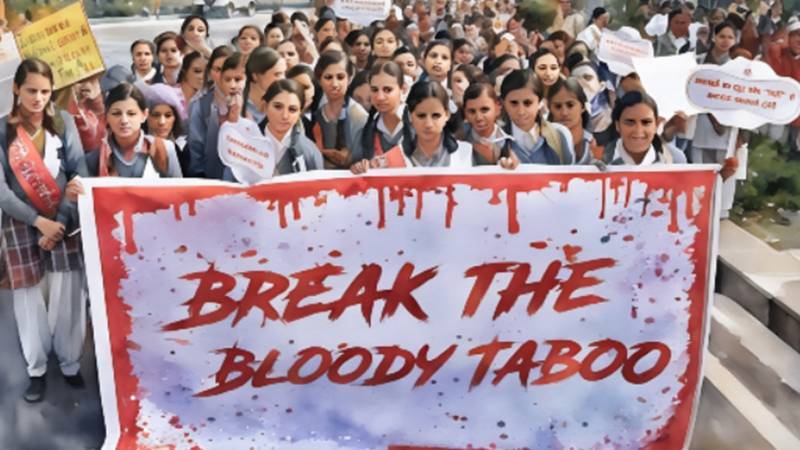
Menstruation remains a deeply stigmatised subject in Balochistan, where cultural taboos, lack of education, and inadequate healthcare infrastructure exacerbate menstrual discrimination. Despite growing global discussions on dignified menstruation as a fundamental human rights issue, the province continues to struggle with systemic neglect. This feature explores the lived experiences of women in Balochistan, expert opinions, and official responses to understand the gravity of the issue and the path forward.
"In our village, talking about periods is considered shameful. Even mothers don’t openly discuss it with their daughters," says Shaista Baloch, an 18-year-old student from Turbat. "We use old rags because sanitary pads are either too expensive or unavailable. Many girls miss school because of this."
Shaista’s experience is not unique. According to a 2022 report by a local NGO, around 70% of girls in rural Balochistan lack access to menstrual hygiene products, forcing them to use unhygienic alternatives. Many schools do not have basic sanitary facilities, making it difficult for menstruating students to attend classes comfortably.
Experts argue that menstrual discrimination is closely linked to gender-based violence and systemic inequalities. Dr Nargis Kakar, a women’s rights activist and health expert, states, "When girls are shamed for something natural, it affects their confidence and self-worth. The cultural silence around menstruation reinforces gender inequalities, restricting their education, mobility, and participation in decision-making."
The media must help normalise conversations about menstruation, break the silence, and promote awareness on a broader scale
The absence of dignified menstruation also exposes women to serious health risks. A 2021 study by the Pakistan Institute of Development Economics (PIDE) found that 65% of women in underprivileged areas suffer from infections related to poor menstrual hygiene. Lack of awareness and inadequate access to healthcare further exacerbate these conditions.
Despite international advocacy, menstrual health remains absent from mainstream policy discussions in Pakistan. While some initiatives have been launched, such as the Prime Minister’s Health Programme, there is no specific policy addressing menstrual dignity.
The issue of dignified menstruation also intersects with other socio-economic challenges. Climate change-induced disasters, such as the 2022 floods in Balochistan, further worsened menstrual health conditions, as thousands of women in relief camps were left without access to hygiene products.
"During the floods, women had no privacy, no clean water, and no pads. It was humiliating and unsafe," recalls Zareena Noor, a social worker from Jaffarabad. She emphasises the need for menstrual dignity to be integrated into disaster response strategies.
Experts highlight that addressing menstrual discrimination requires a multi-faceted approach. Dr Nargis Kakar stresses, "Menstrual education must be integrated into school curricula to break the stigma from an early age. When young girls and boys understand menstruation as a natural process, it fosters a culture of acceptance and awareness."
She also underscores the importance of access to menstrual products, stating, "Government programmes should ensure the availability of free or subsidised sanitary pads in schools and public health centres so that no girl has to miss school due to lack of resources."
Additionally, Dr Kakar calls for infrastructure improvements, explaining, "Schools and workplaces must have gender-sensitive washrooms with proper sanitation facilities to ensure menstrual dignity." She also urges media professionals to play a role in reshaping societal perceptions. "The media must help normalise conversations about menstruation, break the silence, and promote awareness on a broader scale," she concludes.
Dignified menstruation is not just about hygiene—it is about gender equality, health rights, and social justice. While progress is slow, grassroots activism and media advocacy remain crucial in pushing for change. If policymakers fail to address menstrual discrimination, the cycle of inequality will persist, leaving millions of women and girls in Balochistan behind.
As Zareena Noor aptly puts it, "Menstruation is not a choice, but dignity should be. It’s time we made it a priority."