

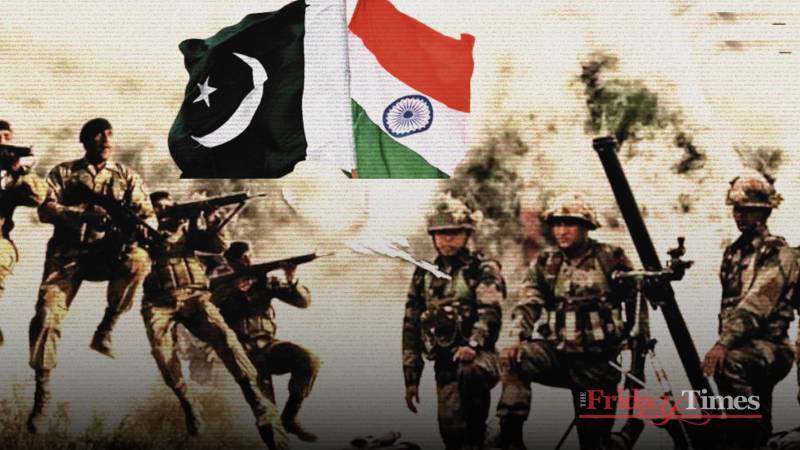
Indian media and defence commentators have recently begun referring to the four-day conflict between India and Pakistan in May as merely a “skirmish” a transparent attempt to downplay the scale of the confrontation, the losses sustained, and the national embarrassment that followed what had originally been launched as Operation Sindoor.
Following the aerial engagement of 6–7 May, the first indirect admission of loss came from India’s Chief of Defence Staff, General Anil Chauhan. He stated that the fact Indian aircraft were lost was not important; what mattered, he said, was understanding why they were lost. This statement, in effect, amounted to an implicit confirmation of those losses. According to Chauhan, the shortcomings were swiftly addressed, and within two days Indian jets were operational again, undertaking further missions against Pakistan.
This was followed by remarks from India’s Deputy Army Chief, Lieutenant General Rahul Singh, who told a press briefing that India was fighting “three adversaries on one front” China, Turkey, and Pakistan. His reasoning: 81% of the weaponry used by Pakistan was of Chinese origin, while Turkey had supplied drones used in combat. If one were to follow this logic, then Pakistan might reasonably argue it was fighting four nations France, the United States, Israel, and India given the origin of the arms used against it.
More startling was General Singh’s disclosure of a phone call between the Directors General of Military Operations (DGMOs) of India and Pakistan on 10 May. During that exchange, the Pakistani DGMO allegedly warned his Indian counterpart that a particular Indian military unit—referred to as “Victor” was preparing for an offensive, and urged India to stand it down. This strongly suggests that Pakistan had access to real-time surveillance of Indian military movements, reportedly via Chinese satellite support. If accurate, this intelligence capability may have been the critical factor prompting India to accept a ceasefire. Singh’s statement could be read as confirmation that Pakistan did not initiate the ceasefire through diplomacy, but rather forced upon India by strategic deterrence.
Islamabad has declared that stopping water would be an act of war, allowing India to provoke a response and portray it as unprovoked aggression
Further commentary emerged from Captain Shiv Kumar, India’s Defence Attaché in Indonesia, who lamented that political constraints had prevented the Indian Air Force from targeting Pakistani military bases suggesting that this operational limitation contributed to Indian losses in the air.
Yet any independent analyst might reasonably question whether an air formation of 70 to 80 jets each armed with eight to ten advanced weapons were deployed solely to strike alleged terror camps inside Pakistan. That explanation, widely circulated in Indian media, simply does not hold up to scrutiny. A more plausible interpretation is that the narrative is being retroactively constructed to preserve credibility with the Indian public.
This episode will undoubtedly have political consequences for the Modi government, which has maintained a conspicuous silence throughout. Some speculate that the military is increasingly sidelining civilian decision-makers in defence matters. This view is reinforced by the public criticism voiced by the Indian Air Force Chief, Air Marshal Amar Preet Singh, regarding Hindustan Aeronautics Limited’s repeated failure to deliver the Tejas fighter jets—an indigenous project long plagued by delays. Compounding the impression of internal instability was the sudden dismissal of Deputy Air Marshal S.P. Dharkar shortly before initiating Operation Sindoor, further deepening perceptions of disarray within India’s defence establishment.
To put it bluntly, both the Modi administration and military leadership now appear to be in a strategic bind.
The only official government comment has come from External Affairs Minister S. Jaishankar, who claimed that India had informed Pakistani authorities of its intended strikes on “terror camps” and did not anticipate a response. This oddly meek justification seems more a clumsy attempt to recast Indian aggression as an act of moral clarity—suggesting, absurdly, that Pakistan’s retaliation was an overreaction. For such dramatic flair, Jaishankar may be better suited to the Filmfare stage than the diplomatic arena.
But the story does not end there.
The Modi government finds itself at its lowest point of public approval since first coming to power in 2014. Alongside domestic discontent, India is facing an increasingly cold reception on international platforms. At recent gatherings such as the SCO Defence Ministers’ Meeting in China, the United Nations Security Council, and the BRICS Summit in Brazil, New Delhi’s position has found little sympathy. Not a single country has endorsed India’s claims regarding Pakistan’s alleged involvement in the April attacks in Pahalgam.
The question now is: what steps might India’s political and military establishment take to restore its credibility, both at home and abroad?
A repeat of false-flag operations—be it Pahalgam, Pulwama, Mumbai, or the attack on Parliament—would risk catastrophic blowback. The world appears increasingly unwilling to accept New Delhi’s narrative framing without evidence. While terrorism remains a global concern, geopolitical attention has shifted towards more pressing matters: conflicts in Europe and the Middle East, growing tensions between the West and China, and the broader transformation of the global order from North to South.
One remaining option for India may lie in its control of water. Suspending the Indus Waters Treaty, in defiance of the Permanent Court of Arbitration’s recent decision in Pakistan’s favour, could trigger a serious escalation. In particular, such a move during the winter months of November and December when flows in the western rivers (Chenab, Jhelum, and Indus) drop significantly could severely disrupt the Rabi crop in Pakistan’s Punjab and Sindh provinces, placing immense strain on farmers and sparking wider unrest.
Islamabad has declared that stopping water would be an act of war, allowing India to provoke a response and portray it as unprovoked aggression.
Given India’s reported collaboration with Mossad in conducting covert operations in Iran during the recent Israel–Iran conflict, it seems unlikely that New Delhi would be able to secure a covert operational foothold in Iran disguised as commercial ventures to support BLA-linked terrorism in Balochistan. Likewise, India’s ability to use Afghan territory for facilitating TTP activities in Khyber Pakhtunkhwa appears increasingly constrained, especially as Pakistan–Afghan relations show signs of improvement.
That said, one cannot entirely rule out Indian-backed subversive activity inside Pakistan particularly in Balochistan, which was pointedly referenced in the final communiqué of the SCO Defence Ministers’ Meeting. India, notably, refused to endorse the statement.
A final and far more dangerous scenario remains: direct military action against Pakistan, driven by desperation rather than calculation. Such a move would amount to strategic insanity and yet, given the current mood in New Delhi, it cannot be entirely dismissed.