

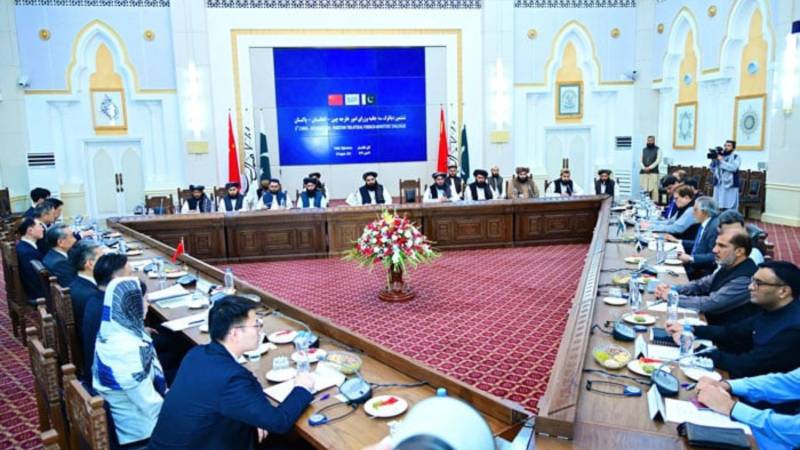
On August 20, in Kabul, Pakistan, Afghanistan and China held a trilateral conference of foreign ministers and expressed their resolve to promote political, economic and security cooperation. It was the sixth such conference participated in by Ishaq Dar (Pakistan), Maulvi Amir Khan Muttaqi (Afghanistan) and Wang Yi (China).
As obvious, Pakistan’s main concern was security, especially related to counter-terrorism. China’s main concern was economic, to run the China-Pakistan Economic Corridor (CPEC) smoothly. Understandably, both security and economic concerns could not be dealt with in isolation from political concerns. That is, the incumbent government of the Afghan Taliban has to take full charge of Afghanistan to subdue terrorism impairing the interests of both Pakistan and China. This is how the subject of counter-terrorism takes centre stage in the constellation of concerns. All three countries expressed their resolve to strengthen joint efforts to curb the menace of terrorism.
The question is this: what was the gain for Afghanistan? One answer to this question was openly addressed: Afghanistan would be made part of the CPEC. Moreover, in the context of Pak-Afghan relations, Pakistan would extend all facilities for trade and transit. Certainly, these concessions were to incentivise Afghanistan to change its attitude. That is, instead of relying on illegitimate drug trafficking, Afghanistan should conduct legal trade through Pakistan’s seaports, as discussed in the conference. However, one answer lingered on for pronouncement: the recognition of the legitimacy of the government of the Afghan Taliban. Neither Pakistan nor China was in a hurry to do so, though both had upgraded the status of the Afghan diplomatic missions to their countries as ambassadors.
Afghanistan has yet to pass through the ordeal of elections to espouse democracy. This is one major hurdle to the recognition of a legitimate representative government, as the ruling government is interim. However, it is demanding all concessions available to a permanent representative regime. To extend any such concession is possible for neither Pakistan nor China. Doing so would be tantamount to challenging the Doha Agreement which had been signed between the Afghan Taliban and representatives of the United States (US) in February 2020. That agreement cannot be overturned by neighbouring regional countries. Hence, the help of Pakistan and China is subject to the conditions settled in the Doha Agreement.
Pakistan has officially asked the US to withdraw or buy back the weapons its forces left in Afghanistan in 2021, as these weapons have fallen into the hands of both the TTP and BLA-Majeed Brigade active against Pakistan
Nevertheless, associated challenges are known, such as giving Afghan girls access to education and jobs; protecting the rights of minorities; and ensuring the non-availability of Afghan soil for launching terrorist attacks on foreign lands. The last one is a thorny issue, as during the conference, the Afghan foreign minister reiterated Kabul’s commitment not to permit Afghan land to be used by any terrorist group for launching cross-border terrorism. Though the proclamation avoided the mention of Pakistan directly, the announcement was in contrast to Pakistan’s assertion, which had been persistently accusing Kabul of failing to do so. In the Doha Agreement, though this point was added by the US to protect its land from any next 9/11, the mastermind of which kept hiding in eastern Afghanistan, the point is Pakistan’s focus of attention presently more than any other country in the world.
On the sidelines (before the beginning of the conference), Dar asked Muttaqi to take concrete and verifiable measures against militants of two entities: first, the Tehreek-e-Taliban Pakistan (TTP); and second, the Balochistan Liberation Army (BLA) and its militant wing, the Majeed Brigade, which kept on seeking refuge in Afghanistan. Dar expressed Pakistan’s dissatisfaction with the measures so far taken by Kabul to check the activities of these banned groups.
Pakistan thinks that without approval, which may be tacit, militants of the TTP cannot cross over the Pak-Afghan border to launch terrorist attacks on Pakistan’s land. Here is a point abutting nuance. The Afghan Taliban say that the terrorist attacks on Pakistan’s land are not being launched from Afghan land but are originating from Pakistan’s land itself. The same is the challenge Pakistan faces when it talks about the activities of the BLA and Majeed Brigade, which have been recently named as Foreign Terrorist Organisations by the US. After 2021, both these groups augmented sabotage activities harming property and lives on Pakistan’s land, especially in the flanking provinces of Khyber Pakhtunkhwa and Balochistan.
Apparently, Pakistan is a victim of nuance. That is, terrorist groups are launching attacks on Pakistan from Pakistan’s land. Time and again, Pakistan is struggling to make Kabul realise that these terrorist groups take refuge in Afghanistan to realign their ranks to prepare for the next assault on Pakistan. Inability to put its point across may frustrate Pakistan to do what may annoy Kabul. That is, to enter the territory of Afghanistan and destroy hideouts of terrorists.
On August 27, late at night, some missile-laden drones struck certain homes in Nangarhar and Khost, which are eastern provinces of Afghanistan. In reaction, the next day, the Kabul government summoned Pakistan’s ambassador to hand down a note of protest against the attack. This is where the rub lies. On the one hand, the Kabul government is failing to stop the activities of the TTP, whereas on the other hand, the Kabul government tries to dissuade Pakistan from launching retaliatory strikes on the hideouts of the TTP in Afghanistan. Nevertheless, Pakistan has officially asked the US to withdraw or buy back the weapons its forces left in Afghanistan in 2021, as these weapons have fallen into the hands of both the TTP and BLA-Majeed Brigade active against Pakistan.
The conference ended on a positive note that the decisions taken on April 19 and July 17 in Kabul and on May 21 in Beijing either had been implemented or were near completion. It simply means that Afghanistan has to do more in the field of counter-terrorism to satisfy Pakistan and China.