

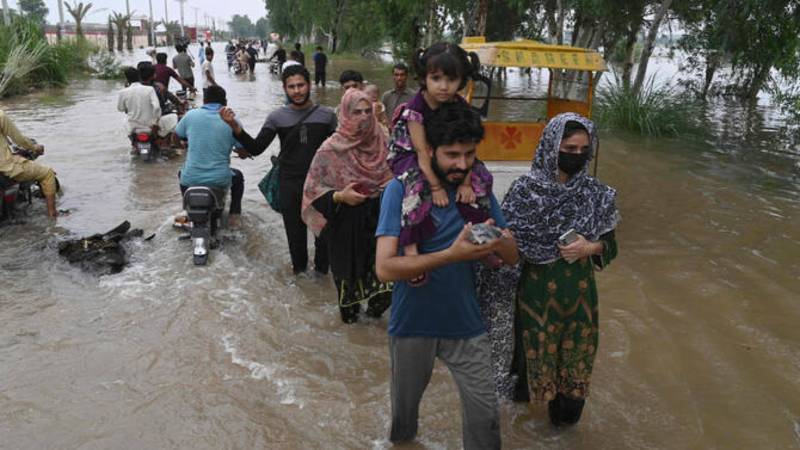
It was the last week of August when the Ravi spilled over its banks and swallowed the fields of Narowal. Farmers stood at the edge of their farmland in silence, watching the water crawl higher. By nightfall, rice stalks that had been their pride only a day earlier were gone. The hum of motors and threshers that usually fills the countryside was replaced by the crash of water.
Haseeb Shahid Gujjar, a small grower near Kartarpur, stayed out in the rain until after midnight. He thought maybe the water would settle, maybe the crop could still be saved. At dawn he saw nothing but a sheet of muddy brown stretching to the horizon. “Three acres, all planted with Basmati,” he muttered. “By morning, nothing remained.”
People here compare these floods to the great deluge of 2010. In Narowal, Sharaqpur, Hafizabad, Abdul Hakim, Kabirwala, and Khanewal, the blow feels even harsher. These are districts known for their fertile soils and heavy yields, the backbone of Punjab’s agriculture. Days of monsoon rain, followed by dam releases upstream, tore new channels across farmland and pushed families onto rooftops and boats.
Narowal, famed for its fine-grain rice, has taken the hardest beating. Dozens of villages were emptied out. Even the Kartarpur Sahib Gurdwara was left standing in waist-deep water, a reminder that the flood spared no landmark. Farmers here say half their rice was ruined before it ripened. That harvest was their repayment for seasonal loans. Now the debts hang heavy.
Further in South Punjab, in Kabirwala, the Ravi and Chenab joined forces to drown fields that normally supply Multan and Faisalabad with fresh vegetables. Tomatoes, onions, chillies — all gone in a single night. For smallholders who live off daily sales in the bazaar, it was like watching their lifeline cut. Rescue workers found families stranded on rooftops, their livestock drowned in the yards below.
And then there is Khanewal, the district officials once pointed to as a showcase of “climate-smart” farming. Drones, drip irrigation, and digital monitoring had been set up to promise resilience. But the flood came too fast. The trial plots went under, the machinery rusted, and the dream of a modernised, climate-proof farming hub vanished under the same water that swallowed the old fields.
Unless the government intervenes with loan waivers or direct compensation, thousands of families risk falling into a spiral of debt
Farmers cautiously embraced these new methods, encouraged by the promise of higher yields and resilience. But when the floodwaters arrived, the technology proved powerless. Fields were submerged, equipment ruined, and the optimism that once surrounded these innovations was washed away along with the crops.
“All that equipment, all that training, none of it could stop the flood,” said a local grower, shaking his head.
The losses across Punjab are staggering. Early estimates suggest nearly two-thirds of rice production has been wiped out. Cotton, already weakened by pest infestations earlier in the year, has lost almost a third of its standing crop. Sugarcane and maize fields have been flattened in low-lying areas. And in the vegetable-growing belt, damage is near total. These setbacks are not just numbers on a government report; they represent the collapse of livelihoods in communities where agriculture is the only safety net.
The economic chain reaction has already begun. In Lahore’s fruit and vegetable markets, tomatoes surged to Rs 200–250 per kilogram, more than double the official rate. Onions and potatoes also saw steep increases. For urban families already squeezed by inflation, the kitchen budget has turned into a daily struggle. The irony is sharp: consumers pay more while producers whose crops never made it to market earn nothing. Broken supply chains have left both sides feeling cheated.
Economists warn the implications reach far beyond dinner tables. Cotton losses threaten Pakistan’s textile exports, the backbone of foreign earnings. With rice exports set to shrink, the country faces the possibility of importing staples at a time when global food prices remain unstable. Analysts caution that GDP growth could falter, rural poverty will deepen, and food insecurity may intensify if relief and rehabilitation remain slow.
Relief operations are ongoing, but the scale of the disaster overwhelms available resources. Camps have sprung up on higher ground, providing temporary shelter for displaced families. The army and the National Disaster Management Authority have deployed boats and helicopters for rescue and supply drops. Veterinary teams are trying to keep surviving livestock alive, recognising that cattle and buffalo are often as important as crops for rural households. Yet clean drinking water, sanitation, and durable housing remain in short supply.
For farmers, the hardest challenge lies ahead. Most had borrowed heavily to finance the season’s sowing. With fields destroyed, repayment is impossible. Unless the government intervenes with loan waivers or direct compensation, thousands of families risk falling into a spiral of debt. For many, the choice now is whether to attempt replanting in the winter season or to abandon farming altogether.
The floods of 2025 have underscored once again Punjab’s vulnerability to climate extremes. What once seemed like a rare catastrophe has become a grim pattern. Experts argue that Pakistan must move beyond short-term relief to long-term resilience, strengthening embankments, redesigning cropping patterns, and scaling up climate-smart farming not as pilot experiments but as widespread practice.
As the floodwaters slowly recede, they leave behind more than silted fields and broken homes. They leave behind a test of endurance. Punjab’s farmers are no strangers to hardship, but this year the struggle feels different. The rising waters have taken not just crops, but confidence. Whether Punjab can rebuild stronger will depend on what choices are made in the weeks and months ahead — choices that could decide if floods remain an inevitable tragedy, or if resilience finally takes root in Pakistan’s agricultural heartland.