

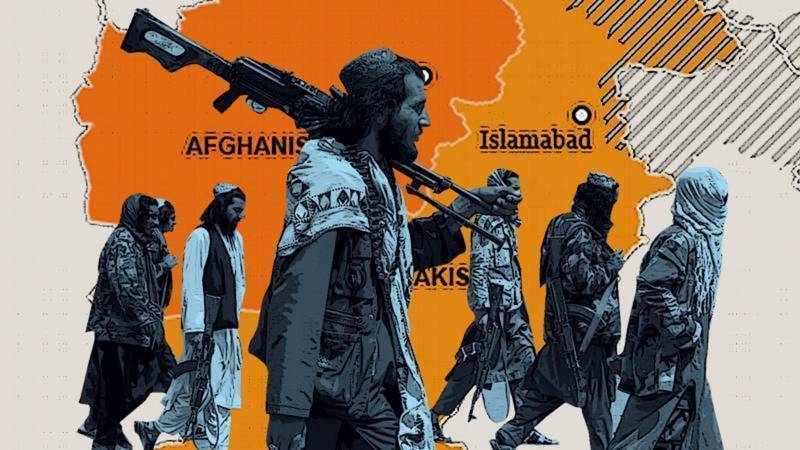
Even though the Islamic Republic of Pakistan hosted more than three million Afghans for decades, providing them shelter besides enabling them to run businesses, access education, and use the country’s health system, the vast majority of Afghans view Pakistan as an enemy country. They assert it was the policy of Islamabad that destroyed the landlocked state, besides tearing down its social fabric, accusing the Land of the Pure of hatching conspiracies against the war-torn country because the ruling elite of Pakistan, they claim, does not want to see stability there.
Some critics understand this anger of the Afghan people, arguing that Islamabad first infuriated Afghan nationalists during the first two decades after the independence of Pakistan. They argue that Islamabad earned the ire of Afghan socialists by siding with the US during the decades of the 1970s and 1980s. The story does not end here. The Pakistani ruling elite alienated all Mujahideen groups by throwing their support behind Gulbuddin Hekmatyar of Hizb-e-Islami during the early years of the 1990s, creating suspicions in the minds of other Afghan parties in the country.
Later, this proxy was also ditched, with Islamabad starting to plan to bolster the most ruthless outfit that came to be known as the Taliban. We extended that support at the expense of our social fabric, which got torn down because of this bankrolling of medieval warriors who not only stunned the world by setting ablaze TV sets and monitors but also carried out massacres of Afghan Shi‘ites, besides coming hard on other ethnic entities in the war-torn country. We celebrated these massacres, with Pakistani religious parties putting up banners across the country congratulating the fanatical bands of the Taliban over their victory in Bamiyan and other Shi‘ite areas.
Our support for the Taliban lent credence to the suspicions of Uzbeks, Tajiks, Hazaras, and Turkmens that Pakistan seeks to establish hegemony over Afghan Pukhtuns. Some of our generals envisioned extending influence in Central Asia by sending a proselytising group from Raiwand. Sensing the danger, the Central Asian rulers immediately banned such preaching missions, saving their lands from the pernicious tentacles of religious extremism and insane sectarianism that were sweeping different parts of Pakistan and Afghanistan during the decade of the 1990s and early 2000s.
Islamabad has its own conspiracy theories, asserting that the Afghan Taliban are sitting in RAW's lap, which wants to avenge Pakistan for the humiliating defeat that Islamabad asserts New Delhi suffered during the Indo-Pak conflict
Our patronage of the Afghan Taliban sharpened Pukhtun and non-Pukhtun divisions in Afghanistan, with Uzbeks, Hazaras, Tajiks, and Turkmens viewing us not only with suspicion but with extreme hostility as well. They started hobnobbing with India, Russia, Iran, and Central Asian states, asserting that Pakistan can never be sincere with the landlocked state. They accused Pakistan of treating Afghanistan as the fifth province of the Islamic Republic.
After 9/11, Pakistan was caught between the devil and the deep blue sea, with General Musharraf being quoted as saying that he did not want to support the Afghan Taliban but that he also feared American wrath. For some time, we remained ambivalent, but it seems that we had been working on a double plan from day one, assuring America of outright support on the one hand and dumping the Taliban's weapons for a prolonged war on the other. Our spymaster General Mahmud Ahmed was allegedly sacked for this double-dealing. Colonel Imam, the late mentor of the holy warriors, would openly brag that he urged the holy warriors to bleed the US.
This approach broadened the mistrust that had already existed for years between Islamabad and non-Pukhtun Afghans, who constituted an overwhelming majority in the Afghan bureaucracy and the army after the toppling of the Taliban. Under the shadow of NATO, they tried to do everything to harm Pakistan. No amount of pressure from Washington could deter us from supporting the Taliban, against whom we were receiving billions of dollars.
The Pakistani ruling elite thought that it was doing a tremendous favour to the Afghan Taliban by supporting them despite all pressure from NATO and the US. But what our rulers didn't understand was: they were sowing the seeds of enmity by handing over Mullah Abdul Salam Zaef and some other Taliban leaders or warriors. This double policy of Pakistan infuriated the US, with one senior American official describing ISI as a veritable arm of the Haqqani network. The US openly vented its anger, but the Taliban chose to remain silent over this double-dealing of the US.
In the aftermath of recent Pak-Afghan tensions, however, they have unleashed a torrent of criticism against Pakistan, mentioning the names of the Taliban leaders, which they claim were handed over to America by Pakistan. They have also lambasted Pakistan for its betrayal. This clearly shows that Pakistan has also lost the last pillar of support in Afghanistan. There are also rumours in Afghanistan that Pakistan is trying to reach out to the former Northern Alliance leaders based in Turkey and elsewhere in a bid to instigate a new insurgency in the territories of the Islamic Emirates.
Islamabad has its own conspiracy theories, asserting that the Afghan Taliban are sitting in RAW's lap, which wants to avenge Pakistan for the humiliating defeat that Islamabad asserts New Delhi suffered during the Indo-Pak conflict. While many critics blame Pakistan for following the strategic depth policy, pro-Pakistan analysts like Major (retired) Amir of ISI claim that it is Kabul that has always sought to pick fights with Islamabad. At a recent event, he asserted that Afghanistan rekindled the debate of the Durand Line soon after the partition, besides invading Dir and Chitral in later decades. It also bankrolled Pukhtun and Baloch nationalists, the Islamist major revealed.
Pukhtun intellectuals believe that Pakistan has always tried to sell its geographical location and strategic importance to global powers, serving as a stooge for imperial states. They cite the speech of former Prime Minister Liaquat Ali Khan, which he made in the US during his visit to the mighty state in the 1950s, and statements of Pakistani officials like former Governor-General Ghulam Mohammad to substantiate their claims. The incident of U2, the alliance with the US during the Cold War, and the partnership during the Afghan Jihad and War on Terror are further offered as evidence.
They believe the socialist government in Afghanistan tried to modernise the landlocked country by carrying out land reforms, opening educational institutions, banning child marriage, ending the interest system, and allowing women to play an active role in public life. Such reforms were opposed by the 'conservative GHQ', which, according to some, contributed to instability in Afghanistan. In this view, Pakistan, along with its religious authorities, KSA, the US, and the West, share responsibility for the challenges faced by the Afghan people.