

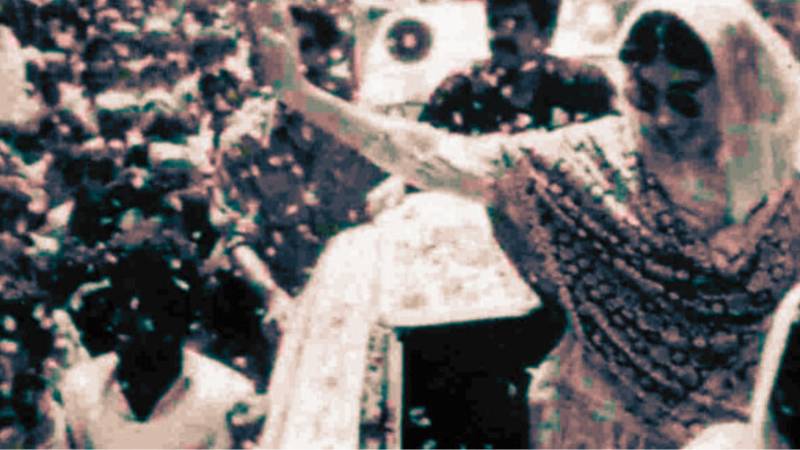
1988 etched itself in the Pakistani psyche as a year when the dreadful military dictator died in a plane crash and Benazir Bhutto and democracy were ushered into Islamabad’s power corridors with PPP’s thumping victory in the first post-Zia parliamentary elections. The narrative of the restoration of democracy is a powerful and all-pervasive one with which even those who don’t share the love for democracy and representative government with most Pakistani people, agree. The year 1988 was a turning point in this narrative: The military dictator died in a plane crash and with him military rule ended, and with it started a new era of democratic rule. Benazir Bhutto was the “princess of hearts” who became the First women Prime Minister in the Muslim World when her party emerged as the single largest party in the parliamentary elections—after the then military-backed President Ghulam Ishaq Khan and the then COAS, General Aslam Beg gave a go-ahead for restoration of democracy in the country. Most of the political histories of Pakistan written in the intervening period revolve around this narrative. Withdrawal of the Pakistani military into barracks and the advent of new political leadership that rose to prominence and power because of parliamentary elections.
Some four months back I started reading the economic history of Pakistan. My first reading of the economic history of Pakistan—of the economic history books, IMF, World Bank, UNDP sponsored reports of analysis of economic forces operating in our society in those fateful years and newspapers reporting of economic issues of those years—I have developed an alternative history of events. Rather I have retraced an alternative history of political developments of those years—which, let me say, I have not invented—as this is a narrative, that had already been projected by historians and economists of those years.
The year 1988 should not be remembered for the restoration of democracy in the country. It should be remembered as a year when Pakistan was trapped in the clutches of the neo-liberal economic agenda of Western powers led by the United States of America. This was a year when Pakistani governments, all the governments since that year, lost all autonomy in presenting their own economic program as a sovereign authority within the territory of Pakistan. Zulfiqar Ali Bhutto ruled Pakistan for five to six years immediately before General Zia’s martial law. He was the last Pakistani ruler to have enjoyed the autonomy of presenting an independent economic program of his government—Nationalisation of private industry, massive public spending, and state assuming control of production processes in the country.
The military government and military-backed interim government left behind a ramshackle economy and an agreement with the IMF to follow a neo-liberal agenda that would deprive the Pakistani state and Benazir Bhutto government of any capacity to care for the downtrodden
Elder Bhutto did receive two or three short-term loans from the International Monetary Fund and World Bank but there were no strings or conditionalities attached to these loans. In fact, the IMF and World Bank didn’t start the worldwide project of implementation of neoliberal economic agenda around the world by then. The Zia military government was the first Pakistani government to apply for a loan from the IMF in the era when the latter started attaching neoliberal conditionalities to their loans like financial deregulation, privatisation, and withdrawal of subsidies on agriculture and industrial activity and utility bills. In the initial years of the decade of the 1980s, the province of Sindh was bracing for a violent project led by the Movement for the Restoration of Democracy (MRD) because of which Zia felt the pressure. It was not that he was popular in Punjab. It was only that Punjab became dormant because of the military government’s repressive tactics while the people of Sindh were in a defiant mood. The Zia regime discontinued the IMF loan after receiving the first tranche when his advisor told him that enforcement of IMF conditionalities would make him more unpopular than he already was.
Both the times Benazir Bhutto was given power, first in 1988 and second time in 1993, the interim governments signed Structural Adjustment Programs with the IMF, which Benazir Bhutto governments were compelled to implement. These were detailed economic programs ordaining the withdrawal of agriculture and industrial sector subsidies, privatisation of industrial units in the public sector, de-regulation of finance operations, and withdrawal of all subsidies on utility bills. We can imagine what Benazir Bhutto’s economic policies would have been in case the military government had bequeathed a stable economy to its successor. Instead, the military government and military-backed interim government left behind a ramshackle economy and an agreement with the IMF to follow a neo-liberal agenda that would deprive the Pakistani state and Benazir Bhutto government of any capacity to care for the downtrodden.
Deregulation of the financial sector and trade led to deindustrialisation of industry in the consumer sector and imported consumer goods flooded the Pakistani market. After 1988—remember it is a key turning point in Pakistani history but for reasons other than the restoration of democracy—no Pakistani government was able to secure for itself enough space for economic policymaking, “It would be fair to say that since 1988 Pakistan’s economic policies management and performance have been almost totally determined by the country’s adherence to IMF/World Bank sponsored Structural Adjustment Programs and Pakistan’s various governments have had no independent or original economic program of their own. Almost without exception, the policy measures undertaken by the various governments in power since the implementation of the 1988 program follow very closely the details in the policy framework papers, which outline steps that the government is to undertake after signing the Structural Adjustment Program document” eminent Pakistani Economist, Akbar Zaidi writes in his “Issues in Pakistan’s Economy” published by Oxford University Press in 1997.
It is now a well-documented fact that Benazir Bhutto was given power after an unsigned agreement with the then COAS, General Aslam Baig, and military-backed President, Ghulam Ishaq Khan that her government would not change Pakistan’s Afghan policy of supporting Afghan Mujahideen against Soviet-backed government of Najeebullah in Kabul and she would not tinker with Pakistan’s foreign policy more generally. If she was not doing foreign policy, if she was not doing Afghan policy, and if she was not doing economic policy, then what exactly was she doing? What part of governance does she have a firm hold on? It means she was good for nothing. When she accepted the IMF Structural Adjustment loan agreement signed by the Interim government only a day before she took over, she tied her hands to a program that even deprived her of the capacity to safeguard her political future—I mean withdrawing subsidies and laying off labour from the privatisation of industrial units would lead to mass social unrest by the downtrodden segments of the society, which provided the backbone to her politics of the people. The flip side to this argument is that if the conspiring military, intelligence services, and the political and religious right wing had spared her from their intrigues and conspiracies, she would have thought about creating space for economic policymaking for her government.
But anecdotal evidence points to a different political reality. Pakistan’s former and foremost journalist and commentator of the 1980s and 1990s, Mushahid Hussein Syed wrote a book titled, “Pakistan Problems of Governance” in the early 1990s. In the writing of this book, he interviewed several government officials, bureaucrats, and politicians. One of these bureaucrats was V. A Jaffery whom Benazir Bhutto appointed her economic advisor with the status of a federal minister. Mushahid Sahib, in the book, says that Mr Jaffery was handpicked by Americans for the job. He narrates a very interesting story gleaned from his conversation with Mr Jaffery himself. Here is an excerpt from Mushahid’s book, “Initially, Benazir Bhutto was given two names — one for Foreign Minister, which she accepted and the other for Finance, which was Dr. Mahboob ul Haq, which she turned down.
Zia came under a lot of criticism from American media for running his Afghan policy independent of the American CIA. He provided weapons, finances, and training to his own favourite Mujahideen
The latter name she rejected on grounds that Dr. Haq had opposed her father way back in May 1977 when during the PNA agitation he had written a letter to The Washington Post comparing her father with Ugandan military dictator, Idi Amin. It was after this rejection of Dr. Haq as Finance Minister that the Principal Secretary to the President Mr. V.A. Jaffrey, who had extensive experience in economic matters as a bureaucrat, received a telephone call from the American Ambassador Robert Oakley, inviting him to a meal. The luncheon was devoted to economic matters, but the very next day Mr. Jaffrey was surprised to receive a call from the office of Prime Minister Benazir Bhutto telling him that he would be sworn in as Advisor to the Prime Minister on Economic Affairs. When Mr. Jaffrey arrived for his swearing-in. Prime Minister Benazir Bhutto asked apparently in all innocence amongst those who had gathered for the ceremony, “One of you is Mr. Jaffrey”. Mr. Jaffrey promptly stood up so that the Prime Minister could recognise the person whom she had just nominated as her Advisor on Economic Affairs”.
If Americans were handpicking her finance advisor and the military was handpicking her foreign minister, and she was endorsing the IMF structural Adjustment Program signed on their last day by the military-backed interim government, only God knows what was she doing in the Prime Minister House? She did not know. But maybe the intra-elite fight that persists to this day was the main factor behind her ouster from power. The fight between different factions of Pakistani elites was not that they were opposed to the economic policies of the Benazir Bhutto government. The fight was that it would not be Benazir Bhutto who would implement the neoliberal agenda in Pakistan, but it would Nawaz Sharif representing another elite faction that would lead the charge. Both factions were not fighting for different economic agendas or ideologies. Political conflict was only a facade.
The politics without economics or without the power to distribute resources in the society proved to be sheer opportunism in the context of Pakistan’s political history. Politics is about the distribution of resources in society. Someone rightly said, “Politics is about the questions of who gets how much and when”. The last Pakistani politician who attempted a redistribution of resources in Pakistani society was Zulfiqar Ali Bhutto. After 1988 no government or political leader had the capacity to redistribute resources in society. Because the template for the distribution of resources in the society was provided to them by the IMF and World Bank—every government since 1988, whether it was military or civil doesn’t matter, has been pro-rich with successive governments dropping crumbs for the poor on their way to neo-liberal paradise. But who first pointed the way toward neo-liberal paradise? Who was the main and central culprit? It was Zia who signed the first Structural Adjustment Program with the IMF, even though Washington was still pumping Dollars into the Pakistani economy and the 1980 construction boom in Gulf Sheikhdom was leading to a dollar bonanza in Pakistani society. Akbar Zaidi, an eminent economist and an honest observer, has noted in his book that economic conditions prior to the signing of the Structural Adjustment Program didn’t warrant desperate measures such as the signing of an IMF loan agreement with harsh conditionalities.
I think we need to rediscover our political history. The narratives that the political and vested interests push in our society are false and outdated. The decade of the 1990s was the worst from the perspective of the economic performance of our society. Poverty became rampant. The economic growth rate touched the lowest ebb. History tells us that the governments we elected in parliamentary elections were not in control of economic policy-making. They had surrendered this right and authority to foreign donor agencies and maybe indirectly to Washington. Here I would like to quote a very interesting but highly ironic example from our history on how two military governments Zia and Musharraf behaved very differently to American pressure—Zia resisted and refused to allow free hands to Americans in the managing of Afghan Jihad against the Soviets and Musharraf completely surrendered before Americans when they only applied slight pressure on his government in the wake of 911.
Zia came under a lot of criticism from American media for running his Afghan policy independent of the American CIA. He provided weapons, finances, and training to his own favourite Mujahideen—the fundamentalist one—as opposed to the secular Mujahideen favoured by the American CIA. Of course, Zia's policy could not be described as something in the best interests of Pakistan as our society paid a very heavy price for supporting fundamentalist groups in Afghanistan. But nevertheless, it was an independent Afghan policy of the Zia regime. Why was he able to resist Americans? Because during his tenure Pakistan was not facing an economic meltdown and there still was some vitality left in our production processes. This vitality could be credited to the relatively better economic performance of the Bhutto government that preceded the Zia regime. The economic growth rate was five percent.
During the Bhutto government, public spending was high. Private sector investment was low because of Bhutto’s nationalisation policies but it was the result of investors losing confidence because of the 1965 Pak-India war. This slowdown in investment continued till the 1990s, according to Pakistani economist historians. Why was Musharraf not able to resist American pressure and get ready to surrender under the slightest pressure from Washington? Maybe because our economic structures had collapsed. By then we had lost our economic vitality. We had lost our economic independence. All this happened after we surrendered to the neoliberal economic order. I think we have enough reasons and evidence to start working on the rediscovery of our political history. Maybe we learn some valuable lessons for the future.