

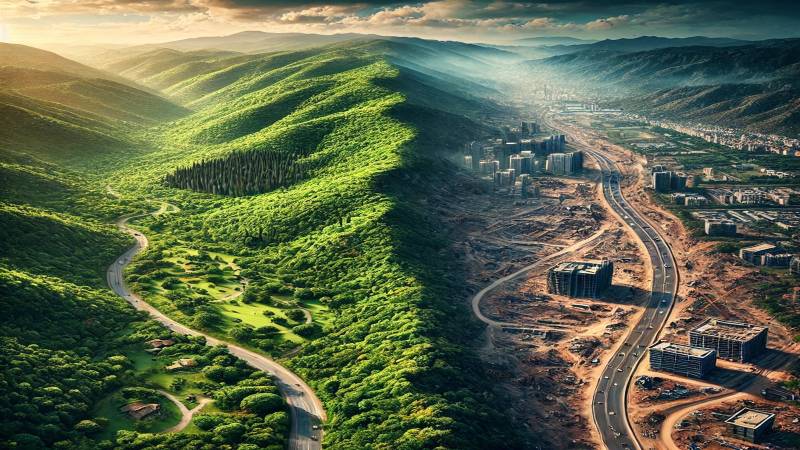
I am no environmentalist. That said, I am a resident of Islamabad who has a duty of care towards the environment I was blessed with. Passive bystanding, while it is threatened, is not an option; climate changes have wreaked havoc all over the world, but also tangibly in my country and city.
I have developed allergies because policymakers who did not know better, two generations ago, planted trees in the nation’s capital that contribute towards harmful pollen. Who was in charge of those decisions when the capital was being developed, and who is paying the price for those decisions? Over time, the mulberry trees, which are not indigenous to this area, have increased the harmful allergens for many citizens sensitive to them. In March and September, when the pollen count is massive, many are in deep distress. Does anyone care? Has anyone even tried to redress or address this tangible, concrete threat to the health of Islamabadis? No one has done anything about this man-made health hazard or taken mitigation measures or risk reduction to improve the quality of air for citizens in Islamabad.
The threat has now increased manifold decades later. Islamabad, the green, lush, walking, hiking, mountaineering city we call home, has now become the target of land mafias and real estate addicts, who see green when they see the natural beauty of Islamabad. Overpopulation has not helped the city, and too many displaced from wars and conflict have settled in a city designed for half a million. We are now 2.4 million residents.
This pressure on the land and natural habitat, which provides a home to much wildlife and is an air filter for residents, is under threat. The threat is not merely climate changes as a result of global temperatures and international development, which are not in our control, but from those who see green as ching-ching inside Pakistan. The Government of Pakistan and those who pander and support their greed see our natural gifts as assets to monetise rather than sustenance for a growing vulnerable population. Green is the colour of mother earth and peace, which should be protected, respected, and preserved, not used or abused.
Crimes and transgressions of the past, never punished, have emboldened the powerful.
Many national parks in the world are protected under special laws and are managed by professionals with the expertise to ensure compliance. These management teams are honoured and supported by their governments and citizens. Rarely are they attacked and undermined.
In Islamabad, the Margalla Hills National Park was first protected by civil society activists in the 1980s. They fought tooth and nail against the government’s destructive encroachments and elite capture development projects; some of those battles were won, but most were lost. We see the state of Rawal Lake, F-9 Park, and Shakarparian—Islamabad lost these large swathes of green and water bodies to unplanned building mafias, with little consideration for conservation, pollution, or developing with green technologies at the centre of its development plans. The battle Islamabadis won was a plan to build a tunnel through the Margalla Hills, which was thankfully stopped by a group of sane civil activists.
Without the building blocks of green adaptation policies, the rhetoric continues to attract donations and funding for theoretical projects that have little to do with improving, qualitatively, the lives of citizens in Pakistan
We can see a pattern here: the government and the ministries and departments dedicated to protecting and preserving are complicit and ill-equipped with the appropriate human resources and skills to safeguard the precious green spaces of Islamabad.
It is clear that after two generations of destroying Islamabad’s greens, and to safeguard what is left, the citizens of Islamabad must demand an independent, technically equipped management team to protect our national park.
Generations later, today, the mantra of ‘climate change’ is one reason we need to protect the national park of Islamabad; but more relevant is that until Pakistan develops conservation and green technologies that can support development inside a conservation national park, it must remain completely free of polluting enterprises. This is not a disputed perspective nor has any alternative point of view—this is simple science. If Islamabadis want to live in a breathable environment and continue to benefit from what God has provided us—the Margalla Hills—it must remain green and a protected area.
Those who argue that national parks can have (green) commercial enterprises need to remember a few facts. Islamabad has been unable to convert into a plastic-free town, even though the PTI government tried. The supporting technologies necessary to create a viable alternative were never developed or invested in. The city’s commercial enterprises could not shift to alternatives even if they wanted to. This applies to recycling systems as well. No waste management system was invested in to support the growing household demand to separate waste and recycle paper, bottles, or waste.
In fact, at an individual level, many of us do separate bottles and waste for compost in our gardens and give the bottles to pickers, BUT this is not systematic and has no link to town waste management systems. Islamabad’s waste management system remains a dump yard of everything.
The lack of basic conservation and adaptation to green behaviour across the city indicates the lack of priority for those who wield the reins of power in Islamabad. All talk at government speak and hot air for the rest of us.
Furthermore, Islamabad has no green building codes that would ensure all construction is environmentally friendly (from materials to conservation designs). Why doesn’t Islamabad have any green policies or initiate the most basic of green conservation programmes? What stops them from implementing policies that would lower heat emissions, improve the scarcity of precious water, and enable recycled materials to thrive? The disingenuous commitments to climate adaptation only mouth western agendas and donor-funded programmes such as ‘carbon counting’ initiatives, completely out of context in the landscape of Pakistan, which has not invested in the basics of going green or adapting to climate change, national policies.
Without the building blocks of green adaptation policies, the rhetoric continues to attract donations and funding for theoretical projects that have little to do with improving, qualitatively, the lives of citizens in Pakistan.
These hills are the city’s lungs, but they also symbolise what Islamabadis cherish most. Those of us who are actually from here and are invested in its present and future will always want it to remain green
If we are one of the most vulnerable nations to climate change, why are policymakers and governors ignoring mitigation measures and risk reduction within their control? Something to think about.
This is a city that has one of the largest natural wildlife preserves. We live/cohabit with leopards and many incredible wild animals. This alone should have created a culture of living with nature (reduction of noise pollution, conservation materials, green sewerage, waste management systems unharmful to the flora, fauna, soil, mountains, and water bodies underground and above).
Planners and governors of Islamabad have remained oblivious to the reality of Islamabad and its environment. Green technologies are necessary in all of Islamabad’s development policies. The reality is Islamabad’s governors do not have these technologies and expertise, nor are they seeking them. Bottom line.
Instead of destroying Islamabad further, Islamabad’s citizens are demanding their national park begin the pivot of protecting the city and its citizens by developing a green agenda. Islamabad must become the model that demonstrates green behaviour from the top down.
We have seen the disingenuous promotional funded programmes of government encouraging citizens to be conscious of green practices, but in the absence of trash cans, water conservation building codes, recycling facilities, green waste management units, or recycled products (alternative to plastic), what are they expecting the citizens to do?
The first sign of hot air or disingenuous speak is when someone asks you to do something which you cannot possibly do because there is no environment to do it.
Reminds me of the anti-corruption messages at the theatres, which only elicit cackles from the audience.
Sadly, the Margalla Hills National Park’s management board (IWMB), once independent, if it had been supported instead of undermined and eventually disbanded, could have begun to work on initiatives to conserve, preserve, and convert plans into actions—using expertise to protect the Margalla Hills.
These hills are the city’s lungs, but they also symbolise what Islamabadis cherish most. Those of us who are actually from here and are invested in its present and future will always want it to remain green.
What is clear is that neither the Climate Change Ministry nor the CDA is equipped or mandated to undertake the necessary green development of Islamabad’s most precious habitat.
We suffered the decisions of those in the 1960s when the capital was being developed, and without accountability or reversing the harmful, uninformed policies, the city slowly but surely began to lose its green.
In 2025, the residents of Islamabad will not stay silent or passive as the influential continue the war against our collective welfare.
Green up first.