

Punjab’s education sector presents a baffling paradox: record-shattering budgets alongside slow progress. Despite allocations inflating more than thirteenfold since 2008—bolstered by billions in foreign grants—literacy rates have inched up at a snail’s pace, learning outcomes remain dismal, and millions of children still lack access to basic schooling. Approximately 10 million children aged 5–16 are out of school (OOSC) in Punjab—accounting for nearly one in three in this age group, in the richest province with a total population of 128 million. Construction of new schools has not been a priority for a long time. The last new school in Lahore was built in 2011.
Despite these shortcomings, Punjab has outperformed other provinces since 2008—especially when compared with Sindh and Balochistan, where overall progress has been poor. Since 2008, Punjab has made the most substantial gains in education among all provinces—its literacy rate has risen to 66%, and the share of out-of-school children has declined to 32%, although capital spending has remained low.
Khyber Pakhtunkhwa (KP) follows: its literacy rate rose modestly to about 51%, with an out-of-school rate hovering near 39%, but it dedicates the highest share (around 21%) of its provincial budget to education. Sindh, despite allocating Rs 613.36 billion for education in FY 2025–26—including Rs 524.32 billion for service delivery and Rs 89.04 billion for development—continues to lag, with about 47% of children out of school and literacy stagnant for 17 years around 58%. Balochistan remains at the bottom with minimal progress, an education budget share under 15%, literacy below 43%, and 69% of school-aged children out of school.
| Province | Literacy Rate (2023) | OOSC Rate (%) | Education Budget (FY 25–26) | Budget Share of Total |
| Punjab | 66.3% | ~32% | Rs 811 billion | ~15% |
| KP | 51.1% | ~39% | Rs 364 billion | ~21% |
| Sindh | 57.4% | ~47% | Rs 613 billion | ~18% |
| Balochistan | 42.1% | ~69% | Rs 145 billion | ~13–15% |
In 2008–09, Punjab’s education budget stood at Rs 63 billion (approximately 1.3 percent of provincial GDP). By 2018–19, it had soared to Rs 357 billion (roughly 2.0 percent of GDP), climbing further to Rs 391 billion during the pandemic. The 2025–26 allocation peaks at Rs 812 billion—now consuming over 2.5 percent of provincial output—yet recurrent costs (salaries, pensions, administrative overheads) absorb more than 85 percent of the total. Development spending on infrastructure, digital integration, and teacher professionalisation languishes below 15 percent—far short of the 30 percent experts deem critical to sustain infrastructure, textbooks, and labs in a rapidly growing system.
Between 2019 and 2024, multilateral and bilateral partners contributed over Rs 136 billion to Punjab’s education
Although per‑student outlays have risen from Rs 5,500 in 2015 to Rs 8,500 in 2024, efficiency indicators suggest many resources fail to translate into classroom improvements. Aggregate literacy ticked up from 55 percent in 2008 to 66 percent in 2023, but district‑level data reveal extremes: some districts boast literacy rates above 85 percent, while a dozen remain under 40 percent. Southern and western districts exhibit the sharpest deficits, driven by geographic isolation, socio‑economic marginalisation, and conservative social norms.
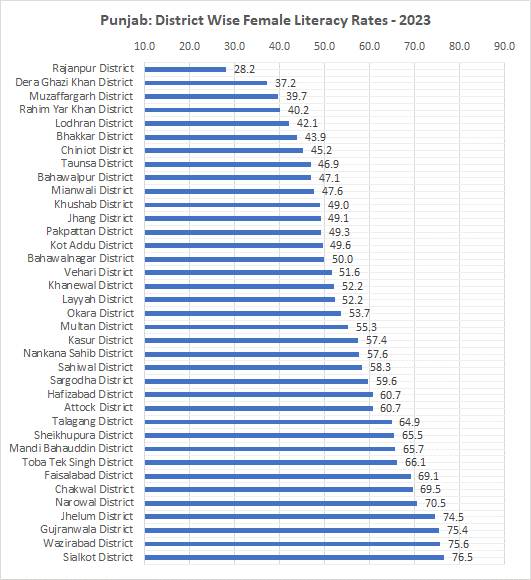
Gender gaps are pronounced: men outpace women by 15–20 points in rural areas, curtailing female participation in higher education and the workforce. Urban districts have narrowed this gap to under 5 points, reflecting better infrastructure and awareness campaigns, but rural gains lag significantly.
Flagship reforms over the past decade include need‑based scholarships disbursed to over half a million students annually; the school‑upgrade programme that has elevated over 8,000 primary schools; and a phased English‑medium pilot targeting urban and peri‑urban schools. The Single National Curriculum, launched in 2021, aspires to standardise learning outcomes across the public and private sectors. Yet recent assessments show only 40 percent of Grade 5 students can fluently read Grade 2 texts, and barely half of Class 3 pupils master grade‑appropriate numeracy. Delays in curriculum rollout, inconsistent teacher training modules, and textbook shortages undermine policy intent.
Furthermore, an estimated 30 percent of sanctioned teaching posts remain vacant in remote districts, where substitute teachers or community volunteers often deliver instruction with minimal formal training. Punjab has approximately 8,950 high and higher secondary schools, but only about 5,000 of these have laboratories. Of those, just 300 are equipped with modern equipment, and even fewer have laboratory attendants available. Notably, practical exams in physics, chemistry, and biology at the Class 10 level carry 25 marks. However, only 10% of government schools are able to adequately support students in preparing for this essential component of the curriculum.
Professional development budgets of Rs 2 billion in 2023–24 were earmarked for in‑service training, but only a fraction of the province’s 320,000‑strong teacher corps received accredited workshops. Trainings—when conducted—are often one‑off seminars lacking follow‑through mentoring. A decentralised model piloted in two districts showed promise, pairing senior educators with junior teachers through fortnightly lesson observations and feedback sessions; its expansion could dramatically improve pedagogical quality but remains unfunded.
In deprived districts, over 40 percent of young children never enrol, deterred by poverty, long commutes, and social norms prioritising labour or domestic roles over education. Reintegration schemes have re‑enrolled 1.5 million learners since 2019, yet they face high dropout rates by Grade 6 and limited support systems. Conditional cash transfers for female students and community‑based pre‑school centres have shown local success, but scaling remains slow.
Between 2019 and 2024, multilateral and bilateral partners contributed over Rs 136 billion to Punjab’s education. World Bank projects built more than 4,000 classrooms; the GPE‑backed TALEEM initiative enrolled 1.2 million additional students; UNICEF, ADB, and FCDO funded digital labs and equity programmes. Despite these injections, execution gaps mean many classrooms stand empty and digital labs idle. Complex donor protocols strain district administrations, and occasional overlap between projects wastes resources.
In July 2025, the provincial leadership unveiled a Rs 100 billion emergency package within the new budget, aiming to recruit 10,000 teachers, upgrade 5,000 schools with libraries and science labs, and re‑enrol 1.5 million out‑of‑school children. Politically powerful, this initiative galvanises short‑term action, but without reallocating a minimum of 30 percent toward development and embedding district‑level performance audits, it risks echoing past cycles of budget spikes followed by negligible impact.
Punjab's education system faces significant infrastructure challenges that hinder student learning and equity. The Punjab Education Department revealed in May 2025 that 40% of public schools lack adequate classrooms, and 37% of schools in rural areas are without boundary walls and electricity. Additionally, 65% of rural schools and 27% of urban schools lack science or computer labs, while 45% of all schools are without proper toilets, fans, or access to safe drinking water.
According to the Punjab School Education Department, there are about 38,000 government schools in the 36 districts of Punjab. Of them, 21,702 are primary, 7,200 middle, 8,000 high and 800 higher secondary schools. These schools are facing a shortage of funds and facilities.
In a tacit acknowledgement of its lack of capacity, the Punjab government has formally brought 3,650 public schools under the Public-Private Partnership (PPP) model in Phase I of its privatisation drive, with memoranda of understanding signed to transfer the day‑to‑day running of these schools—teacher recruitment, infrastructure upkeep and basic supplies—to 21 NGOs, 12 private school chains, and one ed-tech firm. By the end of Phase III, the plan envisages handing over roughly 13,000 government schools province-wide under the same model.
Punjab’s narrative is one of stark contrasts: unprecedented resource inflows contrasted with sluggish progress in core learning metrics. Breaking this paradox demands a paradigm shift—from recurrent‑heavy budgets and top‑down policy pronouncements to development‑focused allocations, localised accountability, and holistic interventions that address both supply and demand. Only then can Punjab’s vast educational investments yield the dividends of literacy, skill, and social mobility that its citizens deserve.