

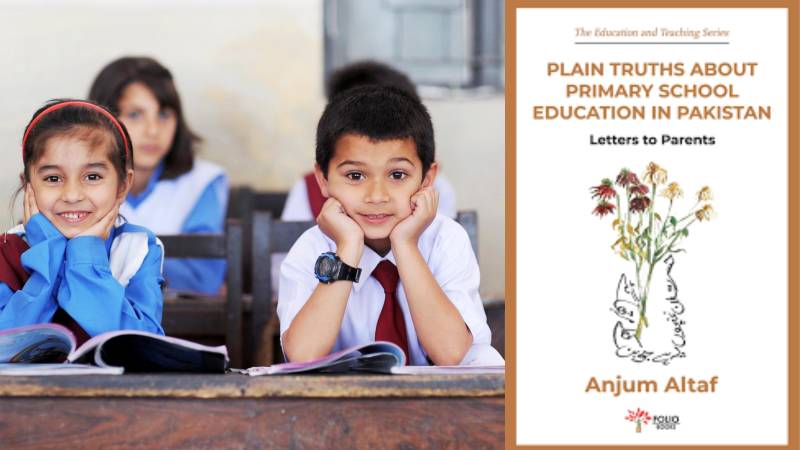
Although Anjum Altaf needs no introduction, for those unfamiliar with his work, it is worth recognising his significant contributions to Pakistan—particularly in the field of education. He is a distinguished economist, educationist, and member of the International Coalition for Education Reforms in Pakistan (ICERP). He has served as professor of economics and dean of the School of Humanities and Social Sciences at the Lahore University of Management Sciences (LUMS). A prolific writer, Altaf has authored several books on education and poetry and continues to share his insights through regular contributions to Dawn.
The book opens with an epigraph from the German playwright and poet Bertolt Brecht:
“There are some who are in darkness,
And the others are in light,
And you see the ones in brightness,
Those in darkness drop from sight.”
This short booklet, consisting of 90 pages and 20 concise letters, serves as a wake-up call directed at parents. Drawing from years of witnessing the decline of Pakistan’s education system, the author speaks directly to parents—those who wish to see their children surpass them in success. Altaf urges them to become more vigilant about the quality of education their children receive, especially in a system where institutions charge exorbitant fees but often fail to deliver meaningful learning, particularly in rural and secondary cities. He argues that quality education is not a privilege but a fundamental right enshrined in the Constitution of Pakistan. In a rapidly evolving world, this right cannot be compromised.
Despite the presence of thousands of schools, colleges, and universities, the quality of education in Pakistan remains alarmingly low. According to Altaf, the core issue lies not in infrastructure but in outdated methodologies, age-inappropriate content, and unskilled teaching staff. Education has become a commercial enterprise, sacrificing learning outcomes for profit, with children suffering irreparable damage as a result. This trend, which began in the 1980s, continues unabated. Successive governments have failed to deliver genuine reforms, making only token gestures. Deeply disillusioned, Altaf no longer places hope in official initiatives. Instead, he addresses parents directly, encouraging them to wake up to the systemic flaws and take active responsibility for their children's educational journey.
The book offers a radical proposition: abolish textbooks and standardised materials in Grade 1, allowing children to learn through self-directed, play-based experiences. At such a young age, rote memorisation only dulls the mind and inhibits critical thinking. Teachers, Altaf insists, should observe children, assess their interests and pace of learning, and group them accordingly. Each child is unique—emotionally, cognitively, and behaviourally—and should be taught through personalised instruction.
Early childhood forms the foundation for all future learning. Just as a building needs a solid base, a child's early educational experiences determine the trajectory of their intellectual development. Referencing a 900-year-old saying by Sheikh Saadi, Altaf reinforces the idea:
“When the first brick is laid crooked by the architect,
The wall will remain crooked even if it rises to the stars.”
Altaf is especially critical of how English is taught—and imposed—on children. Many so-called English-medium schools employ teachers who themselves lack proficiency. Parents, obsessed with English for its association with better career prospects, enrol their children in these institutions without verifying faculty competence. Ironically, they are meticulous about the quality of everyday goods like milk or rice, but fail to scrutinise the quality of instruction their children receive.
Mass education, a relic of the industrial age, was designed to produce obedient workers, not independent thinkers
Children fluent in their native language, such as Urdu or Punjabi, are suddenly forced to learn in English—leading to confusion, disengagement, and diminished creativity. Parents often blame poor results on their children, failing to see that the real problem lies in flawed teaching approaches. As Altaf highlights, even illiterate parents succeed in teaching their children native languages without formal schooling. Yet many expensive schools fail to do the same with English, despite substantial investments in tuition and materials.
A simple visit to a local school—elite or otherwise—will expose the extent of the crisis. Students often cannot speak confidently, tell a story, or form coherent sentences in English. Pakistan’s performance in the 2019 Trends in International Mathematics and Science Study (TIMSS), where it ranked second-last among 64 countries, underscores the depth of the problem. The Annual Status of Education Report (ASER) adds further weight to Altaf’s arguments. The report reveals that students in Grade 5 often have the knowledge levels of Grade 2, with even higher-grade students showing alarmingly low competencies. The 'learning gap' is real and widening.
Altaf argues that children learn best in the language they speak at home. Global education systems in countries such as Japan, Iran, Turkey, China, and the United States follow this model. He proposes teaching all subjects in the mother tongue during the early years and introducing English as a subject around Grades 3 to 5. By Grade 8, children can then transition to English as a medium of instruction, having already acquired foundational proficiency. This model is also supported by the work of The Citizens Foundation (TCF), which has compiled data showing better outcomes when children are taught in the language they understand.
English, for many Pakistani Muslims, remains both an aspiration and a burden. Viewed as the key to escaping a colonial past and economic stagnation, English is pursued with near-religious zeal. But this mindset—rooted in historical trauma from British colonial rule—has done more harm than good. The ability to speak English is often equated with intelligence, perpetuating an inferiority complex that parents unwittingly pass on to their children.
The book endorses the Mother Tongue-Based Multilingual Education (MTB-MLE) approach, which allows students to build a strong base in their native language before transitioning to additional languages. Learning a language takes time—children first listen, then speak, stumble, and gradually become fluent. But many students give up early, discouraged by poor methods and insufficient support. Properly applied, the MTB-MLE model can enable students to become proficient in English by the end of high school.
Altaf rejects the 'one-size-fits-all' approach that dominates Pakistani classrooms. Children learn in different ways—some visually, some aurally, some collaboratively, others independently. Effective teaching requires individualised attention, something that leading institutions such as Oxford and Cambridge have long practised. Mass education, a relic of the industrial age, was designed to produce obedient workers, not independent thinkers. This, Altaf believes, must change.
The disconnect between education and employability is growing. While the world adapts to artificial intelligence and rapid technological advancement, Pakistan's education system remains stagnant. Degrees are being churned out en masse, but few graduates possess the skills required for meaningful employment. Cramming replaces creativity, mediocrity triumphs over merit, and nepotism blocks opportunity. The result is a generation of frustrated, underprepared youth.
Pakistan’s educational decline accelerated during the 1980s under General Zia-ul-Haq. His regime, backed by the CIA, promoted religious orthodoxy to support the Afghan war effort. According to Dr Tariq Rahman’s 2018 book Interpretations of Jihad in South Asia, an Alphabet Primer used in madrassahs—reportedly written by the University of Nebraska and funded by USAID—taught children through militarised vocabulary: “A for Allah, B for Bandook (gun), T for Tank, J for Jihad.” These ideologically driven policies continue to shape Pakistan's educational landscape, fostering extremism and intolerance decades later.
Altaf’s book is both a warning and a guide. It calls on parents to reclaim responsibility for their children's education and not to rely on a government that has repeatedly failed them. To facilitate broader discussion, a Facebook page—Parents for a Better Education—has been created. The author encourages parents to connect, share ideas, and demand systemic change.
The recommendations laid out in this powerful book offer a pathway to a better education system. In the past, it may have been difficult to mobilise public support, but today, with smartphones and social media, collective action is possible. Parents can begin by engaging online and amplifying the message across platforms such as WhatsApp, Instagram, and X (formerly Twitter). Only through public pressure can we demand meaningful reform, improved job prospects, and a brighter future for our children.
This is an insightful, informative, and essential book. Its arguments are well-reasoned, grounded in evidence, and highly relevant to anyone concerned with the future of education in Pakistan. It is especially recommended for parents and teachers, who will find in it practical strategies and deeply valuable perspectives. Available at just Rs. 150, it is a modest investment with potentially life-changing implications.