

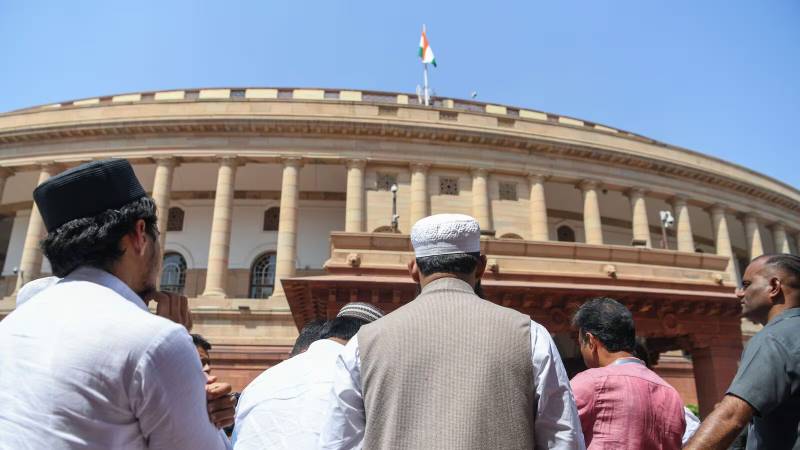
For over a decade, India’s Muslims have felt the squeeze of second-class citizenship in a country constitutionally committed to secularism. Amidst growing communal cacophony elsewhere, Punjab has stood apart, an island of interfaith harmony. But that delicate equilibrium now faces an uncertain future after the Indian Parliament’s passage of the Waqf Amendment Bill 2025.
Where the heartland of India now questions the very existence of ancient mosques, Punjab has been quietly nurturing the opposite spirit. Here, Sikhs and Hindus have not only revived mosques abandoned after Partition in 1947 but have donated land and grants to build new ones, along with graveyards, in villages where Muslim migrants had nowhere to pray.
The number of such mosques has climbed to nearly 200, funded by local residents and panchayats, creating spaces of worship for Muslims migrating to Punjab from across India. However, the new Waqf law bars non-Muslims, and even non-practising Muslims, from donating land to Muslim endowments—a clause that threatens to upend this uniquely Punjabi model of grassroots secularism.
A few years ago, this reporter visited Panjoli Kalan, a village in Fatehgarh Sahib district. In the heart of Sikh religious history—where the young sons of Guru Gobind Singh were martyred—locals were building a mosque inside the premises of a gurdwara. Most Muslims here were migrants from Himachal Pradesh and Bihar, working as agricultural labourers.
“We saw them praying under shady spots in the fields. Eventually, the gurdwara offered them a space to pray on its premises. Then the community decided to allocate a piece of land inside the gurdwara itself for the mosque,” recounted Karnail Singh Panjoli, a senior village resident.
Fatehgarh Sahib’s landscape is heavy with historical scars of Mughal-Sikh conflict and Partition violence. Yet today, a gurdwara and the Dargah Rouza Sharif coexist just 200 metres apart, supporting each other's pilgrimages with open-hearted participation—a testament to reconciliation and mutual respect.
Such stories are woven into the fabric of Punjab today. Across the state, non-Muslims have played a vital role in providing land and financial support for mosques. Following Partition, Punjab’s once-flourishing Muslim population was decimated; homes and mosques abandoned. As Muslims from other states moved in over the decades, Punjab’s non-Muslims helped them find spiritual homes again.
The Waqf Amendment Bill 2025 threatens to undo this fragile progress. By restricting land donations for Waqf purposes to practising Muslims with a minimum of five years’ religious adherence, it invalidates the hundreds of donations made by Sikhs and Hindus.
The law’s logic is riddled with contradictions. Ironically, it allows non-Muslims to be members of Waqf Boards—but forbids them from donating land to Waqf causes
A day after the bill passed, Punjab witnessed rare scenes of solidarity. Muslims and Sikhs united to protest. The Shiromani Gurdwara Parbandhak Committee (SGPC), the apex Sikh religious body, extended strong support to Muslims, calling for the withdrawal of the bill. SGPC president Harjinder Singh Dhami termed the law "an attack on minorities."
Although the law aims to regulate Waqf properties, critics argue it targets the very fabric of Punjab’s interfaith harmony. Professor Gurmail Singh, a retired political scientist from Chandigarh, summed up the sentiment: “The bloodbath of Partition taught Punjab hard lessons. We will not repeat the mistakes of the past.”
If the law prevents non-Muslims from donating directly to Islamic causes, many Punjabis are already considering ways to sidestep it—transferring property titles to Muslim individuals who can then make the donations.
Support for Muslims is both principled and practical. In the village of Umarpura in Malerkotla district, former village head Sukhjinder Singh Noni and his brother donated 5.5 hectares of prime farmland for a mosque earlier this year. “About 30% of our village is Muslim. They had no mosque. This was just our duty,” Sukhjinder said.
At the foundation ceremony in January, Punjab’s Shahi Imam, Mohammad Usman Rehman Ludhianvi, hailed the gesture as “a powerful message of love and humanity.” Other Sikh villagers pitched in with donations, and the mosque's construction commenced.
In Jitwalkalan, another village, 90% of the funding for a new mosque came from Sikh residents. "First they gave us land, then the money," said Mohammed Anwar, a grateful local Muslim.
According to Shahbaz Ahmed Zahoor of Idara Taameerey Masaajid, an organisation supporting mosque construction, around 200 such acts of generosity have occurred across Punjab, resulting in the construction of roughly 100 new mosques.
Yet now, the new law has triggered anger and confusion. By mandating that only practising Muslims of five years can make donations, it leaves past and future acts of interfaith charity in legal limbo.
Critics are deeply sceptical. Shahi Imam Ludhianvi called the bill "illegal" and "deceitful," arguing that it fails to address corruption or mismanagement within Waqf Boards, which was the original stated goal. “Instead, it criminalises our identity and philanthropy," he said. "How does it benefit poor Muslims?"
Moreover, the bill mandates documentary proof for claims over Waqf properties, many of which date back centuries with little formal documentation. For many, this amounts to retroactive disenfranchisement.
The law’s logic is riddled with contradictions. Ironically, it allows non-Muslims to be members of Waqf Boards—but forbids them from donating land to Waqf causes.
Political leaders, including Asaduddin Owaisi, have strongly condemned the bill, calling it a “direct assault” on Muslim religious freedom. "No other community faces such humiliating barriers," Owaisi thundered in Parliament.
In places like Umarpura and Jitwalkalan, Sikhs and Muslims still work together, building mosques, supporting one another’s festivals, and sharing lives. Yet under the new law, their harmony could now be declared illegal
The practical difficulties are staggering: how does one prove five years of Islamic practice? Will certificates of prayer attendance be required? Or affidavits from clerics?
As Owaisi warned, such requirements create a dangerous precedent of religious surveillance, disproportionately burdening Muslims.
Political commentator Sanjay K. Jha, writing in The Wire, termed the bill "a political fraud" dressed up as welfare. Far from helping Muslims, he argued, it deepens marginalisation, isolating them socially and legally.
Jha points out the hypocrisy of a government claiming to champion Muslim welfare while failing to condemn hate speech, lynchings, and economic boycotts targeting Muslims.
“The very government that lectures about Muslim upliftment is the same that imposes special shackles on their religious activities,” he wrote. He described the bill as another entry in the government’s long list of measures aimed at eroding Muslim dignity under the guise of reform.
Across India, the chilling effect is already apparent. Hindus or Sikhs wishing to donate to Muslim endowments must first convert and then wait five years before their charity is considered valid—an absurd bureaucratic hurdle that mocks the spirit of selfless giving.
More disturbingly, it places interfaith charity under surveillance. Ordinary gestures of brotherhood and generosity now risk being criminalised, stifling centuries-old traditions of shared community life.
In Punjab’s fields and villages, where Sikhs and Muslims have quietly rebuilt bonds broken by Partition, the new law feels like a heavy shadow. It sends a demoralising message: interfaith solidarity is suspect; religious charity must be policed.
In places like Umarpura and Jitwalkalan, Sikhs and Muslims still work together, building mosques, supporting one another’s festivals, and sharing lives. Yet under the new law, their harmony could now be declared illegal.
Sanjay Jha sees this not merely as political manoeuvring but as a profound moral crisis. “Evil intentions are often camouflaged by noble pretences,” he warns. “The truth, however, stands beyond these veils, plain for all to see.”
In the end, Punjab’s unique tradition of compassion and co-existence—painstakingly rebuilt after the horrors of Partition—is being tested once again. Whether it survives will depend not on laws imposed from above, but on the unbreakable spirit of the people who continue to believe that love, not hate, should guide a nation’s soul.