

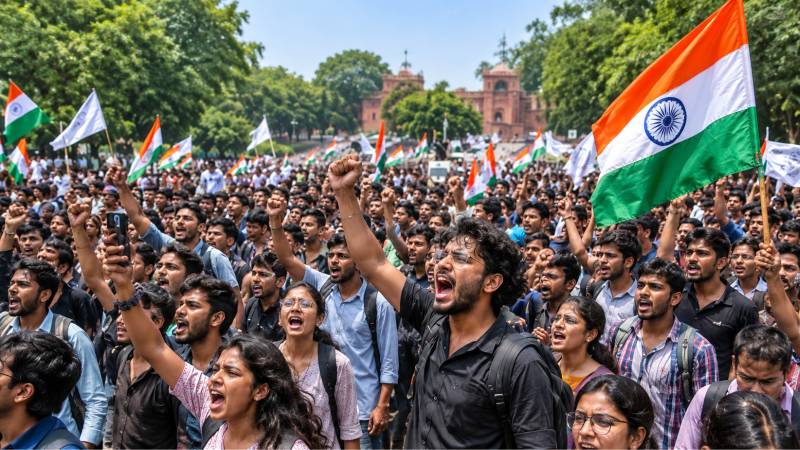
A youth-led movement, in India, that took birth from a critical remark has done something that the traditional mainstream parties struggle to achieve: It has made the government concede. Following the May 15, 2026, Supreme Court hearing with reference to designation of Senior Advocates in Delhi High Court, Chief Justice S.Kant commented resembling unemployed Youth holding fake degrees with “Cockroaches” and “Parasites” which sparked resentment and major online debate on social media, and this statement was interpreted as insulting and derogatory against the country's unemployed youth. Such developments finally paved the way for the emergence of the Gen Z-led, Cockroach Janta Party (CJP) movement that became successful in transforming humiliating remarks into shared political identity and, within days, into anti-government protests. Its primary focus was not to overthrow P.M Narendra Modi’s government but it was centered around accountability for persistent irregularities in examinations, institutional failure, the future of Indian Youth, and the resignation of Education Minister Dharmendra Pradhan.
But following the historical crux of revolutions around the world, we cannot call this resignation a major setback in the Indian Political Sphere, as the Bharatiya Janata Party (BJP) is still in power with full might. But the CJP outbreak depicted something important by its demonstration that a digitally connected generation can convert an apparently ‘isolated youth’ and their grievances into unified political pressure, strong enough to compel the elected government to make concessions. So, the overall moral of this movement does not spin around a single protest and consequent resignation of a minister but also what lessons Youth does have to learn in neighbouring countries.
And, especially in Pakistan, this lesson resonated with full might in the corridors of power. Interior Minister Mohsin Naqvi recently spoke out that if frustrated youth of Pakistan united, they could “turn everything upside down”, and such remarks encapsulated not only the recent Popular rise in India but also prevalent major concerns in Pakistani Youth. And the Pakistani state in the prevalence of security challenges, global energy crisis, flawed governance, and mass unemployment cannot withstand or will not desire to witness such uprisings in the homeland. Pakistan is an exceptional country with nearly two-thirds of its population under 30 but numbers alone do not trigger political movements unless shared grievances unite them. Moreover, such mobilisation in neighbours has raised major debates and questions, in Pakistan, especially among ruling class, the public, and on social media: The real question is not whether Pakistani youth are frustrated; they clearly are. The bigger question is whether that frustration can be turned into mass youth mobilisation strong enough to exploit government policy or challenge the political system.
The overall trajectory of CJP’s (Cockroach Janta Party ) rise, agitation and subsequent resignation of the D.Pradhan unfolds with something that initially appeared trivial: a metaphor. After Chief Justice Surya Kant’s controversial comparison of unemployed young people with “Cockroaches,” Abhijeet Dipke, a 30-year-old with a master's degree in Public Relations, claimed the insult by calling on “all Cockroaches” of India to come together and ultimate response was tremendous as following its creation, CJP crossed 10 million Instagram followers within five days, surpassing BJP’s roughly 8.7 million followers at the time. Moreover, CJP’s name itself was unconventional and overwhelming, which eventually grabbed major Youth attention and brought them closer; A Youth that mostly engages in Politics through social media, its meme culture, political humor, and Mockery rather than traditional political structures. But satire was not enough to bring thousands of people into the streets. Under the cockroach metaphor, there was a much more profound anxiety: The erosion of merit culture and institutional failure.
Firstly, It’s important to learn that, of 1.5 billion Indians, 30% are those whose age is between 15 and 29, and one study at Azim Premji University, Bengaluru, discloses that 40% of young graduates under 25 are unemployed. So, education isn't just a learning phase for millions of Indian students, instead it is the main path through which an average student aspires to achieve social status. Parents borrow loans, spend life savings for the sake of finding the best educational opportunities and students sacrifice their adolescence, preparing for examinations that determine access to medicine, engineering, and other professional careers.
Youth grievances can be buried or suppressed for years, but they can become a breeding ground for mass resistance when institutional failure, political marginalisation and a shared grievance converge.
The main controversy surrounding the latest held NEET-UG 2026 exam on 3rd May, its reporting by Indian Express on 16th May, CBI investigation, consequent arrest of P.V Kulkarni, a Chemistry professor who was a major hand behind the paper leak, all these developments sparked anger, anxiety over fairness, distrust toward NTA, and grievances beyond the NEET exam, both among students and their families. Following this paper leak controversy, 2nd time in the last three years, several suicide stories were reported as according to INDIA TODAY, 22 year old Pradeep Meghwal who was NEET aspirant from Rajasthan, committed suicide several days after cancellation of upheld paper. His family stated that, following the National Testing Agency (NTA) announcement of paper cancellation, he was in deep stress as he expected to perform well in the original examination.
The leaks and irregularities sparked by major allegations created the impression that the system itself is not capable enough to ensure a level playing field for aspirants. So, the major concern did not stick around the paper leak but it also addressed, whether the whole merit system can be trusted or not by placing the grievance in a political hot seat.
The CJP had an idea, what standard political parties usually take time to comprehend, that young people rarely mobilise and withstand beside conventional political parties and groups. Especially when a matter and systemic failure become personal then it paves the way for mass mobilization, anger, solidarity, and ultimately collective action. Congress had raised similar concerns through Rahul Gandhi’s “Chhatron Ki Goonj” campaign on 17 June 2026 in Kota, Rajasthan but failed and Congress MP Shashi Tharoor later acknowledged that it “did not resonate as much.”
To comprehend why Congress could not gain popular support while CJP could, a comparative analysis unfolds with the fact that the difference was clear as Congress was a examined political party many times while the Cockroach party emerged from grievance. Rahul Gandhi sought to provide concerned students a privilege but Dipke provided them with a decentralized platform that they could call their own. So, many factors complementing its uniqueness such as its unconventional symbols, informal uprising, and absence of central and hierarchical structure assisted CJP to grab major attention either in India or globally.
One notable and remarkable change in this digital movement was a gradual 180-degree shift when on June 6, upon Dipke’s return from the U.S.A, CJP supporters, students, and competitive-examination aspirants gathered at Jantar Mantar in Delhi, recorded its very first 7-hour demonstration and demanded accountability, including the resignation of Education Minister Dharmendra Pradhan. Later, we witnessed an indefinite sit-in when student protestors established permanent tents at the historical observatory of Jantar Mantar in the Indian capital on 20th June.
The movement received another significant impetus when Sonam Wangchuk sat beside students, justified student demands, gave the movement a boost and moral authority that CJP somehow lacked. The educationist and environmental activist began a hunger strike at Jantar Mantar on June 28 in solidarity with the protesters’ demands. As CJP was a youth-led campaign, Wangchuk's hunger strike added the dimension of sacrifice and moral struggle for accountability. On July 18, 2026 As his health deteriorated more public pressure mounted against the government on social media and the police eventually moved him to a hospital.
On 20 July 2025, the “Chalo Sansad” March and subsequent confrontation between protestors and security personnel further deteriorated the security situation. Police tried to block the protestors with barricades, tear gas, and lathi charge as they tried to march toward Parliament during the opening of the monsoon session. Rediff Reporting elaborated that 70 protestors and more than 100 security personnel were injured during the confrontation. A blessing in disguise was that despite protestors failing to infiltrate Parliament, this escalation aided CJP to grasp the attention of film actors, civil societies, and international media reporting, ultimately intensifying debate over the government's handling of student protestors, and increasing pressure on the government to fulfil their demands.
Eventually, the NEET controversy accompanied by examination irregularities, sustained Youth Protests, and Social media pressure forced the government to bow down and accept student demands. On 25 July, Dharmendra Pradhan resigned as Union Education Minister and CJP subsequently announced the end of its agitation after negotiations with the government and the acceptance of key demands, including action concerning compensation for families affected by examination-related deaths, withdrawal of cases against protesters and consideration of its examination-reform proposals.
The resignation was undoubtedly a victory for the student lead movement but it is important not to exaggerate what happened. CJP did not topple Narendra Modi’s government, It could not take Modi’s resignation,It did not capture the state and did not change the regime. But what it achieved demonstrated that an organized and united movement can influence state decisions without holding any political stature or office.
Cockroach-led this movement also shares certain features with the mass protests that took place across the South Asian region, in recent years, as economic frustration, digital mobilisation, institutional distrust, and anger at political elites mostly converge and overlap. But India is not Nepal, Sri Lanka or Bangladesh, its political institutions are more democratic, its geography is vastly more complex, its political and economic power is dispersed across multiple centres, and its security institutions have historically remained under civilian political control, in a manner very different from that of several neighbouring states.
So, a more reliable comparison of such an uprising can be drawn with India’s own history. According to Sadanand Dhume, who is a senior fellow for India, Pakistan and South Asia at the Council on Foreign Relations (CFR), the youth-led Sampoorna Kranti (Total Revolution) movement of 1974–75 later led by Jayaprakash Narayan against Indira Gandhi, was also fuelled by unemployment, corruption, inflation and dissatisfaction with institutional governance. They eventually became a much wider political challenge for Indira Gandhi’s government and contributed to the political crisis that culminated in the Emergency imposed at midnight of 25 June 1975. It would be premature and early to predict whether contemporary issues would follow the same trajectory or not but, definitely, sailing would not be smooth for the Modi government. Indira Gandhi, following the Emergency imposition, also seemed firmly entrenched and invincible like Modi until the 1977 elections overturned her government.
All these current developments have a deep connection with Pakistan. India’s CJP movement may have shaken New Delhi, but its more consequential question is now being asked in Islamabad: If Pakistani frustrated youth unite around a common grievance, strongly enough to produce a nationwide uprising, can it influence governance, policy, or can it challenge the government’s hold on power?
The answer is neither an emphatic yes nor an easy no. Pakistan’s Interior Minister Mohsin Naqvi, regarded as very close to the military establishment, recently warned while addressing the Pakistan Economic Summit on July 30 in Islamabad, his speech deserves attention because insights and underlying realities do exist in a country's polarized environment. According to UNDP, Pakistan is predominantly a country with 64% of citizens under the age of 30, and 26% to 30% are those whose age is between 15 and 29, while youth grievances surrounding unemployment, inflation, growing distrust in public institutions, and limited employment opportunities are prevalent. Another survey elicited serious questions about the state policies as according to the 2024-25 Pakistan Labor Force Survey organised by the Pakistan Bureau of Statistics (PBS), Youth unemployment (15-24 years) stands at 12.5% while its ratio from 2020-21 to 2024-2025 increased from 6.3% to 6.9%. If all grievances once United under a single banner, then it will not take much time to turn out Naqvi's recent remarks:
“You can call them youth, you can call them cockroaches, you can call them whatever you want. But if these ‘cockroaches’ unite, they can turn everything upside down.”
Islamic Republic history also tells us its youth does possess such ability to demonstrate political influence, either under a political Umbrella or independently. One such powerful campaign was the 1968–69 NSF campaign, “Decade of Decadence”, which brought together student grievances with workers' protests, opposition mobilisation and general public discontent against Ayub Khan's regime. According to estimates this move mobilised over 10 to 15 million citizens, made the country entirely ungovernable for the state, and eventually Ayub Khan resigned on 25 March 1969. Moreover, the United Students Movement (USM) resistance against Zia-ul-Haq between 1981 and 1984 and the role of students (following the Lawyers Movement) in the 2007 Anti-Musharraf Movement are also prevalent. Despite all the mentioned movements steered around military rule, it does not construct a thesis that the country will or can witness a mass youth-led uprising once the country faces a military takeover; instead, it warns government, policy makers, and stakeholders that:
“Youth grievances can be buried or suppressed for years, but they can be a breeding ground for mass resistance if combined against institutional failure, political marginalisation and a shared grievance.”
The state's evolving focus on narrowing the space against university students to exercise their basic right of freedom of speech, affiliation, or expression alongside reports of instilling patriotism in university students also reflect signs of growing anxiety among the ruling class. Moreover, persistent political polarisation, digital propaganda and mass youth unemployment worsen the situation in an already volatile environment. Recently when the host asked Professor Dr. Pervez Hoodbhoy “Can Pakistan witness a Gen-Z-led popular uprising like India?” on HowDoesitWork.podcast then he replied with shocking remarks that ; Firstly, the actual nursery of major student-led protests ‘Pakistani Educational Institutions’ like Quaid-e-Azam University, Islamabad is under strict scrutiny. Secondly, the Pakistani state can’t grant such political space for protests as India facilitated. Thirdly, the fear of consequences, following recent reports of 40 deaths in ongoing protests in AJK and the history of mass crackdowns against PTI supporters that resulted in the detention of 4000 citizens until November 2024 (Amnesty International Report), has dampened the morale of Youth.
Despite all that, CJP-like uprisings and agitation in Pakistan seems challenging in the current sphere as the young generation is deeply fragmented across PTI, student organisations, religious notions, regional rights movements, ethnic networks and other political groups. Furthermore, their grievances are geographically distinct – insecurity and militancy dominate much of the political discourse in KPK, provincial rights and accountability are central in Balochistan, while in AJK, the issues of reserve Refugee seats, inflation and electricity bill pressures have led to mass mobilisation, and among large PTI supporters, electoral legitimacy, political exclusion and restrictions on political activity are major grievances. So, unlike CJP, which turned a specific grievance into a combined identity, Pakistan has no such grounds to bring together such marginalized fragmented youth.