

Half of Pakistan does not work. Around 120 million people live as dependents, many tied to mosques, madrasas, shrines, or begging, a hidden economic burden rarely acknowledged in official statistics. Absurd as it may sound, the 2023 economic census lays out the numbers clearly.
According to this census, the country has around 604,000 mosques but barely 23,000 factories. The contrast speaks for itself: organisational energy and financial resources are overwhelmingly tied to religious institutions rather than economic production. This is one of the dependency aspects that exists in the country. There are many more.
The Scale of Dependence
If we assume two paid staff per mosque (imam and muezzin), mosques alone employ 1.2 million people. Madrasas add another layer: Pakistan hosts an estimated 36,000 seminaries, each employing an average of five staff, bringing in 180,000 employees. Shrines, numbering roughly 55,000 across the country, typically support two to three workers each, adding another 165,000 employees. That’s more than the population of Balochistan. These roles indeed provide social and spiritual services, but they do not generate transferable skills or scalable economic output in the way that industry, agriculture, or technology can.
Mosques and shrines rarely maintain formal accounts, and madrasas operate largely outside financial transparency. While a few are registered, most rely on undocumented donations and often resist regulation. For analytical purposes, such employment can only be treated as dependent and non-productive.
Some may argue the same about education teachers, like madrasa instructors, who do not produce goods. But the comparison ends there. Teachers equip future doctors, engineers, entrepreneurs, and skilled workers, directly feeding into the economy. By contrast, religious employment structures create neither transferable skills nor scalable output.
Counting the Non-Working
To understand these figures, it is important to show what is being included and excluded. Pakistan’s total population is around 240 million, of which roughly 65 million form the workforce actively engaged in or seeking work. The working-age population (15–64 years) is about 145–150 million, leaving 80–85 million adults outside the workforce. This non-working group consists largely of housewives (around 55–56 million women), along with unemployed adults, students, and others not engaged in productive activity. Added to this are about 30–35 million children under 15 and the elderly above 65, who are naturally dependent.
While industry, technology, and agriculture struggle with underinvestment, the religious and informal begging economies expand unchecked
Within this larger pool of dependents are specific categories tied to religious institutions, widespread begging, and even militancy, each with its own corrosive economic impact.
In other words, a large fraction of Pakistan’s scarce human capital is locked in low-productivity existence. Unlike industrial or service-sector employment, these categories create neither transferable skills nor scalable economic output.
The Forgotten Factor: Beggars
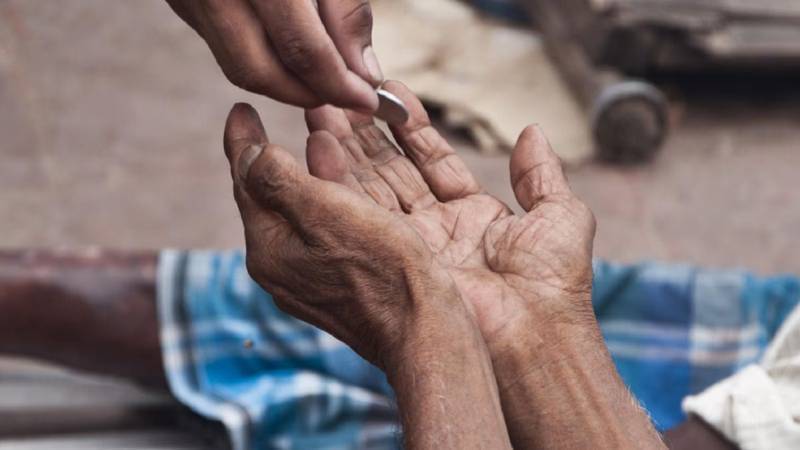
Religious infrastructure is not the only sphere of dependence. Beggary has itself become an institution. Estimates suggest that 2.5 million people survive through begging, including over a million children. This number equals the population of a city like Multan or Hyderabad, an entire urban centre living outside both formal and informal productive sectors.
Unlike mosque or madrasa staff, who at least perform recognised functions, beggars generate no structured services, no training, and no social mobility. Their existence represents the end of a dependency economy.
Beyond Dependence: Predators
Beyond religious and informal dependence, Pakistan faces a uniquely corrosive form of economic parasitism: militancy. Militants and insurgents exploit state resources while actively undermining economic and social stability. While beggars siphon off money through begging practices without contributing meaningfully to society, militants and insurgents contribute nothing other than spreading threats.
They do more than kill and destroy: they extort businesses, disrupt markets, and siphon public funds. According to a recent report, armed groups are diverting 10 percent of government funds in tribal districts, forcing traders to pay extortion simply to operate.
Militants are not just economic dependents; they are economic predators. The state spends billions on counterinsurgency and rehabilitation, while ordinary citizens lose income and opportunity. This form of dependency drains the economy, perpetuates poverty, and erodes the legitimacy of the state.
The Dollar Value of Dependence
The scale of this burden becomes starker when viewed in monetary terms. Pakistan’s GDP per capita is about $1,562. Applying this measure to the 9.23 million dependents tied to mosques, madrasas, and shrines, plus 2.5 million beggars, reveals an opportunity cost of about $18.3 billion annually. That is nearly 5% of Pakistan’s GDP, more than the federal education budget, and almost equal to the annual remittances Pakistan receives from workers in Saudi Arabia. This is the hidden cost of sustaining millions outside productive labour.
An Economy Under Strain
Taken together, the picture is sobering:
9.23 million sustained by mosques, madrasas, and shrines (3.8% of the population)
2.5 million surviving as beggars (1.0% of the population)
108.27 million outside the workforce and not engaged in productive business activity (45% of the population)
The following table gives a crystal-clear picture of the level of dependency that exists in the country:
Table 01: Dependency in Pakistan (Approx. 2023–24)
| Category | People (millions) | % of Total Population (240m) | Notes |
| Mosques, madrasas & shrines | 9.23 | 3.8% | Sustained by donations/offerings |
| Beggars | 2.50 | 1.0% | Includes ~1m children |
| Other non-working population | 108.27 | 45.1% | Housewives, students, elderly, unemployed |
| Total outside productive workforce | 120.0 | 50% | Includes all above categories |
| Active labour force | 65.0 | 27% | Engaged in or seeking work |
| Children (<15) & elderly (>65) | 55.0 | 23% | Naturally dependent |
This is more than an imbalance; it is a structural distortion. Too many Pakistanis survive on donations, shrine offerings, or street alms rather than through labour that expands national output. This is one of the reasons the country keeps seeking foreign aid from the IMF, World Bank, ADB, and bilateral partners.
Towards Hard Questions
None of this dismisses the cultural or spiritual importance of religious institutions. But the economic reality is unavoidable: Pakistan cannot afford to keep nearly half its population outside productive work. While industry, technology, and agriculture struggle with underinvestment, the religious and informal begging economies expand unchecked.
The question is not of faith but of survival. Can Pakistan sustain millions in roles that generate no measurable economic value? Unless this imbalance is addressed, the economy will remain trapped in dependence on foreign loans rather than sustained by real growth. The responsibility now lies squarely with the country’s real stakeholders to confront this challenge.