

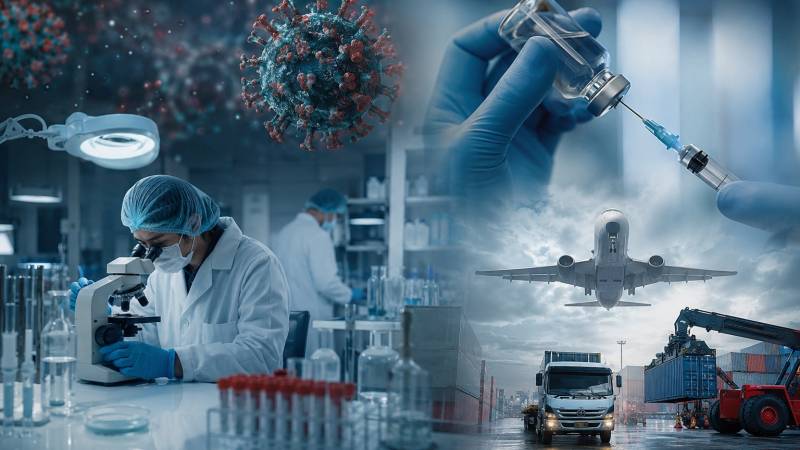
The recent Middle East situation and COVID-19 exposed shortcomings in Pakistan’s pharmaceutical industry that could no longer be ignored. Factories were striving to manufacture tablets, capsules, and syrups, but the real problem they faced was importing active pharmaceutical ingredients. Without these, pharmaceutical manufacturing units could not produce critical medicines.
Experts have said that this reliance is a risky one. According to the Trade Development Authority of Pakistan, some 95 percent of the industry's active pharmaceutical ingredients are imported. Insights from a recent 2024 report conducted by the Pakistan Institute of Development Economics (PIDE) estimate API imports at approximately $330 million in 2022. That said, it also identified $125 million worth of molecules that are produced at home.
The problem is not just securing imported materials. It’s fiscal, too. A weaker rupee means producers have to pay a higher price for imported ingredients. This directly impacts consumers, who then have to pay higher costs. Additionally, logistical constraints persist. Delays in freight, as witnessed in the Middle East crisis, can also hurt Pakistan’s pharmaceutical industry. The delays in delivery can cause shortages of medicine nationwide and force stakeholders to raise prices.
The burden lies with the patient. Uncertainties in hospital supply, shortages in pharmacies, and increased costs for families for essential medicines are detrimental to the health system. According to the BMJ Journals, 55 percent of the physicians in Pakistan report pharmaceutical-related shortages in the country. Due to this, 89 percent of the critical treatments were delayed.
The country exports medicines to 51 markets. Between July and February 2026, the country exported about $230.9 million worth of medicine, notes Pakistan Bureau of Statistics. In November 2025, the government reported export growth of 34 percent and growth of 18 percent in the domestic sector. Radio Pakistan reports profits growing by 78 percent to hit Rs 42.2 billion. Talking about Industry-wide net sales, they rose by roughly 14 percent to Rs 365.7 billion.
Those figures are promising, but there's a big dilemma here. Experts still warn about importing raw materials as a risky endeavour. The sector can expand, but it is fragile. This also affects revenue efforts at exporting. Foreign buyers look for consistency in quality, delivery schedules, and price. If APIs are imported to determine the cost and production plan of a company, none of these can be guaranteed.
Over the years, Pakistan has made multiple efforts to overcome the challenges. The country is capable of packaging medicines and marketing them, but there is a lack of adequate control over the ingredients that provide the therapeutic value to a medicine. The core of the issue is the active substances in the pharmaceutical products. They influence a drug's effectiveness, its price, and accessibility. In times of price increases in API, these hikes are cascaded down the chain and are felt by the patient.
Here, CPEC Phase II can contribute. It should not be limited to roads, energy or to broad investment pledges. Recent engagement with Pakistan has opened the door for China to invest in the pharmaceutical sector. In May 2026, Pakistan and Chinese companies signed ten memorandums of understanding related to API manufacturing, technology transfer, producing vaccines, and pharmaceutical investment.
Unichem Pharmaceuticals Pakistan and China's Xinxu Group announced a Rs10-billion investment. The strategy also covers local production of OMEPRAZOLE API (which historically Pakistan has also been importing around 95 percent of its requirement in the country).
While the agreements are helpful, they aren't enough. More investments are needed to overhaul this sector. Special Economic Zones connected with CPEC could be an appropriate platform. In the case of industrial opportunities, Rashakai is suitable for pharmaceuticals, and Dhabeji mentions chemical and pharmaceutical industries. These areas can draw the investor, supplier, and the regulators together.
Uncertainties in hospital supply, shortages in pharmacies, and increased costs for families for essential medicines are detrimental to the health system.
However, lack of basic infrastructure and energy crisis have caused significant constraints. Unavailability of water, electricity, and gas has made the Special Economic Zones ineffective. Business owners and investors have also called for joining all the Economic zones in the country with motorways and fast-track trains. Moreover, small factories should not be distributed in different areas in Pakistan. API production benefits from clustering of shared laboratories, treatment plants, utilities, storage, and logistics. High scale can reduce costs and enhance quality.
It’s worth mentioning that it is not necessary for all APIs to be manufactured in Pakistan. The first target should be those things that are costly to import, have high local demand, have export potential, and have clear public health significance. PIDE study estimates for the 25 most popular molecules in 2023, which totalled around Rs206 billion or 38 per cent of a total market of Rs748 billion. Only 12 of them were made by local companies as APIs.
These data indicate a clear starting point. The products consistent with this time should include products with a great demand and a heavy import bill in Pakistan. A well-designed industrial policy is always "market friendly" and never "fashionable." But quality will be the key to gaining local production trust. To ensure the quality of API plants, it is imperative to follow strict manufacturing requirements, have reliable inspection, a qualified laboratory, and complete manufacturing records.
DRAP is thus left in a tricky position to balance. It needs to eliminate needless delays without compromising standards. It is also important for international recognition. Government officials say that achieving World Health Organization Maturity Level 3 status could help Pakistan access more than 150 international markets, compared to the 51 markets it currently serves.
Exporting cannot be engineered by itself through a certification, but poor regulation will surely make a certification process less attractive. Such capability of the public also must be borne out by public support. Technological transfer, training, research, quality certification, and commercial production should follow the tax relief, cheaper land, and tariff concessions. Awards should be given not for the announcement but for the outcome.
Vaccines only make this argument more compelling. According to the government's information disclosed in May 2026, poultry vaccines worth $4.5 million are being imported into Pakistan. It also cautioned that the cost of childhood vaccines could go up to almost Rs. 1.2 billion annually after the foreign support mechanism changes by 2030.
Filling and packaging are not sufficient for local vaccine production. It requires quality management, specialization, and technology cooperation over the long term. This is something Pakistan will need to develop in order to upscale. The decision is now made. Pakistan can keep on responding to each pandemic, currency shock, and freight disruption, or take advantage of the opportunity to invest in selected API and vaccine capacity through CPEC 2.0. The 10 new MoUs have given the door a swing – let's execute it.
The surge in the number of factories is not enough to make a resilient pharmaceutical industry. Pakistan needs to show seriousness in the field of science. Furthermore, quality inspection and timely production must be prioritised. A dedicated team or a group is essential to ensure that everything is according to international standards. And that's where a supply shock can turn into a strategic opportunity.