

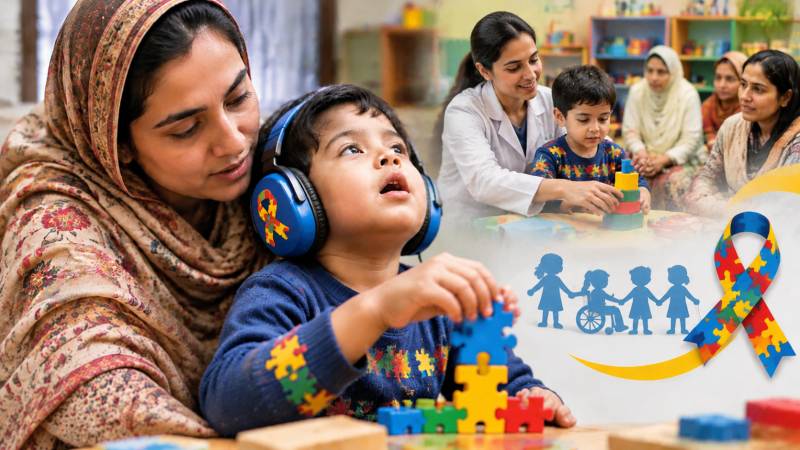
She first noticed it in the doorway. Her two-year-old son would not turn when she called his name, would not point at things, would not make eye contact and never babbled the way his cousin had at that age. She told herself not to worry, saying that boys took longer to talk and assuring herself that there was no reason for alarm. Her mother-in-law, meanwhile, insisted that there was no reason to believe anything was wrong. It would be another year, she would learn, before a doctor could give a name to what she already knew.
This is not an unusual experience for families. A study of children with autism spectrum disorder at a centre in Rawalpindi found that the median age at first consultation was 30 months, the median age at diagnosis was 36 months, and the median age at referral to a specialist centre was 42 months. This represents a year's gap between the first consultation and referral to a specialist, according to research published in the Journal of the College of Physicians and Surgeons Pakistan. Recent tertiary-care data from Karachi suggest that children are, on average, presented to specialist services for suspected developmental conditions at around five years of age, with only a minority receiving consultations before the age of three. International paediatric guidelines recommend autism-specific developmental screening from 18 months. In Pakistan, however, families face delays of up to two or three years in obtaining the right diagnosis, potentially missing critical opportunities for timely early intervention and support.
These delays are not simply the result of limited awareness among parents or society at large. Numerous other barriers also come into play. In Pakistan, developmental paediatricians and other specially trained therapists are available primarily in major cities. Families without access to Karachi, Lahore or Islamabad may face another two or three years of delay before securing a diagnosis. Even in major cities, readily accessible lists of qualified professionals are not always available, resulting in significant information gaps.
Moreover, in a country where nearly 30 per cent of the population lives below the national poverty line, the cost of therapy is no trivial expense. The Pakistan Economic Survey 2025–26 places the monthly consumption poverty line at Rs 8,483.80 per adult equivalent, barely enough to cover basic necessities. To put the costs into perspective, a 2025 study of 30 parents of children with autism in Pakistan reported average monthly rehabilitation expenses of Rs 37,900, comprising Rs 28,500 in direct service costs and Rs 9,400 in other expenses. Seventy per cent of those parents reported moderate to high levels of financial stress.
The Aga Khan University Hospital currently lists charges of Rs 22,360 for 20 speech and language therapy sessions and Rs 18,100 for 10 occupational therapy sessions. Initial assessments and detailed reports are charged separately. Similarly, Shifa Foundation lists a subsidised contribution of Rs 2,060 per therapy support session for donors. These costs accumulate rapidly over the weekly sessions that a child with autism typically requires, often over several years. Add transport, schooling where necessary, and the loss of income when a parent has to reduce paid work to manage appointments, and the financial burden can depend as much on geography and access to services as on a family's income.
Ensuring that no child is left behind is not the responsibility of parents alone; it requires greater public awareness, affordable access to appropriate services, reliable information and policies that are not only written into law but actually implemented.
Pakistan has laws intended to promote the inclusion of persons with disabilities, but implementation remains inadequate. The idea of introducing reserved employment quotas for persons with disabilities is not without its critics. Such criticism often overlooks the well-documented potential for compensatory adaptability when assistive technologies, accessible workstations and reasonable accommodations are prioritised. At present, however, much of this debate remains theoretical. Federal law reserves 2 per cent of jobs for persons with disabilities, while the corresponding quotas are 3 per cent in Punjab and Khyber Pakhtunkhwa and 5 per cent in Sindh. Yet questions remain about how effectively these provisions translate into actual appointments.
Pakistan's 2023 census recorded 3.1 per cent of the population as having a disability, compared with 9.64 per cent classified as having a functional limitation. This suggests that many people with disabilities may be excluded from the categories intended to protect them. The census recorded 691,228 children aged 5–16 in the disability category, while a further 1,304,522 were recorded in the separate functional-limitation category, illustrating the scale of unmet need. The availability of government and charitable services also varies by location, and these barriers extend into education. While financial assistance and assistive devices, including wheelchairs, hearing aids and white canes, are available in some cases for certain conditions, many families of children with autism cannot access the services they need and cannot afford, particularly speech and behavioural therapy, which the existing system does not adequately provide.
Addressing these problems requires more than awareness campaigns. It calls for three specific policy changes: developmental screening as part of district-level hospital care to reduce the delay between initial parental concerns and specialist diagnosis; province-by-province transparency regarding diagnostic and enrolment rates, as well as compliance with employment quotas, so that commitments to persons with disabilities are not merely aspirational; and public health coverage for outpatient care, including speech, occupational and behavioural therapy, with clear eligibility criteria and safeguards against fraudulent claims. These procedures must not become so cumbersome that a mother needs a law degree simply to understand them.
The mother with the child in the doorway is now a few years further along. Her son speaks, in his own way and on his own timetable. What has not changed is that his future still depends on his mother's ability to navigate the system: to find a specialist, understand and afford the fees, withstand disapproval from relatives and fight three separate institutions for the care she knows her child is entitled to receive under the law. Support, therefore, must extend beyond the child. Parent support groups can provide mothers with a space to share their experiences, learn from families facing similar challenges, exchange practical advice and feel less isolated.
No child's future should depend solely on a parent's determination to navigate the system. In Pakistan, meaningful change will require greater public awareness, the dismantling of community taboos, reliable information about qualified practitioners in every city, affordable access to appropriate services, and policies that are not only written into law but also effectively implemented. Ensuring that no child is left behind is therefore not the responsibility of parents alone; it is a collective one.