

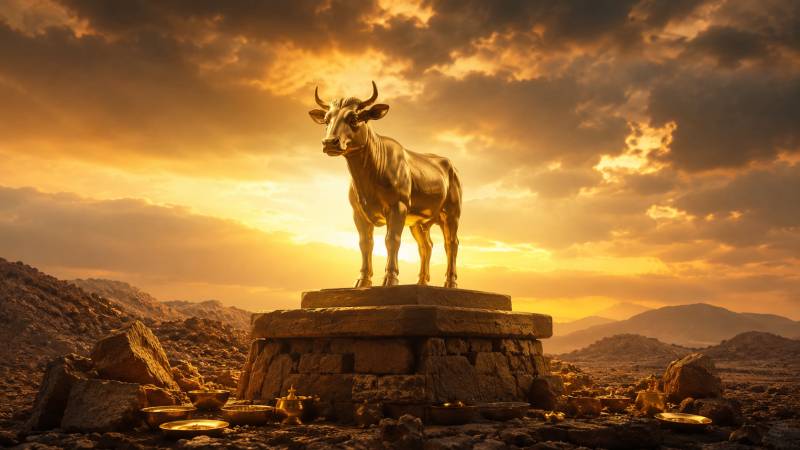
The Israelites did not build their idol from nothing. They built it from gold. Not clay, not wood, not stone pulled from the riverbed, but gold—the same gold they had carried out of Egypt, the material form of whatever security they had accumulated through generations of labour and survival. When they melted it down and shaped it into a calf, they were not reaching for something alien. They were reaching for what they already knew how to trust.
The golden calf is not a story about the worship of something worthless. It is a story about the worship of something real, something that had sustained them, raised in a moment of uncertainty into something final. That is the point. And it is what makes the story not a condemnation but a recognition of something structural in human life.
Every living thing begins with need. Before meaning or identity, there is the body, requiring food, shelter, warmth, and the proximity of others. Forms arise in response. At this level, form is not a problem. It is intelligence. The same is true inwardly. The sense of a coherent self forms in response to vulnerability and uncertainty. Carl Jung called this structure the ego, and insisted its formation is not the problem. It organises experience, manages threat, and allows us to function. The structures of identity begin as survival tools, and there is nothing false about them in their origin.
Aristotle drew a distinction that still holds. He separated oikonomia, acquiring what is needed for a good life, from chrematistics, the pursuit of accumulation as an end in itself. The first is natural. The second is confusion, which means mistaken for the end. What begins as a response to need reorganises itself around its own continuation. Security becomes accumulation. Enough becomes the platform for more. This movement is not only economic. The ego that forms to help us survive can, over time, lose contact with what it formed in response to. The structure remains, but its relationship to its source shifts.
Seen developmentally, this is not only drift but arrest. The movement from basic survival towards more complex forms of awareness and relation does not unfold automatically. It can stall. What was meant to be a foundation becomes a ceiling. The structures that once enabled growth begin to limit it.
Ibn Khaldun saw the same pattern at the level of civilisations. Groups cohere around solidarity forged through shared struggle. But as hardship recedes, that solidarity hardens into hierarchy, then into dynasty, and power concentrates in ways the original community neither needed nor imagined. The form does not dissolve once its purpose is served. It entrenches, and when it does, what was once necessary begins to function as a limit on what might otherwise emerge.
Every form reveals something of the real, but none contains it. To stop at the form is a kind of forgetting
The golden calf sits at this threshold. The Israelites were not inventing a false god. They were in distress. Their leader had disappeared, the ground felt uncertain, and the future unclear. So they reached for what had worked before: the tangible, the valuable, the holdable. They took what had secured their survival and gave it a shape.
The gold was real. The need behind it was real. But something else was also true. They had already been called beyond it. The calf was not only a response to fear. It was also a turning back, a retreat into what had already been outgrown. What had sustained them was asked once again to be sufficient, even after a different possibility had been opened.
This is what gives the story its tension. It is not simply understandable. It is recognisable as a moment in which development falters, in which what has been revealed is not yet lived.
The Buddhist tradition calls this upādāna, clinging. Not need, but the tightening that comes when we try to make something permanent. At the individual level, it appears as identity held so tightly it cannot be revised; at the collective level, as institutions that cannot be questioned.
The same movement appears within religious institutions themselves. Moses finds his people gathered around gold. Jesus overturns the tables of merchants who have reorganised the temple around commerce. Structures meant to orient people towards something larger gradually reorganise themselves around their own survival. What began as a path becomes a destination. The form remains, but the function shifts. Ibn Arabi put it plainly: every form reveals something of the real, but none contains it. To stop at the form is a kind of forgetting.
Karbala makes the same point in sharper terms. Husayn ibn Ali refused allegiance to a ruler whose authority rested on the consolidation of power rather than moral legitimacy. A community formed around purpose had reorganised itself around power. His refusal was a refusal to treat the form as self-justifying. For Shia Muslims, Karbala is not only history. It is a question that returns: whether the structures we inhabit still carry what they were meant to carry, or have quietly become something else.
The body needs food. The psyche needs structure. Societies need institutions. None of this is the problem
Rudolf Otto described the sacred as something that cannot be reduced or contained, overwhelming and fascinating at once. The idol is what remains when that openness is removed, when the mystery is made manageable. What is true of institutions is true of the psyche: the self that can no longer be revised has, in its own way, built its calf.
This pattern is not confined to religious history. It appears wherever human beings build systems meant to carry meaning over time. The United States offers a visible example. The founding commitments—natural rights, limits on power, self-governance—were real aspirations. But over time, a proposition becomes a brand, a brand becomes an identity, and an identity begins to behave like an idol.
Rights are applied unevenly. Institutions designed to restrain power become entangled in it. The language remains while its meaning shifts. The consequences extend far beyond national borders, felt across the Middle East and the Global South.
The same tension appears in societies shaped by strong religious traditions, where faith carries real meaning but becomes entangled with political authority and economic pressure—something many in Pakistan and across the region will recognise in their own lived context.
What emerges is not simple hypocrisy, but something more complex. It is often experienced not as theory, but as a daily negotiation between belief, survival, and authority. This too is the golden calf: the elevation of what once sustained life into something asked to bear more than it can.
If the pattern is structural, what does it mean to move through it? The alchemical tradition offers not an escape but a process. The base material is placed in the fire. What once felt stable dissolves. This is not destruction. It is the condition for clarity. Jung understood this as a psychological unfolding: a period of breakdown, a clearing of perception, and a return, not as escape from form, but as deeper participation in it.
As the structures we rely on are loosened, attention does not collapse inward. It moves in two directions at once, deeper into oneself and outward into relationship. What emerges is not only clarity, but connection—a contact with aspects of experience less organised around defence, and alongside it, a growing sensitivity to others. The movement towards what is often called the transcendent does not take us away from the world. It moves through this widening.
Martin Buber described this shift as a movement from I–It to I–Thou. Simone Weil called it attention. Ibn Arabi saw in it the unity of being. The inward and the outward are not separate paths. They are one.
We need forms. Without them, nothing can be sustained or shared. The body needs food. The psyche needs structure. Societies need institutions. None of this is the problem.
The golden calf was made of real gold. The need behind it was real. The people who built it were not uniquely misguided. They were doing what living things do when the ground shifts, reaching for what had worked, what could be held, what promised to stay still.
That is why the story has lasted. Every generation finds itself holding something real and asking it to be more than it is. The question is not whether we will do this. It is whether we are willing to place what we are holding back in the fire, not to destroy it, but to see more clearly what it is.
The gold was always real. The fire shows us what we had made it carry.