

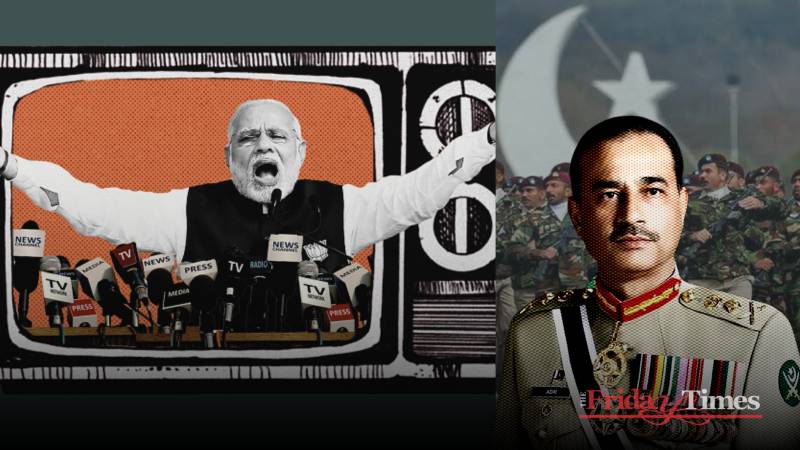
The Indian media is a master of devising theories that suit the interests (or the perceived interests) of the Indian state. The latest among these theories is the speculation that Pakistan’s Army Chief, General Asim Munir, masterminded the Pahalgam attack in order to secure for himself the extension in his service tenure. He had served as DG ISI and DG Military Intelligence in the past, and terror attacks like Pulwama had taken place under his watch. Because of the communal nature of his speech only a few days before the Pahalgam attack, he is now being dubbed as “Mullah General”, “Islamist”, and has been compared to General Zia-ul-Haq. And this theory and its details are simultaneously appearing in multiple Indian publications, which compels one to draw the conclusion that its source or its origin is the same, probably some third-rate intelligence report originating from the desk of some so-called Pakistan expert in some Central Indian Intelligence agency.
One of these media reports even points out that Indian analysts are, at the moment, analysing the psychological makeup and development of General Asim Munir to put the political and military situation faced by the Indian state in proper perspective. While claiming to be analysing the psychological makeup of Pakistan’s top general, all the material on the desk doesn't go beyond the tongue-in-cheek rumors and gossip, which only the non-serious gossip-mongers of Islamabad believe in. India's need for a professional psychological analysis of General Asim Munir’s personality could not be overstated--what kind of response should India expect from Pakistan in case of a surgical Indian strike inside Pakistani territory? How would the Pakistani state define the nuclear threshold for itself? All such questions could only be answered after analysing the psychological makeup of Pakistan’s top general.
Despite this urgent need for understanding the person they are faced with, Indians are in fact recycling their biases, hatred, and prejudices into full-fledged intelligence reports, which are then finding their way into Indian media. For instance, the Indian media’s latest invented theory of blaming General Asim Munir for the Pahalgam attack is an extremely vulgar attempt to implicate Pakistan’s top general on the basis of what will appear as PR-conceived notions and hatred of the person and institution he represents. The argument for implicating General Asim Munir in the Pahalgam attack goes like this: He was DG ISI when the Pulwama attack took place, he needed an extension in service, for which he orchestrated the Pahalgam attack, and now he was taking Pakistan on the dangerous course of military confrontation with India.
Modi wants to consolidate the Hindu vote bank; he needs to win all state elections, and for this, he needs an opportunity to beat the anti-Pakistani drum
Let me invent a counter-theory, for which I have no evidence, but which will serve the political interests of the Pakistan state and which will elevate my status as a patriotic Pakistani journalist at home. It goes like this: India Raw is financing and training Baluch rebels, and Prime Minister Modi is running an aggressively anti-Pakistan policy back home. He needed to win state elections in Bihar, and for this, he allowed Indian RAW to orchestrate the Jaffar Express attack through their proxies in Balochistan. This theory can be extended to the Pahalgam attack; we only have to replace Jaffar Express with Pahalgam, and the rest of the storyline will remain the same. Modi wants to consolidate the Hindu vote bank; he needs to win all state elections, and for this, he needs an opportunity to beat the anti-Pakistani drum. Hence Pahalgam and Jaffar Express attacks. So simple.
As they say, patriotism/nationalism is not only about remembering the past and present, but it is also about forgetfulness. Let's examine what Indian analysts are forgetting while analysing the Pakistani situation and General Asim Munir’s role in it. Till the time when the present crisis in Pak-India relations emerged, General Asim Munir was completely focused on two things: Consolidating Pakistan’s gains in the counter-insurgency operations in North West and Southern Province of Balochistan. Secondly, he was desperately trying to help the civil government of Prime Minister Shehbaz Sharif in its economic revival program. And most importantly, General Asim Munir doesn’t need a crisis to extend his tenure, as the Pakistani parliament has already extended his tenure to five years almost a year ago.
So, the patriotism of Indian media is more about forgetting these highly pertinent facts about analysing the Pakistani situation than about carrying out a dispassionate analysis of General Asim Munir’s political position or his psychological makeup. Similarly, those Pakistani analysts who think Prime Minister Modi has himself ordered the Pahalgam attack should think again that he has, for the past two years, focused on stabilising the situation in Indian controlled Kashmir, where he has been trying to consolidate the gains made by the Indian security apparatus. The question Pakistani analysts should be asking themselves is why would he endanger his gains in Kashmir by orchestrating a terrorist attack that would potentially destabilise Kashmir but would not help improve his election standing in Bihar, where his party is likely to win the elections in any case.
It is now clear that India’s western allies are not supportive of India's response, which would push South Asia into a full-scale military conflict
There is, however, a difference in political situations in Pakistan and India at the moment. Indian society is getting hysterical about going to war with Pakistan. Whereas Pakistani society has so far not yet started taking war as a serious possibility. Indian society is baying for blood. The trends in Pakistani society are extremely non-serious, if trends and memes in social media are any indicator. I have seen very serious-minded Indians demanding that their government launch military strikes deep inside Pakistani territory, with the slightest regard for the implications. On the other hand, the social and political trends in Pakistani society don't at all match the belligerent mood in power corridors in Pakistan.
I believe Indians have been fed on the belief about their superiority in material progress and superiority of their beliefs in righteousness of their counter-terrorism cause--something they believe to be a product of the general political consensus of the whole international community. We have to realise the international war against terror was accompanied by massive propaganda campaign in support of the military efforts of the US-led western world that pressed on one point: state led violence is good, specifically if the state is a democracy and non-state actor led violence is extremely bad, even if the non-state actors are freedom fighters. So the international propaganda and the propaganda of the Indian media machine and India have convinced Indian society that they are on the right side of the divide. Pakistani society, on the other hand, is confused, as their own state and media are saying that Pahalgam is bad. And yet the same state and media are confused about whether Baluch rebels are equally bad. Firstly, western propaganda machinery, which still has vast access in Pakistani society, is not dubbing Baluch as unequivocally bad. There are no voices in support of Kashmiri freedom fighters in the international community. While Baluch rebels are celebrating their terror attacks in Scandinavian countries.
Pakistanis are indifferent towards war or the political and military situation that is emerging on their eastern border. But this situation of public opinion in Pakistani society widens the space for Pakistan’s political and military leaders to make decisions rationally and dispassionately. They don’t need to be influenced by a hysterical public opinion. This will allow them to pull back from the brink without feeling the pressure to perform some spectacular act. I really don’t know how the Pakistani public will react after Indian military strikes have taken place. There is a possibility they will also bay for blood. There is a possibility they remain mostly indifferent. It will largely depend on the target Indians will choose. On the other hand, Prime Minister Modi has put himself in a tight spot by creating war hysteria in his society. Now he cannot pull back from the brink. He will have to do something dramatic to appease his people. This would, in other words, mean that his decisions about launching a military strike inside Pakistani territory would not be based on objective analysis of the military situation, but would be based on the subjective demands coming from the war-mongering of his Hindu extremist constituency.
There is a whole edifice of artificial and fake structures that define India's position towards Pakistan in the wake of the Pahalgam attack--baseless and unfounded allegations, bogus media campaign based on phony analysis, and a political decision-making process that is drawing strength from a hysterical society and public opinion. It is now clear that India’s western allies are not supportive of India's response, which would push South Asia into a full-scale military conflict. Otherwise, Indians would have carried out the strikes almost a week ago. Whether or not Indian strikes would lead to full full-fledged war is not clear. However, this much is clear that even if there is a brief and small exchange of military strikes, Prime Minister Shehbaz Sharif’s program of economic revival will take a big hit.
For the past few months, Pakistan’s economy has been showing signs of recovery. And Prime Minister Shehbaz Sharif appeared jubilant in many of his television appearances. A prolonged military tension with India would also hurt the economic recovery plans of Prime Minister Sharif's government. This, perhaps, could become the basis for any bogus analysis that Prime Minister Modi wanted to ruin Pakistan’s economy by a false flag operation like Pahalgam. But only if Pakistani media could stoop so low as Indian media.