

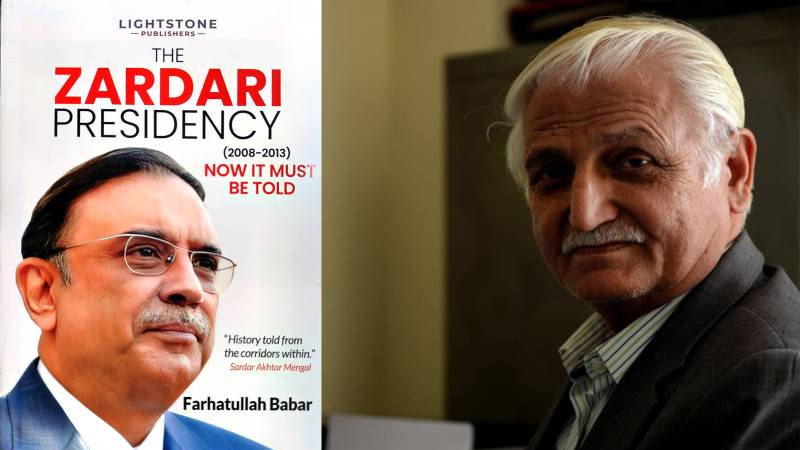
Richard Neustadt’s classic book, Presidential Power: The Politics of Leadership (1960), illustrates how American presidents govern and exercise power. He lists factors like the ability to command, authority, reputation, choice of policies and most importantly, the persuasive capacity of leaders, while exercising presidential power. His key argument is that presidential power is about power ‘to persuade and bargain and not command’. In that continuum, Farhatullah Babar does an excellent job in demonstrating the persuasive powers and resilience of Asif Ali Zardari as President and shielding his ‘reputation’ by mystifying him as, ‘an enigma inside a paradox’ (p.40). He acknowledges that allegations of financial corruption and media portrayals did damage his reputation but insists that it is Zardari’s contributions in politics, sustaining democracy, strengthening parliamentary institutions and a strategic vision for Pakistan that deserve attention.
From that standpoint, his book, The Zardari Presidency (2008–2013) provides a perceptive, insider's version of Asif Ali Zardari’s five-year tenure as Pakistan’s head of state, chronicling a “Tumultuous” period marked by democratic transition, civil-military friction, major foreign policy crises, and constitutional transformation (p.33-34). Babar—an outspoken journalist turned into a seasoned politician, long-time spokesperson of the Pakistan Peoples Party (PPP), and a Zardari amigo—merges political memoir with documentary history. He is up front and emphatic in stating; “Detached academic studies by scholars and media… are available in abundance. Whereas his, “account of the Zardari Presidency from the perspective of a witness and participant— from inside the ring” (p.26). Given this context, Babar does provide informative insights on the politics of decision making at the highest level in Pakistan.
I read this book as a treatise on the politics of decision making in the country, what motivates politicians to converse with each other in informal meetings and make political decisions; sometimes instinctively, other times their assessment of ground realities; conscious of compulsions of ethnic realities and always watchful of the moves of the ‘military establishment’—where distrust and suspicion of each other’s moves is foxy and mutual. In fact, a critical appraisal of Asif Ali Zardari’s politics, policies, leadership and his possible legacy has already begun. In April 2025, Nadeem Farooq Paracha, a renowned journalist and public intellectual wrote in TFT, a chronicle-driven, analytical and remarkably insightful article: Asif Ali Zardari: A Politician’s Politician, identifying nuances and political skills of Zardari and how the death of his wife in 2007 became a catalyst in pushing him into politics and making him an ‘accidental president’ (Babar’s account reinforces it). This led Paracha to characterise Zardari as a ‘realist’ and ‘hard-core pragmatist’ steering stormy Pakistani politics.
Babar remains sharply focused on the ‘persona of Zardari’ and the ‘presidency’ and that makes it an engaging read. The book is divided into ten thematic sections and spans over personal attributes of leadership, domestic governance, foreign relations, crisis management and security policy (458 pages). This review by a ‘detached academic’ concentrates on sections 2, 3, 4, 5, 6 & 7 and forays into five key issues that the author brings to attention: civil-military relations; democratic consolidation and the 18th Amendment; China relations and CPEC; the U.S.-Pakistan crises involving Osama bin Laden, Raymond Davis, and Memogate; and the enigma surrounding Zardari’s persona.
Babar portrays Zardari’s actions as a voluntary “abdication of power,” noting that he could have constitutionally clung to presidential supremacy; instead, Zardari chose to become the designer of post-authoritarian consensus
Civil-Military Relations: Babar details with caution and candour the uneasy relations with the military and how Zardari attempted to redefine the civil-military power equilibrium without prompting open confrontation. While he held the office of President—a position with symbolic stature post-18th Amendment—Yet, according to Babar, Zardari, through his persuasive skills keeps striving to create space for civilian supremacy in decision-making. In chapters 2, 6, & 7, the author acknowledges the military’s dominance in shaping Pakistan’s security and foreign policy, yet documents Zardari’s attempts to assert civilian input. Notably, Babar recalls Zardari’s early push to bring the ISI under the Ministry of Interior—a move swiftly reversed within 24 hours under military pressure. Such episodes show that despite formal democratic transition, the civilian authority suffers from serious limitations. In Babar’s account, Zardari emerges as a ‘cautious pragmatist’.
He illustrates, the November 2008 terrorist attacks in Mumbai, which resulted in over 170 fatalities and brought India and Pakistan to the brink of a military confrontation, were the earliest and most explosive diplomatic challenges of Zardari presidency. The attackers were linked to Lashkar-e-Taiba (LeT), a Pakistan-based militant group which reportedly has close ties to the country’s intelligence agencies. The attacks marked a severe rupture in regional stability and posed an existential test for the president and newly elected civilian government. Babar evaluates this episode astutely, offering glimpses into the high-level decision-making, staying away from poking into the intelligence complexities. Zardari initially adopted a conciliatory tone, signalling Pakistan’s willingness to cooperate with India and promising transparent investigation into any credible evidence. Babar presents Zardari’s response as prudent, wise and posturing peace. While the military adopted a deflective and ambiguous stance (pp. 67-69, pp. 117-118).
Continuing on the fallout effects of the episode, Babar describes Zardari’s televised interview given to Karan Thapar, in which he floated the idea of a “no first use” policy on nuclear weapons vis-à-vis India—a daring statement by a Pakistani political leader. Babar claims, while these gestures were welcomed in diplomatic circles, they drew admonition from Pakistan’s security establishment, who viewed them as unwarranted concessions. Babar avers, “It brought the two countries the closest to war in years and dashed all hopes of peace. The warmongers shattered Zardari’s dream of peace with India by offering talks on No-First-Use”. p.69
The Mumbai attacks highlight the civil-military rupture that ran through Zardari’s tenure. While he envisioned a Pakistan that moved away from non-state proxies and regional antagonism, the military establishment’s entrenched strategic doctrines made such recalibration unattainable. During this crisis, Babar depicts Zardari’s role as a leader who shows preference for de-escalation, seeks multilateral diplomacy and struggles to establish civilian control over the military. Ironically, the crisis exposed the limits to Zardari’s authority: he was unable to bring the military and intelligence services fully in line with his vision of needed transparency and regional rapprochement. This tension resurfaced during the Memogate crisis, where Zardari’s perceived outreach to the U.S. to curb military role led to charges of “treason” in the court of public opinion. Babar contends that Zardari showed prudence and pragmatism in avoiding confrontation with the military to sustain democracy and ensure stability of the civilian regime. The critical question is, why President Zardari could not reach out to the opposition parties and build a coalition to strengthen party system as a counter weight to military dominance?
Democratic Transition & 18th Amendment: Babar is instructive and discerning in narrating the passage of the 18th Constitutional Amendment in 2010—a colossal reconfiguration of Pakistan’s federal structure and executive power. Babar provides behind-the-scenes insight into Zardari’s decision to devolve the sweeping powers accrued by General Musharraf under the 17th Amendment. Theoretically and to a considerable degree in practice, in renouncing the power to dismiss parliament, Zardari broke away from the authoritarian legacy of civilian-military rulers—Ghulam Ishaq Khan and General Musharraf. The 18th Amendment restored parliamentary sovereignty, enhanced provincial autonomy, made local government third tier of the government and symbolically marked a return to the federal vision of the framers of the 1973 Constitution. Babar portrays Zardari’s actions as a voluntary “abdication of power,” noting that he could have constitutionally clung to presidential supremacy; instead, Zardari chose to become the designer of post-authoritarian consensus.
Babar does not claim to be academic or objective; he is sympathetic and rehabilitative and tries to record lucidly & carefully as he observed and witnessed the events and conversations
The passage of the 18th Amendment, Babar argues, reveals persuasive and bargaining skills combined with the weight of presidential power, demonstrating acumen of Zardari as a consensus-building builder political leader. This involved intense inter-party negotiations, within the PPP, with PML-N, ANP, and MQM all engaged in the Parliamentary Committee on Constitutional Reforms. Zardari was crafty in prompting and allowing Prime Minister Gilani to lead and kept himself above the fray, thus helping Pakistan swing towards parliamentary democracy.
China, CPEC and the Regional Setting: Although sceptics would find it hard to fathom but Babar provides valuable insights into Zardari’s foreign policy vision; advocating economic diplomacy, curbing terrorism and improving relations with Afghanistan and India, bridge-building between Iran and Saudi Arabia and particularly his thrust on strengthening of ties with China, yet tenaciously managing bumpy relations with the U.S. Babar mentions Zardari’s nine visits to China during his tenure, but gives little detail on what transpired in these, except, taking away Gwadar port from the clutches of Singapore and creating space for China and that leads him to assert that the ‘jewel of CPEC was studded’ under his presidency (p.74). Zardari revived the Gwadar port project. As a party loyalist, Babar argues, that the CPEC idea had its roots under Zardari presidency and not a post-2013, PML-N government’s product. This section of the book is most revealing, as it recasts the ‘wheeler-dealer’ image of Zardari and accentuates how Zardari anticipated a shift in global power dynamics and sought to anchor Pakistan’s economic future in regional integration with China. Yet in popular perception Zardari is not seen as the primary architect of Pakistan’s CPEC policy, why? Babar does not address it.
Managing U.S.-Pakistan Tensions: Babar does not shy away from reporting the series of embarrassing crises that strained U.S.-Pakistan relations during Zardari’s presidency. Each of the three incidents—the Raymond Davis affair, the Abbottabad raid, and Memogate—exposed vulnerability of Pakistan’s sovereignty, civil-military disjuncture, and ‘roller-coaster alliance’ with the U.S.
In the Raymond Davis case (2011) Babar’s depiction conveys that the presidency was intentionally kept out of the intelligence diplomacy that led to Davis’s release. The glimpses of conversations and interactions that took place among the U.S. ambassador to Pakistan, Senator Kerry, Pakistan’s foreign minister, the ISI chief and the president reveal the complex nature of negotiations in securing the release of the culprit. Despite personal engagement and formal presidential authority Zardari had little operational control in security matters and the military’s dominance were visible and real (pp. 247-261).
Babar describes Zardari’s reaction to the Abbottabad operation (May, 2011), in which U.S. Navy SEALs killed Osama Bin Laden, as one of “strategic shock”. It revealed gross intelligence failure and lack of trust between the civil-military leadership. According to him, Zardari made efforts to salvage Pakistan’s international image, even by writing an op-ed in The Washington Post defending Pakistan as “not complicit.” Yet the event remains shrouded in secrecy. And Babar leaves reader’s guessing what ‘compulsions’, internal or external led to the extension of General Kayani as the COAS? (pp. 429-433)
The Memogate scandal shook the very foundations of the civilian government and Zardari presidency. Husain Haqqani, a close associate of the president, was accused of seeking U.S. help to restrain the military—Babar argues that the military’s reaction to the memo, and the Supreme Court’s willingness to entertain it, reflected the deep suspicion that the military had about the motives of the civilian leaders. The episode led to vociferous calls for the resignation of the president; however, despite serious health issues, Zardari stayed calm, lay low and saved his presidency. These three episodes illustrate the fragility of civilian authority and the deep entrenchment of the military in Pakistan’s institutional matrix. Zardari’s political survival, despite the stigma of corruption, personal tragedy (the assassination of Benazir Bhutto), and systemic media hostility, is depicted as a form of resilience.
In Babar’s The Zardari Presidency (2008–2013), Zardari emerges as a symbol of humility, a devout friend, a persuasive, resilient, pragmatic, rational and strong-willed leader. Babar’s portrayal of Zardari as a visionary leader and strategic thinker is thought-provoking, inviting and could be irksome for some. The reality is that from an ‘accidental president’ (2008), he bounced back in 2024, retaking the presidency, plus other key parliamentary positions is a rare historic accomplishment, if past is an indicator, he is most likely to complete the second term. Humility, pragmatism, resilience and persuasive survival skills are his assets in a volatile, uncertain and unpredictable local, regional and global order. It is too early and hazardous to predicate about Zardari’s impact or legacy!
Babar does not claim to be academic or objective; he is sympathetic and rehabilitative and tries to record lucidly & carefully as he observed and witnessed the events and conversations. The authenticity and primary source value of the book lies in the credibility and repute of Babar. The greatest weakness of the book is lack of any sources, citations and at places it reads like patchy and incomplete columns but its strength is as a primary insider narrative. In my view, the book fills a major gap in contemporary political history writing in Pakistan. A must-read for those who want to understand decision-making at the highest levels, its pitfalls, gaps, and an understanding of key players and the institutional matrix of the country.