

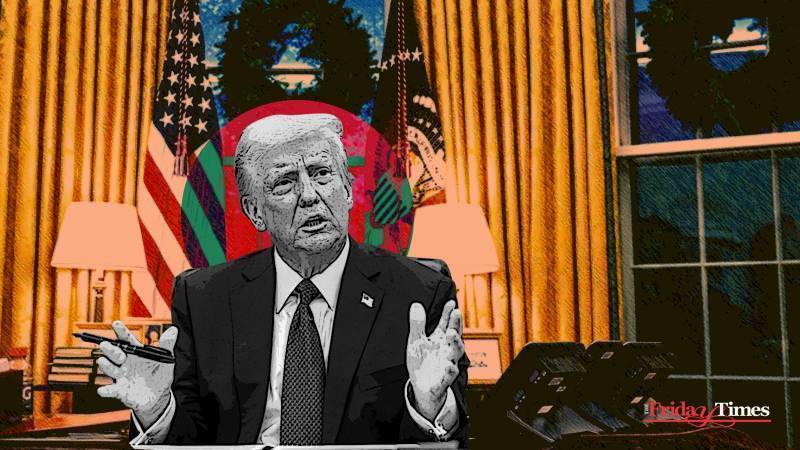
Undoubtedly, President Trump has brought about drastic, almost revolutionary changes in both the political and social order of the US, and has extensively realigned international relations. He has vastly and unprecedentedly expanded the power of the presidency, almost turning it into a personal rule. He has promoted conservatism and banished liberal values of equality, diversity and inclusivity. Authoritarianism is ascendant in the US, contrary to its long-standing claim to be the bastion of democracy and a model of checks and balances. The question to be probed is how and why this transformation has happened in a few months.
The list of far-reaching changes introduced by Mr Trump encompasses almost every aspect of public life and social ideology. Politically, they begin by concentrating unprecedented powers in the presidency. With the control of his MAGA (Make America Great Again) followers, he has almost completely captured the Republican Party. The slight majorities in both the Senate and the House have given Republicans an edge in legislative powers, which they submissively deploy to reduce checks on presidential actions. Similarly, the Supreme Court has been favourably disposed towards many of his controversial policies.
Mr Trump has ignored court orders, commanding public officials to implement his policies regardless of laws and conventions. He overrides states’ authority, sending troops into cities on the unproven claims of ‘cities being burned’ by criminals. Former and present public officials who have pursued inquiries or lodged cases on Trump’s business actions are being prosecuted on flimsy excuses for vengeance.
The Department of Justice has lost its constitutional independence, serving instead as Mr Trump’s personal prosecutor. Long-established Western alliances have been disregarded, and tariffs are imposed on imports from friends and foes alike. Universities are being coerced, with threats to their grants and research funding, to promote conservative ideologies and the Trump government's policies. Almost every day, he springs a surprise by arbitrary acts and policies contrary to long-held public practices and rules.
American identity is increasingly being defined as Christian and white
Socially, Mr Trump has laid the ground for white supremacy and ethnic inequality. There may have been excesses in the liberal drive for diversity, equality and inclusivity (DEI), but banning their use as public policy resurrects racial and ethnic prejudices. Feminism, anti-racism and multiculturalism have been banished from official narratives and policies.
Immigrants are cast as ‘invaders’ in the US, and immigration has been greatly reduced. Recruitment of international students and scholars has been officially discouraged. In pursuit of illegal immigrants, police raids are being carried out in states and cities governed by the Democratic Party and in non-English-speaking communities. Entry into the US has been made difficult, even for those with valid visas. American identity is increasingly being defined as Christian and white. Health insurance for the poor is being cut back, and taxes are being reduced for higher-income groups and corporations. Conservative ideology is flourishing. Masculinity is the theme of official policies.
Yet overall, Mr Trump is quite successful in implementing his views and projecting his personal command over national as well as international affairs. He is a dominant leader who is the arbiter in conflicts between countries. His latest success in getting back Israeli hostages and restraining death and destruction in Gaza, even without resolving the issues, is hailed by Arab and Muslim countries. European and Asian/African leaders seek his goodwill for their governments. China is an exception by standing up to him. He likes being admired and is appreciative of flattery by eminent persons at home and abroad. He likes being courted by people of titles, such as the Field Marshal of Pakistan.
Turning to the question of how he has come to dominate contemporary decision-making, there are three distinct reasons for his prominence on the national and international stage.
Mr Trump’s many behaviours and statements are contrary to the values and norms associated with his office
First, his strong and unrestrained personality has an intimidating effect. He asserts his views and implements his policies with extreme confidence, without harbouring any doubts. He has little regard for his critics and is not reluctant to use abusive language toward them. He calls previous presidents or foreign heads of state stupid or enemies of the US. He has assembled a cabinet that carries out his orders and defends his actions with full obedience.
Second, with the control of Congress and a sympathetic Supreme Court, he has been able to implement his ideas, sentiments and even whims. By politically neutralising checks on presidential power, as discussed above, Mr Trump can act with impunity on his ideas. It is not surprising that a segment of the population has protested by marking a ‘No Kings Day’. Yet he seems unaffected.
Third, a less noticed part of his success lies in his disregard for long-established values, norms or ethics of American political and social orders. He has defied conventions such as presidents not benefiting financially from their position, or being respectful to competitors, or at least refraining from abuse. He has shown no regard for such norms.
The examples can be many, but the point is that such behavioural expectations are norms and values associated with public life and presidential conduct. Violations of norms and values, the software of behaviour, carry no punishment. There may be some public ostracism, but no material or legal consequences. Only one’s own sense of respectability and shame are the checks on the violation of norms and values.
Mr Trump’s many behaviours and statements are contrary to the values and norms associated with his office. His violations of these carry little or no substantive consequences. And he seems to care little for such expectations. The waving away of such expectations is a significant contributor to his success.
What stands out from this narrative of President Trump’s policies and behaviour is that democracy is both a moral and political system. The moral underpinning of democracy is inseparable from constitutional and political organisations. In fact, constitutional and political institutions function properly only within a regime of moral and social order subscribed to by a majority. Without this, inefficiency and corruption seep into political institutions. For an orderly and democratic society, its people must be committed to relevant norms and values. They must honour them and be willing to defend them socially and politically.
The breakdown of social and moral order is also the source of Pakistan’s problems, except that it has not been produced by any strong person like Trump, but by institutions like Mullahism and the military. Its ethnic and regional divisions are the result of false notions of unity and the use of force to address social differences. People’s behaviour does not align with their beliefs. This cultural lag between beliefs and living patterns is a source of much confusion in social and political life. Pakistan needs a cultural revolution, where religious and traditional values are openly discussed, and the role of the establishment is reduced in internal affairs.