

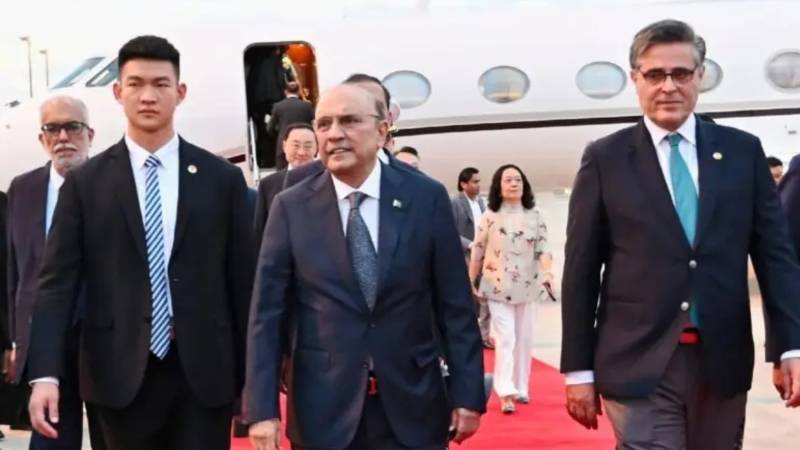
President Asif Ali Zardari’s five-day official visit to China was, by all means, a crucial visit. His visit made significant progress on industrial, agricultural, water desalination cooperation and CPEC 2.0, with several MoUs signed. A joint venture agreement and two MoUs were signed in Sanya on construction machinery, animal vaccines and medical technology, supporting cooperation between Pakistan and China in key sectors. His visit reaffirmed Pakistan’s commitment to the China-Pakistan Economic Corridor (CPEC).
President Asif Ali Zardari’s visit was significant as both countries marked the 75th anniversary of diplomatic relations. President Zardari termed friendship with China the cornerstone of Pakistan's foreign policy; he reaffirmed the two nations' status as All-Weather Strategic Cooperative Partners.
Pakistan-China friendship goes back more than five decades. Zulfikar Ali Bhutto established a strong bond of friendship with China. Mao Zedong and Zulfikar Ali Bhutto established foundational "all-weather" friendship ties and laid the foundation for friendship between China and Pakistan. Bhutto, first as Foreign Minister and later when he became Prime Minister, strengthened ties through the 1963 Boundary Agreement, major economic cooperation, and by making China a "second home" to the Bhutto family.
When Mao Zedong was in poor health and had difficulties in speaking and walking, he nevertheless met Prime Minister Zulfikar Ali Bhutto, who was the last foreign dignitary to meet Mao Zedong at his Zhongnanhai residence. It symbolised the depth and warmth of both leaders’ longstanding relations.
President Zardari went to pay respect to Mao Zedong; he visited Mao Zedong Square in Shaoshan, paid respect and presented a flower basket at the bronze statue of Mao Zedong.
Some of the key highlights of President Asif Ali Zardari’s visit provide insight into both countries’ diplomatic and strategic scenarios. The meeting with Hainan Party Secretary Feng Fei in Sanya was aimed at advancing trade, investment and cooperation in agriculture, port development, seed technology and fisheries, and would strengthen ties in tourism, high-tech industry, enterprise and tropical agriculture. The collaboration would help boost Pakistan's industrial and export sectors.
It is significant to mention that more than 500 Pakistani students are studying in Hainan's universities, which would provide a good number of human resources for Pakistan’s future
As Mr Feng emphasised, since the launch of island-wide special customs operations in December 2025, foreign investment and import values have risen sharply, and trade between Pakistan and Hainan nearly doubled in the first quarter of this year. Hainan has China's largest seed breeding lab, using biotechnology and artificial intelligence; therefore, President Zardari expressed Pakistan's interest in port development, seed technology and fisheries.
President Asif Ali Zardari’s presence at the commissioning of PNS HANGOR reaffirms his commitment to fortifying Pakistan’s defence by acquiring effective deterrence, particularly after India attacks Pakistan in May 2025. It is in continuity of the PPP leadership’s legacy of strengthening Pakistan’s defence, from Zulfikar Ali Bhutto’s nuclear programme to Benazir Bhutto’s missile technology. The advanced state-of-the-art submarine strengthens Pakistan’s maritime defence, protects economic lifelines and reflects a strategic partnership with China.
The induction of the first Hangor-class submarine is a historic step in Pakistan’s naval modernisation. It will also increase the defence capabilities and maritime security of Pakistan. The submarine is equipped with advanced technology, including air-independent propulsion. It is expected to strengthen deterrence and safeguard key sea routes in the Arabian Sea and Indian Ocean. It is also being seen in the context of addressing evolving threats to global trade and energy security.
During the visit of President Asif Ali Zardari, three MoUs in Changsha were signed relating to water desalination in Karachi, agricultural technology and tea sector cooperation, marking continued engagement between Pakistan and China in priority sectors.
Another major highlight of President Asif Ali Zardari’s visit was exploring future possibilities of collaboration with Sany Heavy Industry in Changsha, which has China's advanced high-tech equipment for increased Chinese investment in priority sectors, including alternative energy, water treatment and electric vehicle battery systems, smart manufacturing, and technology transfers in construction and clean energy.
Pakistan imperatively needs modernisation in agro-processing. In this regard, his visit to Hunan Tea Group in Changsha was important to explore cooperation in agro-processing, value addition and supply chain mechanisms. The President invited the Group to bring their expertise in tea cultivation and exports to Pakistan.
In acknowledging and honouring the outstanding services of a Chinese professor, President Asif Ali Zardari conferred the Sitara-i-Pakistan on Professor Pan Xiangbin in Changsha, recognising his contributions to cardiac care, including treatment of Pakistani children with congenital heart disease and training of local medical professionals. Mr Pan expressed his resolve by stating that: "We're committed to sharing the techniques with our colleagues in Pakistan, so that they can save more patients".
Amid global and regional uncertainties and unpredictable challenges after the United States and Israel war on Iran, and the situation arising after the blockade at the Strait of Hormuz, President Zardari’s visit would reinforce long-term economic, industrial, technological, agricultural, livestock, water desalination, alternative energy, electric vehicle battery initiatives and, above all, strengthen maritime security through naval defence via the advanced Hangor submarines. President Zardari’s visit would provide a boost to CPEC, which faced significant slowdowns during the Imran Khan government from 2018 to 2022.
It is significant to mention that more than 500 Pakistani students are studying in Hainan's universities, which would provide a good number of human resources for Pakistan’s future. The students would bring a wealth of knowledge and exposure to the latest technologies, which they could utilise and apply back home in bringing innovations in collaboration with China.
The Government of Pakistan should proactively engage with the Government of China for exchange visits of Pakistani researchers, academia and people from the industrial and technology sectors to China. Pakistani students should be facilitated to pursue higher education in universities in China. The youth of Pakistan can take huge benefit from China’s high-tech and advanced industrial sector.