

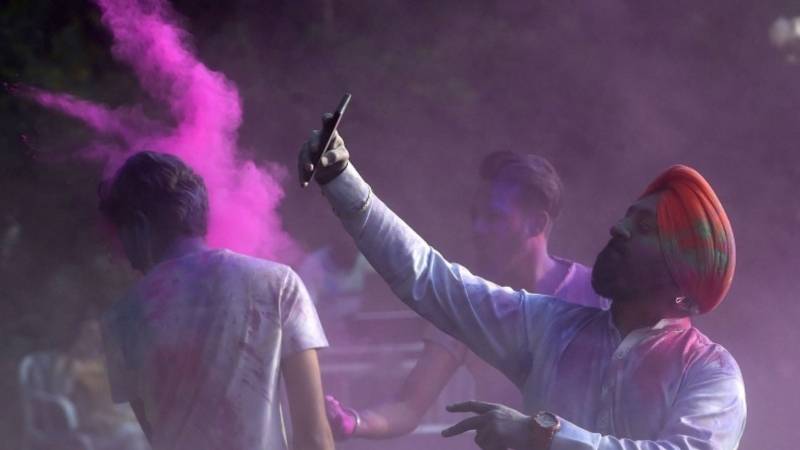
The festival of Holi is an ancient Indian celebration of spring, marked by vibrant colours, music, and communal joy. Traditionally linked to the legends of Krishna, its core ritual is the exuberant throwing of coloured powders and water. What distinguishes Holi is its carnival spirit: for one day, social distinctions of age, gender, caste, or class are suspended. It becomes a festival of inclusion and spontaneity, a joyous leveller that paints everyone in the same spectrum of colour and cheer.
Before Partition, Lahore, like much of northern India, was a city alive with the pulse of Holi. During the Sikh era in the early nineteenth century, the festival was not only widely celebrated but officially endorsed by the state. The court historian of Maharaja Ranjit Singh, Sohan Lal Suri, recorded in his Umdat-ut-Tawarikh that the Maharaja took a keen interest in festivals such as Lohri, Basant, and Holi. At Holi, the king himself would join nobles, commanders, and courtiers in elaborate celebrations.
The 1831 festival, for instance, was held with great pomp and ceremony and witnessed by prominent figures such as Dewan Kirpa Ram and high-ranking chieftains. The ceremonial lac-dye game, a hallmark of Holi, was enjoyed by everyone, great or small. Lavish gifts, robes of honour, and alms were distributed freely, as the Maharaja accepted offerings and reciprocated with generous rewards for both officials and Brahmins.
Perhaps more strikingly, Ranjit Singh used Holi as a tool of diplomacy. As described by Sohan Lal, he welcomed British envoys with great ceremony during the festival. Each guest received baskets of red powder balls and bowls of saffron dye, and the Maharaja himself jovially doused Sir Henry Fane, Britain’s new Commander-in-Chief, with colour. This playful gesture was not just a moment of light-heartedness; it was symbolically significant. In the Maharaja’s own words, it helped water the garden of friendship with his imperial counterparts, revealing how cultural rituals were deftly used to cultivate political ties.
Beyond the royal court, the streets of old Lahore were transformed into a vibrant canvas of public festivity. Younas Adeeb, a twentieth-century resident of the city, described the way Holi turned Lahore’s lanes and bazaars into scenes of collective revelry. At dawn, the city was already in motion. Men and women roamed the streets, their garments soaked in pink and yellow, their faces streaked with red and purple.
Laughter, banter, and unrestrained joy filled the air. Even stray dogs, slow-moving bulls, and curious bystanders became part of the celebration’s natural rhythm. Lahore’s famed havelis and narrow lanes, always rich in architectural charm, appeared even more animated and resplendent under the spell of Holi.
While Hindus led the rituals—singing Holi songs, playing pichkaris, and chanting Krishna’s name Sikhs, Muslims, and even Christians joined the celebration
What made Holi in Lahore especially unique was its spirit of inclusivity. While Hindus led the rituals—singing Holi songs, playing pichkaris, and chanting Krishna’s name Sikhs, Muslims, and even Christians joined the celebration. Tahir Lahori, recalling the city’s pre-Partition fabric, noted that Hindus would often spray colour on their Muslim friends, and no one took offence if a passing stranger got splashed. There were no fights or quarrels, he remembered.
On such occasions, people simply tolerated one another. Men and women participated together, and the entire city seemed to suspend its ordinary boundaries. Even the Sikh Darbar, in a gesture of unity, instructed officials of all faiths to organise the preparation and distribution of gulal. Holi, in Lahore, was not confined to one community; it was shared.
Alongside the official celebrations, a week of harmless mischief and playful antics preceded the main day. Younas Adeeb describes how markets and alleyways brimmed with pranks. In one popular trick, a neatly wrapped box would be placed in the middle of the street to mimic a lost treasure. When someone opened it, expecting coins, they would find a broken shoe instead, and the whole market would erupt with laughter. In another game, a silver rupee was nailed to the ground.
As someone stooped to pick it up, they found themselves the target of collective amusement. Holi was a festival of fun, frolic, and amusement, Adeeb wrote, noting the liberty people took in jesting with friends and strangers alike. On the festival day itself, the city’s streets rang with Holi songs. Water guns sprayed coloured dye, and the gutters flowed with rainbow-tinted streams.
The effect was nothing short of transformative. As Adeeb observed, the whole day was brightened by smiles, laughter, and frolic. Women, too, celebrated with unbridled joy—gathering in homes and courtyards, their saris and kurtas drenched in colour, singing and dancing with playful abandon. The streets and by-lanes of Lahore turned colourful, he wrote. Along with the throwing of colour, Holi songs were sung, and coloured water flowed along the gutters. For a brief week each spring, Lahore shook off its daily routines and divisions, becoming a city united by spontaneity, mischief, and joy.
The communal spirit of Holi was perhaps most dramatically on display in the processions that wove through the city. Professor John Campbell Oman of Government College Lahore documented his experience of witnessing these parades. Through the labyrinthine streets of the Walled City, vibrant floats appeared at regular intervals, featuring figures of Radha and Krishna, flower garlands, musicians, and dancers.
Influenced by Social Darwinist thought, the British Empire often depicted Indian traditions as backwards to legitimise its civilising mission
Young men shouted joyfully as they hurled gulal into the crowd, while neighbours on balconies and rooftops rained coloured water from above. The energy was infectious, and the processions flowed like a river—one group followed by another, blending into a continuous current of movement and music. Even non-Hindu families took part, watching and celebrating from their homes. For hours, Holi swept through the city, turning its corners and courtyards into theatres of joyous expression.
Sikh communities had their own affiliated celebrations that often coincided with Holi. Akali Nihang Singhs paraded through the Delhi Gate area in their distinctive martial dress, performing weapon demonstrations and sharing in the colour play. Members of the Sanatan Dharm Sabha led devotional songs, and the processions moved under fluttering flags and bursts of colour.
These displays, although rooted in different religious traditions, echoed the same spirit of open-hearted celebration and mutual respect. Occasional moments of playful rivalry between groups only added to the merriment. The streets of Lahore belonged to everyone on Holi.
Under the British Raj, however, the celebration of Holi in Lahore came under missionary scrutiny and reformist pressure. By the late colonial period, some Christian missionaries denounced the festival as immoral and sought to replace it with a more restrained “Purer Holi,” organised in collaboration with sections of the urban Hindu elite.
These sanitised events, often held under missionary supervision, aimed to replace what was portrayed as the indecency of traditional Holi with a morally acceptable version. Records from 1896 to 1902 describe meetings of the Lahore Christian Mission encouraging such reforms, suggesting that educated Hindus were growing disillusioned with older customs. In practice, however, these campaigns had limited reach. While a few high-society gatherings adopted the cleaner format, the broader public remained loyal to Holi’s original vibrancy and inclusiveness.
These missionary critiques were more than religious disapproval. They reflected a larger colonial strategy to reframe Indian society through the lens of imperial morality. Indigenous customs were measured against the values of the Raj, and anything falling short was labelled deviant.
Influenced by Social Darwinist thought, the British Empire often depicted Indian traditions as backwards to legitimise its civilising mission. As Edward Said noted, colonial regimes preferred not to assert their superiority directly but to portray the colonised as inherently inferior. The effort to purify Holi thus served dual purposes: projecting moral reform while reinforcing political domination.
Today, Holi in Lahore survives only in memory and in modest temple gatherings. The grand processions no longer colour the city's bazaars, and only a small number of devotees gather at the Krishna and Valmiki temples each spring. Communal tensions and demographic shifts have all but ended the public observance of what was once a city-wide jubilee.
Yet the echoes of Holi remain in Lahore’s cultural memory—memories of laughter ringing through the alleyways, of children and elders united in play, of a city that for one week each year became a living kaleidoscope. In an era increasingly marked by cultural amnesia and social division, remembering how Lahore once celebrated Holi is not just an act of nostalgia. It is a call to imagine a future that embraces complexity, honours shared histories, and finds joy in difference rather than fear.