

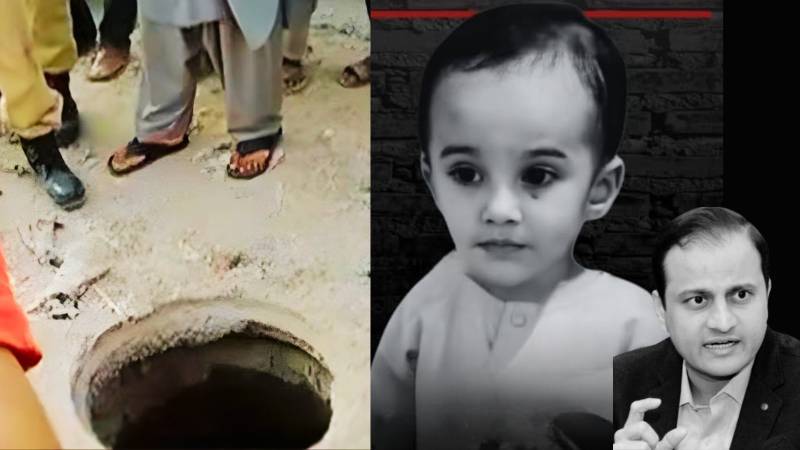
The death of three-year-old Ibrahim is most tragic – not only because he had lived for only three years but also because his falling into an open manhole was entirely avoidable.
The city of Karachi and those who run it, at all levels, failed him. Those whose job it was to ensure that any manhole without a cover is quickly covered with a replacement failed him. The department store that he and his family had gone to and were coming out of also failed him, because it had encroached upon a stormwater drain, to which the manhole was connected, and had built a parking lot over it. The police also failed Ibrahim because, if they had wanted, they could have put a stop to the racket of manhole cover theft in the city, since the primary scrap dealers who buy these from the thieves are known to the police.
The responsibility lies first with those who run the city, and that includes the Karachi Metropolitan Corporation, which is headed by Karachi Mayor Barrister Murtaza Wahab, and then by the Union Council of the area where the tragedy happened, Gulshan-e-Iqbal, and its town municipal administration (TMA), which is in charge of things like roads, sanitation, and sewerage.
When the tragedy happened, the political polarisation which is found in the city came to the fore. The mayor is from the PPP, and he was roundly attacked on social media, usually by those who don’t like the party and/or support parties that oppose the PPP. The TMA under whose jurisdiction the tragedy happened is run by the Jamaat-e-Islami, and therefore, the whole incident became politicised. This went to such an extreme that a controversy erupted even over who discovered the child’s body the next day, with opposition parties and supporters claiming that a ragpicker found the body, and the KMC refuting this and saying that it was its rescue team that did so. Either way, such a level of politicisation should always be avoided, especially in a time like this.
Good sense seems to have prevailed with the Karachi Mayor Murtaza Wahab taking the lead. He visited the family home of the deceased child and met his grandfather and other members of the family, and he sought their forgiveness.
It’s not just the Mayor of Karachi or the KMC but society as a whole that needs to see to it, by acting as watchdogs on the authorities, as well, that Ibrahim’s tragic death does not go in vain
After the meeting, he told reporters that, being a father himself, he could deeply feel the grief of the family. “I had no words when I heard the cries of Ibrahim’s mother. I am also a parent, and as a father, I can imagine the pain this family is going through. May God never let another mother lose her child. We all have a responsibility to make this city safe. I, my team, and the entire city administration seek forgiveness.” The Mayor also said that Ibrahim’s grandfather spoke with “great kindness” and said, “the child lived the life Allah had destined for him.” The grandfather expressed the hope that such steps be taken so that no similar tragedy occurs in the future.
Following the tragedy, senior officials of the KMC, as well as the Karachi Water & Sewerage Corporation, were suspended, as were several other local land revenue officials, as well as the assistant commissioner. The Mayor has said that more action will follow once a detailed inquiry into the tragedy is completed.
Given the massive size of Karachi and its population, and the fact that the city, as per the Mayor’s admission, has over 245,000 manholes, it is very likely that at any given point in time, a handful, at the very least, will always be without a cover – for whatever reason, usually theft. The point here is that while it is the government’s primary responsibility to ensure that any open manholes are covered immediately, the general public also needs to keep a close eye on them, especially those who live in a certain area where open manhole or manholes are present. The Mayor did say that he had checked the record of the helpline, and no one had reported that this particular manhole didn’t have a cover.
There is already a hotline in place where citizens can report a manhole without a cover, and it is up to the KMC or the local union council acting through the TMC to ensure that it is covered very soon. In this particular case, the role of the large department store where the child had gone with his family for shopping also needs to be investigated, since reports suggest that it had encroached upon a stormwater drain to which the manhole was connected. This is a very common occurrence in Karachi, and all such encroachments by businesses and commercial establishments should be removed permanently, and the encroachers given hefty fines.
The Mayor should also order a citywide audit of manholes so that a comprehensive database can be drawn up. This will allow for quicker and more effective monitoring and rapid replacement when covers are found missing. Priority should also be given to manholes close to public parks, playgrounds, schools, etc. The city should stop installing covers made of steel or iron and switch to those made of polymer fibre. It should also work towards having covers that can be locked, therefore making it hard for them to be stolen.
Manholes left uncovered around private building sites or close to excavation work being done by government agencies must always be cordoned off by suitable warning signs and protective barriers. Contractors who do not follow these guidelines should be blacklisted and fined. Officials directly responsible for such tragedies should not be merely suspended and transferred elsewhere but should be punished through the legal system for their negligence, which resulted in the entirely avoidable death of a human being.
It’s not just the Mayor of Karachi or the KMC but society as a whole that needs to see to it, by acting as watchdogs on the authorities, as well, that Ibrahim’s tragic death does not go in vain.