

Mujhe ek nauras kalī ne
yeh ṭa‘na diyā thā:
"Terī ‘umr kā yeh taqāzā hai
tū aisē phūlon kā bhanwra banē
jin mein do chār din kī mehak rah ga’ī ho."
(A tender, unopened bud once taunted me:
“At your age, it is only natural
that you would hover like a bee
around flowers whose fragrance
has only a few days left.”)
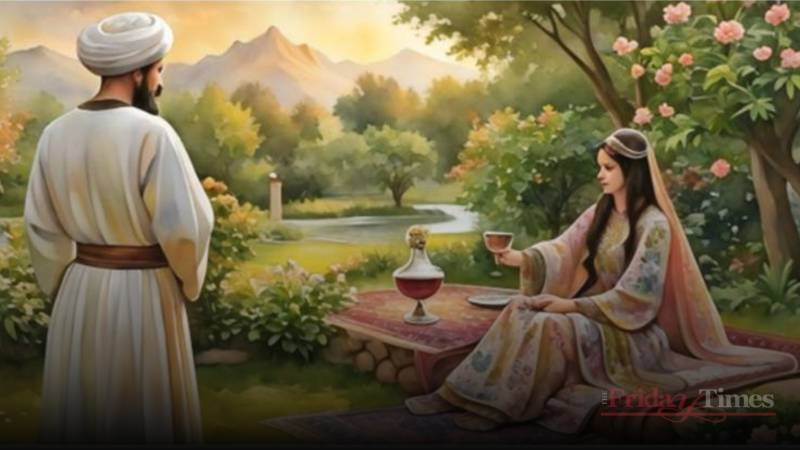
These lines appear almost at the beginning of a relatively lesser-known or scarcely discussed poem by N. M. Rashed, Shabāb-e-Gurezān (The Fleeing Youth)." This poem unfolds through the voice of an ageing man who stands at the threshold between longing and resignation. The drama pivots on a stark, almost cruel opposition: the world-weary, ageing male speaker and the “tender bud” who mocks him.
Rashed is a modern poet with a contemporary sensibility, but the disjunction he highlights in his poem is by no means new. Classical and modern Urdu and Persian poetry are replete with examples of this unequal pairing — though it may not have been seen as a disparity at all — where an ageing or even aged male seeks affection, intimacy, or recognition from a young or still-blooming beloved. This recurring trope transcends time and tradition.
Almost a thousand years ago, Hafez wrote:
"Garchē pīram, tū shabī tang dar āghūsham kash
Tā sahargah ze kanār-e tū javān barkhīzam"
(Though I am old, pull me tight into your arms tonight,
So that by dawn I may rise young again from your side.)
Mīr offers a poignant reflection on this temporal irony:
"Qudrat ne āsmān kī ‘ajā’ib kiā sulūk
Pīr-e kabīr jab main hu’ā, woh javān hu’ā"
(What strange injustice has heaven shown!
I grew into an old man just as she became young.)
And our senior contemporary, the veteran poet Zafar Iqbal, says with a sharp tinge of self-aware irony:
"Us shokh pe marnā to baṛī bāt hai, lekin
Kahte hain ke "is umr mein achchhā nahī̃ lagtā"
(To die for that playful beauty is no small matter, but
They say at this age, it no longer looks becoming.)
In contemporary Urdu ghazal, the same age asymmetry often appears in a more subtle, sublime, and suggestive form — one that does not directly state the disparity, but hints at it through tone, relational dynamics, or emotional distance
Each of these couplets presents a different mood — from Hafez’s sensual yearning, to Mīr’s melancholy observation, to Zafar Iqbal’s wry wit — yet they all circle the same emotional truth: the portrayal of an ageing male in the shadow of youthful beauty, a dynamic that is at once poignant, ironic, and deeply human.
These couplets make the age gap between the older male speakers and the younger beloveds quite explicit, in the last two even somewhat ironic in tone.
However, in contemporary Urdu ghazal, the same age asymmetry often appears in a more subtle, sublime, and suggestive form — one that does not directly state the disparity, but hints at it through tone, relational dynamics, or emotional distance. The poetic voice still belongs to an older male, but the beloved now exists not in contrast, but in delicate counterpoint. Age difference is neither flaunted nor concealed; it is insinuated, allowing layers of meaning to unfold.
Consider this couplet by Ahmad Mushtāq, where regret and nostalgia blend into the realisation of faded desire:
"Woh jo raat mujh ko baṛe adab se salām kar ke chalā gayā
Usē kyā khabar, mere dil mẽ bhī kabhī ārzū-e gunāh thī"
(The one who respectfully greeted me last night and walked away —
What would he know, that once my heart too had yearned for sin.)
Here, the age gap is never named, but powerfully suggested through the female’s excessive politeness and the speaker’s private, fading memory of transgression. It is a moment of quiet devastation: the beloved no longer sees the speaker as a figure of passion but of decorum, of reverence — as one who belongs to another emotional generation.
In another couplet, Muhammad Khālid traces a similarly complex transformation in relational dynamics:
"Woh mere dil kī ghalat khwāhishē̃ bhī jān gayā
Ab us ke dil se merā ihtirām khatm hu’ā"
(He came to know even my heart’s misguided desires —
And from that moment, his respect for me vanished.)
The phrase “ghalat khwāhishē̃” (misplaced or inappropriate desires) acts as a quiet marker of generational inappropriateness, hinting that the speaker’s feelings may have been deemed unseemly due to age or status. What’s significant is that respect replaces intimacy — a recurrent theme when the lover has grown older while the beloved remains young.
In a more quietly aching register, Aftab Husain presents a stark contrast between emotional transparency and social performance:
"Main dil ko khol kar rakhtā hū̃ us ke sāmnē, aur
Woh ādmī adab-ādāb mẽ paṛā hu’ā hai"
(I lay my heart bare before her, and
She remains entangled in courtesy and decorum.)
Here, the speaker’s emotional candour is met not with reciprocal affection but with a distancing politeness — a polite refusal that does not reject, but gently avoids. The beloved’s preoccupation with “adab-ādāb” becomes a barrier, an unspoken signal of discomfort, perhaps with the speaker’s age, vulnerability, or intensity. The age difference is not named, yet it echoes through the interaction, in the form of emotional asymmetry.
Together, these couplets suggest that in modern Urdu ghazal, the theme of an older lover yearning toward a younger beloved has not disappeared; it has instead evolved from overt declarations to nuanced implication, from proclamations of virility to meditations on absence, distance, and fading relevance. Where once the older lover boasted of passion despite time, now he quietly mourns what can no longer be enacted, or even desired without shame.
This shift in tone reflects not only literary change but also cultural self-awareness: a recognition of shifting power dynamics, a more introspective exploration of age, loss, and emotional honesty. The ageing male figure now carries not heroic longing but fragile memory, and the beloved ever-young appears not as muse or flame, but as a distant silhouette walking respectfully away.
But what if we reverse the conventional age dynamic — if the lover is a young, budding man, and the beloved an ageing, perhaps even elderly woman? Does such a pairing seem incongruous, aesthetically jarring, or even improper within the domain of our poetic sensibility? It is a telling question, because while literature — particularly classical Persian and Urdu poetry — has long accommodated the image of the older male and the youthful beloved, its mirror image remains largely uncharted, or at best, marginalised.
In contrast to Mushtāq Lakhnawī’s aesthetic tenderness, Munīr Niyāzī presents a starker and more sombre image of time’s devastation on feminine beauty
And yet, life itself does not observe such aesthetic decorum. In the real world, such relationships exist — quietly, meaningfully. They have even found space in mythic and religious traditions. The love of an ageing Radha for Krishna, or the tale of Zuleikha and Yusuf in Islamic tradition, both reflect this reversal of age roles: where the female figure carries the weight of years, and the male becomes the site of unspoiled beauty or awakening.
This poignant reversal receives a haunting, deeply human portrayal in Akhtarul Iman’s poem: Dāsna Station kā Musāfir (The Traveller of Dasna Station), where Qaisar, the woman once central to the poet's life, appears only in memory — but what a vivid, emotionally charged memory it is. She is remembered not as a distant muse but as a fully fleshed, intimate, ageing woman — once full of fire, now lost to time and partition.
The poet says:
"Is diyār mein shāyad Qaisar ab nahī̃ rahtī
Woh baṛī baṛī ā̃khẽ ab na dekh pāū̃gā"
(Perhaps Qaisar no longer lives in this land,
I shall never again see those large, searching eyes.)
The tone is not one of exoticised longing for youthful beauty, but of loss shaped by memory, by time, by emotional weight. This beloved is not imagined in the glow of her prime alone, but remembered through the passing of years, in the stillness of spaces they shared, in the rhythm of intimacy once lived:
"Deorhī kā sanāṭā aur hamārī sargoshī
'Mujh se kitne chhoṭe ho'
Main ne kuchh kahā thā phir
Us ne kuchh kahā thā phir
Hai raqam kahā̃ woh sab"
(The silence of the threshold, and our whispering:
'How much younger are you than me?'
I had said something then,
She had said something then—
But where is all of that now, written down?)
This brief exchange — "Mujh se kitne chhoṭe ho?" — captures with aching simplicity the awareness of age difference. But it is not guilt or shame that inflects this moment — it is tenderness, acceptance, mutual complicity. Akhtarul Iman dares to present a woman who is not only older but also fully desiring and desired, cherished and remembered not in defiance of age, but in tandem with it.
The reversal of the conventional age dynamic in Urdu love poetry — that is, the portrayal of an ageing beloved and a younger lover — is rare, but not absent. It surfaces occasionally in modern and contemporary ghazal, offering a quiet subversion of established aesthetic norms. One of the most striking and earliest examples of this reversal comes from a lesser-known and nearly forgotten poet, Mushtāq Lakhnawī, possibly writing in the early decades of the 20th century. His couplet carries an extraordinary aesthetic delicacy:
"Dhalā hai ḥusn lekin rang hai rukhṣār-e jānāñ par
Abhī bāqī hai kuchh kuchh dhūp dīvār-e gulistāñ par"
(Beauty has waned, yes, but there is still colour on the beloved’s cheek —
Just as some sunlight still lingers on the garden wall.)
This verse reconfigures the trope of beauty not as eternal youth, but as fading radiance —a sunset glow rather than the noon of spring. The metaphor of "sunlight on the garden wall" is gentle, tender, and profound, suggesting both loss and endurance, the last warmth before night. The mention of rang (colour) works doubly: it evokes the beloved’s fading charm and the persistent beauty of spring’s afterglow.
The celebrated fiction writer Intizār Ḥusain, while translating Attia Hosain’s iconic English novel Sunlight on the Broken Column into Urdu, once shared with me that he was tempted to borrow the phrasing of Mushtāq’s couplet — “Abhī bāqī hai kuchh kuchh dhūp” — for the title. How apt that would have been! Yet, to great disappointment, the published translation bore the more literal and prosaic title: Shikasta Sutoon par Dhūp, which lacked the poetic luminosity of the former phrase.
In contrast to Mushtāq Lakhnawī’s aesthetic tenderness, Munīr Niyāzī presents a starker and more sombre image of time’s devastation on feminine beauty. His couplet is direct, but lacks the lyrical subtlety of Mushtāq’s:
"Waqt ke sāth ‘ajīb sā ban jātā hai ādmī
Hālat dekh ke dukh hu’ā āj us parī-jamāl kī"
(With time, one becomes strangely altered —
Today I felt grief seeing the condition of that fairy-like beauty.)
This is not just a recognition of ageing, but a lament for transformation, for decline. Where Mushtāq Lakhnawī offers a sun-warmed elegy, Munīr Niyāzī gives us the cold gaze of realism. Beauty, once radiant, now elicits pity, not passion.
Aḥmad Mushtāq, a poet deeply attuned to the passage of time and its psychological residues, gives us a hauntingly evocative couplet:
"Dil pareshāñ ho gayā rang-e zawāl-e ḥusn se
Āg dekhī thī, dhuāñ pehlē kabhī dekhā na thā"
(My heart was disturbed by the colour of beauty’s decline —
I had once seen the fire, but never before the smoke.)
Here, the poet meditates on the poignant aftermath of fading beauty. The beloved, once radiant and consuming like fire, has now entered a phase of decline — not sudden or dramatic, but slow and residual, like smoke. The speaker confesses that while he had once seen the fire — the youthful beauty that burned bright—he had never seen the smoke: the lingering signs of ageing, the quiet erosion of allure. It is this unfamiliar, unsettling transformation that disturbs the heart. He conveys not just loss, but the ache of witnessing beauty’s slow and irrevocable departure.
In contrast to these solitary visions, Sāqī Fārūqī captures a shared temporality — both lover and beloved growing old together, echoing John Lennon’s intimate vision, “Grow old along with me, the best is yet to be.” His line is brief, yet expansive:
"Tujh par bhī ḳhizāñ baras rahī hai, mujh par bhī zawāl ā gayā hai"
(Autumn is descending upon you, and decline has come to me too.)
This is a rare moment in ghazal — a kind of emotional parity, where love is not frozen in the asymmetry of age, but softened in shared decay. They are no longer lover and beloved, but co-travellers through time, weathering the same storm of impermanence.
Finally, Khursheed Rizvī offers a cosmic, dignified view of diminishing beauty. In his hands, the ageing beloved becomes almost astronomical, her face compared to the waning glow of the sun:
"Ab bhī woh rū-e dil-nashīn, zard sahī, ḥasīn to hai
Jaise jabīn-e āftāb marḥala-e zawāl mẽ"
(That lovely face is now pale, but still beautiful —
Like the sun’s glowing brow in the stage of its setting.)
This couplet elevates human ageing into the realm of celestial metaphor. There is no regret here — only reverence. Beauty has passed its peak, but it remains dignified, illuminated, and mythic.