

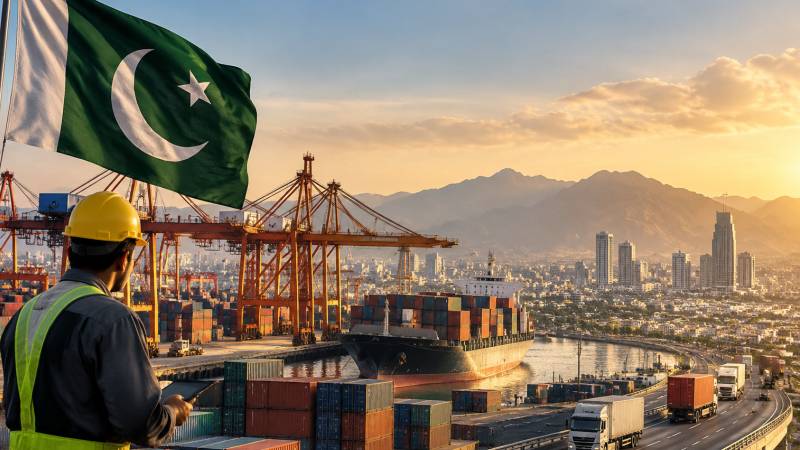
History’s gears don’t just turn quietly in the background. They shake the very floorboards under nations. While they force them to adapt or fall behind. Right now, Pakistan stands smack in the middle of one of those big shifts. Some countries react with suspicion and isolation. Others just stare sadly at the progress of their neighbors, stuck in a rut of self-pity. But every once in a while, there’s a state that grabs the moment, cuts through illusions, gets real, and starts building with whatever it got. Too often, talking about Pakistan abroad boils down to a tired roll call of financial stress. They discuss ballooning debts. Paying heed to the fueling, rising inflation, big deficits. Sure, these numbers matter. Public debt is a real concern, and it needs cold, hard honesty, not panic or spin. But honestly, a country is more than a balance sheet. A country is more than a balance sheet. A state is more than its ledger. What matters is how it plays its cards on the world stage.
If Pakistan really wants to break free from decades of playing catch-up, it needs to ditch the crisis-mode mindset and think bigger, about building real strength, not just plugging financial leaks. This is the heart of the Pakistan Uraan 2030 Initiative. It isn’t just another bailout plan. The goal is to climb higher and build a competitive, modern economy that can actually hold its own. The biggest asset? People. Nearly two-thirds of Pakistanis are under 30. That’s a massive advantage, or a ticking time bomb. Without skills, hope, and a way into the system, young people have nowhere to go. But if you teach them what the world wants, from software and cybersecurity to AI, advanced farming, and manufacturing, they become a powerhouse, not just for the local economy but for global markets.
These days, a country isn’t judged by how much money it borrows. It is by how well it adopts new technology, trains its own talent, and grows its exports. Take China’s work with Pakistan. It all including the roads, ports, and power plants built through CPEC. These are solid foundations, but the next step is linking that infrastructure to real economic activity. Link them up to factories, export zones, and technical training. The point is to connect investment to jobs and products that matter.
Look east, and the map widens. Pakistan has had social ties with ASEAN for decades, but hasn’t really made the most of them. High-level meetings and cooperation plans are nice, but trade tells the real story. In 2024, two-way trade between Pakistan and ASEAN stood at about $10.45 billion, and Pakistan imported considerably more than it exported. To fix this, polite chats aren’t enough. Pakistan needs a sharp, targeted strategy to move in textiles, surgical tools, pharmaceuticals, IT services, and farm products into ASEAN markets. It comes down to the nitty-gritty: finding buyers, meeting quality standards, speeding up customs, and making sure products actually fit what other countries want. Geography helps only if there’s real, smooth logistics. The proof? China and ASEAN’s bilateral trade crossed $1 trillion in China’s official figures for 2025. Pakistan shouldn’t treat that as trivia and It’s a wake-up call.
Pakistan’s economic dilemma hits the nail on the head: the country needs foreign exchange to stay afloat, but it cannot build lasting prosperity on remittances alone. The policy rate stands at 12 per cent, while the State Bank has projected workers’ remittances at $45 billion for the current fiscal year. These inflows matter. They support families, ease pressure on the external account and keep money moving through the economy. But they are not a substitute for exports, industrial growth or productive investment. Pakistanis abroad can send their earnings home, but they cannot do the country’s economic homework for it. That responsibility lies at home, in building businesses that compete, industries that produce and an economy that earns more than it spends.
If Pakistan really wants to break free from decades of playing catch-up, it needs to ditch the crisis-mode mindset and think bigger, about building real strength, not just plugging financial leak.
But let’s be clear: looking for a single market to solve everything won’t work. Pakistan’s 2030 plan is ambitious. It aims to push annual exports up to $60 billion by 2029. That requires more than just shipping out raw materials or basic goods. The future is in processed foods, advanced medicines, engineered goods, IT, and other higher-value sectors. The challenge isn’t just setting targets but actually building an environment where businesses can succeed, where factories, farmers, and IT startups have a real shot at growth. This same clarity is needed when it comes to international organizations like BRICS. Pakistan can’t join just because it sounds impressive, or with hopes of an overnight fix. BRICS is complicated. It has its own rivalries, especially between India and China, and membership is no magic bullet. Pakistan needs to play on all global stages, including ASEAN, the SCO, OIC, the UN, and major financial institutions, with the aim of opening as many doors as possible, not choosing sides.
That’s why partnerships, like the one with the Asian Development Bank, matter. Its strategy from 2026 to 2030 focuses on getting the private sector moving, making growth more inclusive, and building resilience and sustainability. Projects in transport, energy, farming, water, and small businesses can strengthen the foundation for real progress and investment. Pakistan’s foreign ties can’t be a tug-of-war. The U.S. still matters for trade and technology. China is a long-term strategic partner. Gulf countries bring investment and energy links; Europe offers export markets; Russia and Central Asia offer room for more connections. It’s not about swapping one partnership for another. It’s about building solid, reliable relationships, each tied to Pakistan’s own interests.
Regional diplomacy counts, too. Remember the October 2026 meeting in Tehran? Pakistan, Saudi Arabia, Iran, and Türkiye at the same table. No one expected every difference to magically disappear. But just getting those countries talking is a step forward, especially if it leads to better security and more trade. Pakistan’s relationships with each, whether a neighbor, a friend, or a strategic partner, have unique challenges and opportunities. The real task is to make the most of shared interests while keeping disagreements from getting in the way.
Economic potential is already there for the taking. Pakistan and Saudi Arabia want to boost Pakistan’s agricultural and food exports to $3 billion within two years. Rice, meat, fruits, and other food products are among the priorities. But for farmers to win, the country needs better storage, processing, and logistics. The same goes for Türkiye. Both governments are aiming for $5 billion in bilateral trade, with scope for cooperation in manufacturing, technology, and engineering. With Iran, the goal is $10 billion in two-way trade, though sanctions complicate things. Whatever happens must stay above board.
Inside the country, the real work is putting these ideas into practice. Agriculture is still the backbone. Farmers don’t need flowery speeches. They need better water management, access to high-yield seeds, modern equipment, solid supply chains, and direct access to markets. Technology-driven farming and smarter export channels can turn basic crops into premium global products. And don’t forget, Pakistan is right at the crossroads of South Asia, Central Asia, the Middle East, China, and the Indian Ocean. Karachi and Gwadar ports, along with transit routes, offer huge opportunities. But things won’t change just because Pakistan looks important on a map. If connections with Afghanistan and Central Asia improve, it’s not just about sending goods out. It’s about becoming a real player in regional trade.
Everything rests on stability, the rule of law, and steady policies. Investors want to know that contracts will be enforced. They need a surety that energy prices won’t spiral, and institutions will actually deliver. Government, business, universities, and young people need to pull in the same direction. In simple terms, Pakistan needs to cut debt, boost exports, skill up its youth, and make its foreign ties work for the economy. Respect in international politics isn’t won with big speeches. It comes from economic strength, smart diplomacy, and the ability to make independent decisions. That’s earned through reform, partnership, and hard work. Building closer ties with the U.S., the Gulf, Europe, Russia, and ASEAN, while deepening links with China, isn’t hesitation. That’s how a smart, sovereign state operates. History always keeps moving. The real question for Pakistan, between now and 2030, isn’t how to escape its past. It’s how to use its youth, its strategic location, and its grit to rise on its own terms. It is the time to take flight.