

Afflicted with paranoia, Pakistan’s policy makers are determined to end net energy metering (NEM) for customers who have installed solar panels on their roof, even though less than 1% of customers are on NEM.
California might be a leading indicator of the troubles that await Pakistani solar users. It is home to 40 million people. Its economy is the 4th largest in the world. But it has high electric rates, approaching 40 cents/kWh. Two million customers, or roughly 6 million people, have installed solar panels to lower their electric bills. On 15 April 2023, California ended NEM and replaced it with the Net Billing Tariff (NBT), which dropped export compensation by nearly 80%. Solar sales dropped precipitously.
The utilities talked up the benefits of solar panels at public gatherings. Behind the scenes, they put forward a mendacious narrative with the regulator – one that blamed solar customers for raising electric rates. The utilities also invoked the Reverse Robin Hood argument, saying that solar customers were wealthy homeowners while non-solar customers were low-income customers living in rented houses. The regulator bought that narrative for reasons that remain murky.
Not content with killing NEM, the utilities pushed the regulator further, which instituted a monthly fixed charge of $24.15, ostensibly to promote electrification. To avoid a backlash, they lowered the fixed charge for low-income customers. This income graduated fixed charge (IGFC) hit solar customers really hard. This was the “second bite at the apple” of the utilities.
In some ways, the IGFC did what the regulator had sought to do back in December 2021, when it called for the imposition of a grid access charge of $8/kW-month. A customer with a 5 kW solar installation would pay $40 a month, in addition to their normal bill. The utilities essentially wanted to tax the sun. While this egregious idea was not approved, it was resurrected through the IGFC.

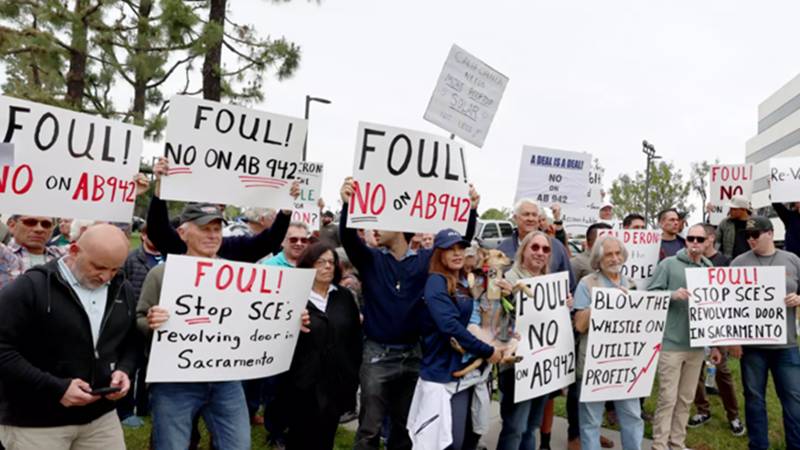
Not content to rest on their laurels, the utilities convinced a California assembly member, Lisa Calderon, to introduce a bill, AB 942, that would reduce the 20-year term that was granted to solar customers under NEM to 10 years. How would customers react if an equipment manufacturer reduced the warranty on their equipment from 15 years to 7.5 years? Of course, they would be angry. A class action lawsuit would follow.
The claim that solar customers shifted a large portion of their costs to non-solar customers is false, as stated in a letter that a dozen energy experts had sent to Governor Newsom in December
AB 942 also sought to end NEM once the house was sold. That would certainly lower the price at which the house would sell, harming the interests of the seller who had installed solar panels.
AB 942 was submitted to the Utilities and Energy Committee of the California Assembly. After a heated debate on 30 April, an emaciated version of the bill was approved by a vote of 10-4. The deeply unpopular retroactive ratemaking feature was struck out. All that remained was the provision which would end net energy metering once the house was sold. The emaciated bill still must jump through many hoops before it becomes the law.
I testified against the bill before the California Assembly along with a homeowner who was in the process of selling his house, while two experts testified in favour of the bill. Each witness expert was allotted only two minutes to make their case.
After the witnesses had testified, members of the public lined up to vote ‘yes’ or ‘no.’ Most of those who supported the bill worked for the utility unions. Many more lined up to oppose the bill. Most of them were customers not affiliated with the solar industry. Many were renters and many were middle-income customers, putting a lie to the allegation by utilities that only wealthy homeowners install solar panels on their roofs. Several customers who opposed the bill did not have solar panels on their roofs.
Two assembly members eloquently summed up why they opposed the bill. In my testimony, I stated that the bill violated a contract that three judges of the regulatory commission had approved over a ten-year period. It would harm millions and make it more difficult for California to achieve its goal of Net Zero carbon emissions, which call for rapid replacement of gas furnaces with electric heat pumps and replacement of gasoline vehicles with electric vehicles. Only customers with solar panels can undertake those investments.
The claim that solar customers shifted a large portion of their costs to non-solar customers is false, as stated in a letter that a dozen energy experts, including myself, had sent to Governor Newsom in December. The co-signatories included professors from four of California’s leading universities, a university in Australia, and retired regulators, utility executives and consultants.
Electric rates are high because of excessive and wasteful spending by utilities, not because customers are installing solar panels. Regulators need to focus on reining in utility spending.
Later, I also challenged the assertion by an opposing witness that the payback period for solar under NEM ranges from 3-4 years and under the NBT it ranges from 5-6 years. The real numbers are much higher. According to most experts, the payback period under net energy metering is 7-9 years. Under the net billing tariffs, it is 12-14 years.
I am sure that the utilities will continue to push their case before regulators and through the legislature. But the more they push, the bigger the public backlash will be. The sponsor of the bill told a newspaper that she hesitated before proposing AB 942, knowing it would arouse anger.
Why would things be any different in Pakistan, if the utilities and the regulator seek to go down the path that their counterparts in California have chosen to do so? There are some serious lessons to be learned here.
Pakistan’s policymakers should focus on controlling wasteful utility spending and stop blaming solar customers for high electric rates. Solar is the gateway to the future since it makes electrification affordable. To quote Victor Hugo, “No one, not even all the armies of the world, can stop an idea whose time has come.”